




Three vectors $7{ {\hat i}} - { {11\hat j}} + { {\hat k, 5\hat i}} + { {3\hat j}} - { {2\hat k, 12\hat i}} - { {8\hat j}} - { {\hat k}}$ forms?
$\left( 1 \right)$ an equilateral triangle
$\left( 2 \right)$ an isosceles triangle
$\left( 3 \right)$ a right angled triangle
$\left( 4 \right)$ Collinear
Answer
 Verified
503.7k+ views
Hint: In this question, we have given three position vectors, by using them we will calculate the sides of the triangle then will calculate the magnitude of the sides and then check that the sides follow the conditions for which type of triangle. To specify the position of a point , we need to have a reference point and that reference point is called the position vector. For example: $\vec r = x\hat i + y\hat j + z\hat k$ is a position vector where $\hat i = $ is a unit vector in the x-direction , $\hat j = $ is a unit vector in the y-direction and $\hat k = $ is a unit vector in the z-direction. The unit vectors are generally used to specify directions and are dimensionless quantities. A unit vector is calculated as : $\hat r = \dfrac{{\vec r}}{{\left| {\vec r} \right|}} = \dfrac{{x\hat i + y\hat j + z\hat k}}{{\sqrt {{x^2} + {y^2} + {z^2}} }}$ , where $\left| {\vec r} \right|$ is magnitude of the vector r .
Complete step by step answer:
Let vectors $7{ {\hat i}} - { {11\hat j}} + { {\hat k, 5\hat i}} + { {3\hat j}} - { {2\hat k and 12\hat i}} - { {8\hat j}} - { {\hat k}}$ be the position vectors of points A , B and C respectively, i.e.
Let ${ {OA = 7\hat i}} - { {11\hat j}} + { {\hat k}}$ , ${ {OB = 5\hat i}} + { {3\hat j}} - { {2\hat k}}$ and ${ {OC = 12\hat i}} - 8{ {\hat j}} - { {\hat k}}$ ;
Now, vectors ${ { \vec {AB}, \vec {BC}, \vec {AC}}}$ represent the sides of a triangle ABC.
The side ${ { \vec {AB}}}$ can be calculated as ;
$ \Rightarrow { { \vec {AB}}} = \left( {5 - 7} \right){ {\hat i}} + \left( {3 + 11} \right){ {\hat j}} + \left( { - 2 - 1} \right){ {\hat k}} = - 2{ {\hat i}} + { {14\hat j}} - 3{ {\hat k}}$
Similarly, we can calculate ${ { \vec {BC} and \vec {AC}}}$ as follows ;
$ \Rightarrow { { \vec {BC}}} = \left( {12 - 5} \right){ {\hat i}} + \left( { - 8 - 3} \right){ {\hat j}} + \left( { - 1 + 2} \right){ {\hat k}} = 7{ {\hat i}} - 11{ {\hat j}} + { {\hat k}}$
$ \Rightarrow { { \vec {AC}}} = \left( {12 - 7} \right){ {\hat i}} + \left( { - 8 + 11} \right){ {\hat j}} + \left( { - 1 - 1} \right){ {\hat k}} = 5{ {\hat i}} + { {3\hat j}} - 2{ {\hat k}}$
Now, let us calculate magnitudes of all the sides of the triangle;
$ \Rightarrow \left| {{ { \vec {AB}}}} \right| = \sqrt {{{\left( { - 2} \right)}^2} + {{\left( {14} \right)}^2} + {{\left( { - 3} \right)}^2}} = \sqrt {4 + 196 + 9} $
$ \Rightarrow \left| {{ { \vec {AB}}}} \right| = \sqrt {209} $
Similarly, the magnitudes of sides ${ { \vec {BC} and \vec {AC}}}$ can be calculated by ;
$ \Rightarrow \left| {{ { \vec {BC}}}} \right| = \sqrt {{{\left( 7 \right)}^2} + {{\left( { - 11} \right)}^2} + {{\left( 1 \right)}^2}} = \sqrt {49 + 121 + 1} $
$ \Rightarrow \left| {{ { \vec {BC}}}} \right| = \sqrt {171} $
And now,
$ \Rightarrow \left| {{ { \vec {AC}}}} \right| = \sqrt {{{\left( 5 \right)}^2} + {{\left( 3 \right)}^2} + {{\left( { - 2} \right)}^2}} = \sqrt {25 + 9 + 4} $
$ \Rightarrow \left| {{ { \vec {AC}}}} \right| = \sqrt {38} $
Here, we can notice that ;
$ \Rightarrow {\left| {{ { \vec {BC}}}} \right|^2} + {\left| {{ { \vec {AC}}}} \right|^2} = {\left| {{ { \vec {AB}}}} \right|^2}$
By Pythagoras theorem, we know that in a right angled triangle $ \Rightarrow {\left( {{ {Base}}} \right)^2} + {\left( {{ {Perpendicular}}} \right)^2} = {\left( {{ {Hypotenuse}}} \right)^2}$
Means; ${\left( {\sqrt {171} } \right)^2} + {\left( {\sqrt {38} } \right)^2} = {\left( {\sqrt {209} } \right)^2}$
Hence, $\Delta { {ABC}}$ is a right angled triangle.
So, the correct answer is “Option 3”.
Note: Alternate method:
Step I : Check whether the sum of any two given vectors out of three generates the third vector or not. If this condition is satisfied then it is clear that the three given vectors form a triangle.
Given: ${ {\vec A = 7\hat i}} - { {11\hat j}} + { {\hat k}}$ , ${ {\vec B = 5\hat i}} + { {3\hat j}} - { {2\hat k}}$ and ${ {\vec C = 12\hat i}} - 8{ {\hat j}} - { {\hat k}}$
Notice that, ${ {\vec A}} + { {\vec B}} = \left( {{ {7\hat i}} - { {11\hat j}} + { {\hat k}}} \right){ { + }}\left( {{ {5\hat i}} + { {3\hat j}} - { {2\hat k}}} \right)$
$ \Rightarrow { {\vec A}} + { {\vec B}} = \left( {7 + 5} \right){ {\hat i}} + \left( { - 11 + 3} \right){ {\hat j}} + \left( {1 - 2} \right){ {\hat k}}$
Which gives ; ${ {\vec A}} + { {\vec B}} = { {12\hat i}} - 8{ {\hat j}} - { {\hat k}} = { {\vec C}}$
Hence, it is clear that the three given vectors form the sides of a triangle.
Step II : Now for a right angled triangle, we need to check which of the two vectors out of the given three vectors have an angle of ${90^0}$ between them.
We know that two vectors are perpendicular to each other if their scalar or dot product is zero ;
As we have calculated above;
$ \Rightarrow { { \vec {AB} = }} - 2{ {\hat i}} + { {14\hat j}} - 3{ {\hat k}}$
$ \Rightarrow { { \vec {BC} = }}7{ {\hat i}} - 11{ {\hat j}} + { {\hat k}}$
$ \Rightarrow { { \vec {AC} = }}5{ {\hat i}} + { {3\hat j}} - 2{ {\hat k}}$
The dot product of ${ { \vec {AB} and \vec {BC} }}$ can be calculated as;
$ \Rightarrow { { \vec {AB}}} \cdot { { \vec {BC} = }}\left( { - 2{ {\hat i}} + { {14\hat j}} - 3{ {\hat k}}} \right)\left( {7{ {\hat i}} - 11{ {\hat j}} + { {\hat k}}} \right)$
$ \Rightarrow { { \vec {AB}}} \cdot { { \vec {BC} = }} - 14 - 154 - 3 = - 171 \ne 0$
Hence, ${ { \vec {AB} and \vec {BC} }}$are not perpendicular to each other.
Let us check for ${ { \vec {AB} and \vec {AC}}}$ ;
$ \Rightarrow { { \vec {AB}}} \cdot { { \vec {AC} = }}\left( { - 2{ {\hat i}} + { {14\hat j}} - 3{ {\hat k}}} \right)\left( {5{ {\hat i}} + { {3\hat j}} - 2{ {\hat k}}} \right)$
$ \Rightarrow { { \vec {AB}}} \cdot { { \vec {AC} = }} - 10 + 42 + 6 = 38 \ne 0$
Therefore, ${ { \vec {AB} and \vec {AC}}}$ are also not perpendicular to each other.
Now, check for ${ { \vec {BC} and \vec {AC} }}$ ;
$ \Rightarrow { { \vec {BC}}} \cdot { { \vec {AC} = }}\left( {7{ {\hat i}} - 11{ {\hat j}} + { {\hat k}}} \right)\left( {5{ {\hat i}} + { {3\hat j}} - 2{ {\hat k}}} \right)$
$ \Rightarrow { { \vec {BC}}} \cdot { { \vec {AC} = 35}} - 33 - 2 = 0$
$\therefore { { \vec {BC}}} \cdot { { \vec {AC} }} = 0$
Therefore, ${ { \vec {BC}}}$ is perpendicular to ${ { \vec {AC}}}$ since their dot product or scalar product is zero means there is an angle of ${90^0}$ between them. Therefore, the given vectors forms a right angled triangle as drawn below;
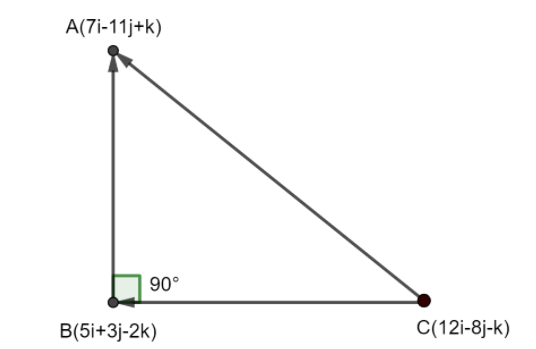
$\left( 1 \right)$ Dot product or scalar product: The scalar product of two vectors is the product of magnitudes of the two vectors and the cosine of the angle between them i.e. , the resultant value is always scalar in nature. $\left( 2 \right)$ Cross product or vector product: If $\theta $ is the angle between the two vectors then cross product is given by : $a \times b = \left| a \right|\left| b \right|\sin \theta $ , the resultant value is always vector in nature.
Complete step by step answer:
Let vectors $7{ {\hat i}} - { {11\hat j}} + { {\hat k, 5\hat i}} + { {3\hat j}} - { {2\hat k and 12\hat i}} - { {8\hat j}} - { {\hat k}}$ be the position vectors of points A , B and C respectively, i.e.
Let ${ {OA = 7\hat i}} - { {11\hat j}} + { {\hat k}}$ , ${ {OB = 5\hat i}} + { {3\hat j}} - { {2\hat k}}$ and ${ {OC = 12\hat i}} - 8{ {\hat j}} - { {\hat k}}$ ;
Now, vectors ${ { \vec {AB}, \vec {BC}, \vec {AC}}}$ represent the sides of a triangle ABC.
The side ${ { \vec {AB}}}$ can be calculated as ;
$ \Rightarrow { { \vec {AB}}} = \left( {5 - 7} \right){ {\hat i}} + \left( {3 + 11} \right){ {\hat j}} + \left( { - 2 - 1} \right){ {\hat k}} = - 2{ {\hat i}} + { {14\hat j}} - 3{ {\hat k}}$
Similarly, we can calculate ${ { \vec {BC} and \vec {AC}}}$ as follows ;
$ \Rightarrow { { \vec {BC}}} = \left( {12 - 5} \right){ {\hat i}} + \left( { - 8 - 3} \right){ {\hat j}} + \left( { - 1 + 2} \right){ {\hat k}} = 7{ {\hat i}} - 11{ {\hat j}} + { {\hat k}}$
$ \Rightarrow { { \vec {AC}}} = \left( {12 - 7} \right){ {\hat i}} + \left( { - 8 + 11} \right){ {\hat j}} + \left( { - 1 - 1} \right){ {\hat k}} = 5{ {\hat i}} + { {3\hat j}} - 2{ {\hat k}}$
Now, let us calculate magnitudes of all the sides of the triangle;
$ \Rightarrow \left| {{ { \vec {AB}}}} \right| = \sqrt {{{\left( { - 2} \right)}^2} + {{\left( {14} \right)}^2} + {{\left( { - 3} \right)}^2}} = \sqrt {4 + 196 + 9} $
$ \Rightarrow \left| {{ { \vec {AB}}}} \right| = \sqrt {209} $
Similarly, the magnitudes of sides ${ { \vec {BC} and \vec {AC}}}$ can be calculated by ;
$ \Rightarrow \left| {{ { \vec {BC}}}} \right| = \sqrt {{{\left( 7 \right)}^2} + {{\left( { - 11} \right)}^2} + {{\left( 1 \right)}^2}} = \sqrt {49 + 121 + 1} $
$ \Rightarrow \left| {{ { \vec {BC}}}} \right| = \sqrt {171} $
And now,
$ \Rightarrow \left| {{ { \vec {AC}}}} \right| = \sqrt {{{\left( 5 \right)}^2} + {{\left( 3 \right)}^2} + {{\left( { - 2} \right)}^2}} = \sqrt {25 + 9 + 4} $
$ \Rightarrow \left| {{ { \vec {AC}}}} \right| = \sqrt {38} $
Here, we can notice that ;
$ \Rightarrow {\left| {{ { \vec {BC}}}} \right|^2} + {\left| {{ { \vec {AC}}}} \right|^2} = {\left| {{ { \vec {AB}}}} \right|^2}$
By Pythagoras theorem, we know that in a right angled triangle $ \Rightarrow {\left( {{ {Base}}} \right)^2} + {\left( {{ {Perpendicular}}} \right)^2} = {\left( {{ {Hypotenuse}}} \right)^2}$
Means; ${\left( {\sqrt {171} } \right)^2} + {\left( {\sqrt {38} } \right)^2} = {\left( {\sqrt {209} } \right)^2}$
Hence, $\Delta { {ABC}}$ is a right angled triangle.
So, the correct answer is “Option 3”.
Note: Alternate method:
Step I : Check whether the sum of any two given vectors out of three generates the third vector or not. If this condition is satisfied then it is clear that the three given vectors form a triangle.
Given: ${ {\vec A = 7\hat i}} - { {11\hat j}} + { {\hat k}}$ , ${ {\vec B = 5\hat i}} + { {3\hat j}} - { {2\hat k}}$ and ${ {\vec C = 12\hat i}} - 8{ {\hat j}} - { {\hat k}}$
Notice that, ${ {\vec A}} + { {\vec B}} = \left( {{ {7\hat i}} - { {11\hat j}} + { {\hat k}}} \right){ { + }}\left( {{ {5\hat i}} + { {3\hat j}} - { {2\hat k}}} \right)$
$ \Rightarrow { {\vec A}} + { {\vec B}} = \left( {7 + 5} \right){ {\hat i}} + \left( { - 11 + 3} \right){ {\hat j}} + \left( {1 - 2} \right){ {\hat k}}$
Which gives ; ${ {\vec A}} + { {\vec B}} = { {12\hat i}} - 8{ {\hat j}} - { {\hat k}} = { {\vec C}}$
Hence, it is clear that the three given vectors form the sides of a triangle.
Step II : Now for a right angled triangle, we need to check which of the two vectors out of the given three vectors have an angle of ${90^0}$ between them.
We know that two vectors are perpendicular to each other if their scalar or dot product is zero ;
As we have calculated above;
$ \Rightarrow { { \vec {AB} = }} - 2{ {\hat i}} + { {14\hat j}} - 3{ {\hat k}}$
$ \Rightarrow { { \vec {BC} = }}7{ {\hat i}} - 11{ {\hat j}} + { {\hat k}}$
$ \Rightarrow { { \vec {AC} = }}5{ {\hat i}} + { {3\hat j}} - 2{ {\hat k}}$
The dot product of ${ { \vec {AB} and \vec {BC} }}$ can be calculated as;
$ \Rightarrow { { \vec {AB}}} \cdot { { \vec {BC} = }}\left( { - 2{ {\hat i}} + { {14\hat j}} - 3{ {\hat k}}} \right)\left( {7{ {\hat i}} - 11{ {\hat j}} + { {\hat k}}} \right)$
$ \Rightarrow { { \vec {AB}}} \cdot { { \vec {BC} = }} - 14 - 154 - 3 = - 171 \ne 0$
Hence, ${ { \vec {AB} and \vec {BC} }}$are not perpendicular to each other.
Let us check for ${ { \vec {AB} and \vec {AC}}}$ ;
$ \Rightarrow { { \vec {AB}}} \cdot { { \vec {AC} = }}\left( { - 2{ {\hat i}} + { {14\hat j}} - 3{ {\hat k}}} \right)\left( {5{ {\hat i}} + { {3\hat j}} - 2{ {\hat k}}} \right)$
$ \Rightarrow { { \vec {AB}}} \cdot { { \vec {AC} = }} - 10 + 42 + 6 = 38 \ne 0$
Therefore, ${ { \vec {AB} and \vec {AC}}}$ are also not perpendicular to each other.
Now, check for ${ { \vec {BC} and \vec {AC} }}$ ;
$ \Rightarrow { { \vec {BC}}} \cdot { { \vec {AC} = }}\left( {7{ {\hat i}} - 11{ {\hat j}} + { {\hat k}}} \right)\left( {5{ {\hat i}} + { {3\hat j}} - 2{ {\hat k}}} \right)$
$ \Rightarrow { { \vec {BC}}} \cdot { { \vec {AC} = 35}} - 33 - 2 = 0$
$\therefore { { \vec {BC}}} \cdot { { \vec {AC} }} = 0$
Therefore, ${ { \vec {BC}}}$ is perpendicular to ${ { \vec {AC}}}$ since their dot product or scalar product is zero means there is an angle of ${90^0}$ between them. Therefore, the given vectors forms a right angled triangle as drawn below;
$\left( 1 \right)$ Dot product or scalar product: The scalar product of two vectors is the product of magnitudes of the two vectors and the cosine of the angle between them i.e. , the resultant value is always scalar in nature. $\left( 2 \right)$ Cross product or vector product: If $\theta $ is the angle between the two vectors then cross product is given by : $a \times b = \left| a \right|\left| b \right|\sin \theta $ , the resultant value is always vector in nature.
Recently Updated Pages
Master Class 11 Computer Science: Engaging Questions & Answers for Success

Master Class 11 Business Studies: Engaging Questions & Answers for Success
Master Class 11 Economics: Engaging Questions & Answers for Success
Master Class 11 English: Engaging Questions & Answers for Success
Master Class 11 Maths: Engaging Questions & Answers for Success
Master Class 11 Biology: Engaging Questions & Answers for Success
Trending doubts
One Metric ton is equal to kg A 10000 B 1000 C 100 class 11 physics CBSE
There are 720 permutations of the digits 1 2 3 4 5 class 11 maths CBSE
Discuss the various forms of bacteria class 11 biology CBSE
Draw a diagram of a plant cell and label at least eight class 11 biology CBSE
State the laws of reflection of light
Explain zero factorial class 11 maths CBSE