




Three straight parallel current carrying conductors are shown in the figure. The force experienced by the middle conductor of length 25cm is:
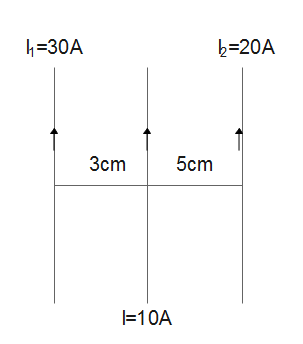
A. Zero
B. $9 \times {10^{ - 4}}N$ Towards left
C. $6 \times {10^{ - 4}}N$ Towards left
D. $3 \times {10^{ - 4}}N$ Towards right
Answer
 Verified
633.9k+ views
Hint: In this question, we use the relation of force experienced by the conducting wires with current flowing in parallel direction. Further, we find the force experienced by the middle conductor; this will give us the required result. Also, we learn about some basic concepts of force and current.
Formula used-
$F = \dfrac{{{\mu _0}{I_0}{I_1}}}{{I\pi }} \times l$
Complete answer:
Here, force due to first wire on the middle wire is given by:
$\eqalign{& {F_1} = \dfrac{{{\mu _0}I{I_1}}}{{6\pi }} \times 25 \cr
& \therefore {F_1} = \dfrac{{2500{\mu _0}}}{{2\pi }} \cr} $
Now, force due to the second wire on the middle wire is given by:
$\eqalign{
& {F_2} = \dfrac{{{\mu _0}I{I_2}}}{{10\pi }} \times 25 \cr
& \therefore {F_1} = \dfrac{{1000{\mu _0}}}{{2\pi }} \cr} $
So, from the above two equations, we get the net force as:
$\eqalign{
& {F_1} - {F_2} = \dfrac{{1500{\mu _0}}}{{2\pi }} \cr
& \therefore {F_1} - {F_2} = 3 \times {10^{ - 4}}N \cr} $
Therefore, the correct option is D), i.e. The force experienced by the middle conductor of length 25cm is given by $3 \times {10^{ - 4}}N$, towards the right.
Additional information:
As we know that ampere is defined as one ampere of current through each of two parallel conductors of infinite length, separated by one meter in empty space free of other magnetic fields, causes a force of exactly $2 \times {10^{ - 7}}$ N/m on each conductor.
Force is simply any push or pull. The S.I unit of force is Newton represented by N. The acceleration is defined as the increase in the velocity of an object. The acceleration is measured in meters per Second Square.
There are three laws of motions given by Newton. These laws of motion relate an object's motion to the forces acting on it.
First law of motion states that an object continues to be in rest or in motion in a particular direction until and unless any external force is applied on it.
In the second law of motion, the force on an object is equal to its mass times its acceleration. This law also gives the relation of momentum and force.
In the third law of motion, every action has an equal and opposite reaction.
Note:
We should know, there is always a force experienced in parallel current carrying conductors. Also, if the parallel wires currents are in opposite directions, then the wires repel each other, whereas these wires attract each other if the current in the wires are flowing in the same direction.
Formula used-
$F = \dfrac{{{\mu _0}{I_0}{I_1}}}{{I\pi }} \times l$
Complete answer:
Here, force due to first wire on the middle wire is given by:
$\eqalign{& {F_1} = \dfrac{{{\mu _0}I{I_1}}}{{6\pi }} \times 25 \cr
& \therefore {F_1} = \dfrac{{2500{\mu _0}}}{{2\pi }} \cr} $
Now, force due to the second wire on the middle wire is given by:
$\eqalign{
& {F_2} = \dfrac{{{\mu _0}I{I_2}}}{{10\pi }} \times 25 \cr
& \therefore {F_1} = \dfrac{{1000{\mu _0}}}{{2\pi }} \cr} $
So, from the above two equations, we get the net force as:
$\eqalign{
& {F_1} - {F_2} = \dfrac{{1500{\mu _0}}}{{2\pi }} \cr
& \therefore {F_1} - {F_2} = 3 \times {10^{ - 4}}N \cr} $
Therefore, the correct option is D), i.e. The force experienced by the middle conductor of length 25cm is given by $3 \times {10^{ - 4}}N$, towards the right.
Additional information:
As we know that ampere is defined as one ampere of current through each of two parallel conductors of infinite length, separated by one meter in empty space free of other magnetic fields, causes a force of exactly $2 \times {10^{ - 7}}$ N/m on each conductor.
Force is simply any push or pull. The S.I unit of force is Newton represented by N. The acceleration is defined as the increase in the velocity of an object. The acceleration is measured in meters per Second Square.
There are three laws of motions given by Newton. These laws of motion relate an object's motion to the forces acting on it.
First law of motion states that an object continues to be in rest or in motion in a particular direction until and unless any external force is applied on it.
In the second law of motion, the force on an object is equal to its mass times its acceleration. This law also gives the relation of momentum and force.
In the third law of motion, every action has an equal and opposite reaction.
Note:
We should know, there is always a force experienced in parallel current carrying conductors. Also, if the parallel wires currents are in opposite directions, then the wires repel each other, whereas these wires attract each other if the current in the wires are flowing in the same direction.
Recently Updated Pages
Master Class 11 Social Science: Engaging Questions & Answers for Success

Master Class 11 English: Engaging Questions & Answers for Success
Master Class 11 Accountancy: Engaging Questions & Answers for Success
Master Class 11 Physics: Engaging Questions & Answers for Success
Master Class 11 Computer Science: Engaging Questions & Answers for Success
Master Class 11 Business Studies: Engaging Questions & Answers for Success
Trending doubts
Find the value of the expression given below sin 30circ class 11 maths CBSE
One Metric ton is equal to kg A 10000 B 1000 C 100 class 11 physics CBSE
Draw a diagram of nephron and explain its structur class 11 biology CBSE
10 examples of friction in our daily life
Proton was discovered by A Thomson B Rutherford C Chadwick class 11 chemistry CBSE
The teeth used for biting and cutting food are called class 11 biology CBSE