




Three rods made of the same material and having the same cross-section have been joined as shown in figure. Each rod is of the same length. The left and right ends are kept at ${0^0}C$ and ${90^0}C$ respectively. The temperature of the junction of the three rods will be
A. ${45^0}C$
B. ${60^0}C$
C. ${30^0}C$
D. ${20^0}C$
Answer
 Verified
600k+ views
Hint: Generally when temperature difference is maintained then heat transfers from higher temperature body to the lower temperature body. The amount of heat transferred depends upon the various factors like the temperature difference, thermal resistance of the material.
Formula used:
$\eqalign{
& R = \dfrac{L}{{KA}} \cr
& H = \dfrac{{\Delta T}}{R} \cr} $
Complete step by step answer:
Flow of a quantity with time is known as a current. It can be fluid current or heat current or electric current.
In case of fluid current a pressure difference is maintained and that drives the flow of fluid and fluid always flows from high pressure region to the low pressure region and fluid current is governed by fluid resistance too
Whereas in electric current the electric charge flows with time and the voltage difference and electric resistance combined will govern the electric current. Charge flows from higher voltage to lower voltage naturally.
Similarly in thermal current it is governed by temperature difference and thermal resistance.
Thermal resistance of a thermal conductor of length ‘L’ and cross sectional area ‘A’ and thermal conductivity ‘K’ is given by $R = \dfrac{L}{{KA}}$
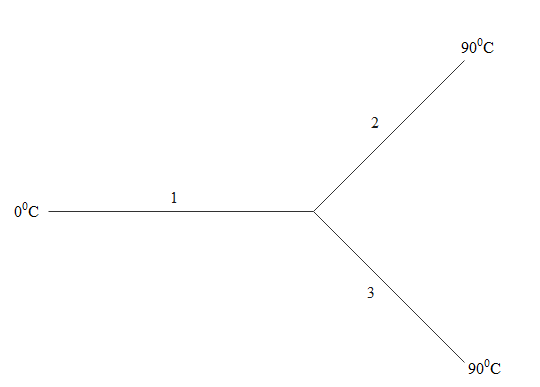
It is clearly evident that the right ends of rods 2 and 3 are at higher temperature than that of the left end of the first rod.
So the heat will flow from the 2 and 3 rods to the first rod. The heat can’t escape anywhere so the sum of rate of flow of heat from second and third rods will be equal to rate of flow of heat in the third rod. Let the junction temperature be ${x^0}C$. Rate of flow of heat is given by $H = \dfrac{{\Delta T}}{R}$. Where H is the rate of flow of heat and $\Delta T$ is the temperature difference between two ends of a conductor and $R$ is the thermal resistance which is given as $R = \dfrac{L}{{KA}}$ where L is the length of the conductor and K is the coefficient of heat conduction and A is the cross section area of the conductor. Thermal resistance for all three rods is the same. So the rate of flow of heat only depends on the temperature difference between the two ends of a conductor.
So sum of rate of flow of heat from second and third rods will be equal to rate of flow of heat in the third rod
$\eqalign{
& {H_3} = {H_1} + {H_2} \cr
& \Rightarrow \Delta {T_3} = \Delta {T_1} + \Delta {T_2} \cr
& \Rightarrow x - 0 = (90 - x) + (90 - x) \cr
& \Rightarrow 3x = 180 \cr
& \therefore x = {60^0}C \cr} $
Hence option 3 will be the correct answer.
Note:
As long as the temperature difference is maintained between the ends of the rods, the heat keeps on flowing. If the thermal resistance of the rods are different then the heat current will be depending on the length and area of cross section and thermal conductivity coefficients of all the conductors.
Formula used:
$\eqalign{
& R = \dfrac{L}{{KA}} \cr
& H = \dfrac{{\Delta T}}{R} \cr} $
Complete step by step answer:
Flow of a quantity with time is known as a current. It can be fluid current or heat current or electric current.
In case of fluid current a pressure difference is maintained and that drives the flow of fluid and fluid always flows from high pressure region to the low pressure region and fluid current is governed by fluid resistance too
Whereas in electric current the electric charge flows with time and the voltage difference and electric resistance combined will govern the electric current. Charge flows from higher voltage to lower voltage naturally.
Similarly in thermal current it is governed by temperature difference and thermal resistance.
Thermal resistance of a thermal conductor of length ‘L’ and cross sectional area ‘A’ and thermal conductivity ‘K’ is given by $R = \dfrac{L}{{KA}}$
It is clearly evident that the right ends of rods 2 and 3 are at higher temperature than that of the left end of the first rod.
So the heat will flow from the 2 and 3 rods to the first rod. The heat can’t escape anywhere so the sum of rate of flow of heat from second and third rods will be equal to rate of flow of heat in the third rod. Let the junction temperature be ${x^0}C$. Rate of flow of heat is given by $H = \dfrac{{\Delta T}}{R}$. Where H is the rate of flow of heat and $\Delta T$ is the temperature difference between two ends of a conductor and $R$ is the thermal resistance which is given as $R = \dfrac{L}{{KA}}$ where L is the length of the conductor and K is the coefficient of heat conduction and A is the cross section area of the conductor. Thermal resistance for all three rods is the same. So the rate of flow of heat only depends on the temperature difference between the two ends of a conductor.
So sum of rate of flow of heat from second and third rods will be equal to rate of flow of heat in the third rod
$\eqalign{
& {H_3} = {H_1} + {H_2} \cr
& \Rightarrow \Delta {T_3} = \Delta {T_1} + \Delta {T_2} \cr
& \Rightarrow x - 0 = (90 - x) + (90 - x) \cr
& \Rightarrow 3x = 180 \cr
& \therefore x = {60^0}C \cr} $
Hence option 3 will be the correct answer.
Note:
As long as the temperature difference is maintained between the ends of the rods, the heat keeps on flowing. If the thermal resistance of the rods are different then the heat current will be depending on the length and area of cross section and thermal conductivity coefficients of all the conductors.
Recently Updated Pages
Three beakers labelled as A B and C each containing 25 mL of water were taken A small amount of NaOH anhydrous CuSO4 and NaCl were added to the beakers A B and C respectively It was observed that there was an increase in the temperature of the solutions contained in beakers A and B whereas in case of beaker C the temperature of the solution falls Which one of the following statements isarecorrect i In beakers A and B exothermic process has occurred ii In beakers A and B endothermic process has occurred iii In beaker C exothermic process has occurred iv In beaker C endothermic process has occurred

Master Class 11 Social Science: Engaging Questions & Answers for Success
Master Class 11 Physics: Engaging Questions & Answers for Success
Master Class 11 Maths: Engaging Questions & Answers for Success
Master Class 11 Economics: Engaging Questions & Answers for Success
Master Class 11 Computer Science: Engaging Questions & Answers for Success
Three beakers labelled as A B and C each containing 25 mL of water were taken A small amount of NaOH anhydrous CuSO4 and NaCl were added to the beakers A B and C respectively It was observed that there was an increase in the temperature of the solutions contained in beakers A and B whereas in case of beaker C the temperature of the solution falls Which one of the following statements isarecorrect i In beakers A and B exothermic process has occurred ii In beakers A and B endothermic process has occurred iii In beaker C exothermic process has occurred iv In beaker C endothermic process has occurred
Master Class 11 Social Science: Engaging Questions & Answers for Success
Master Class 11 Physics: Engaging Questions & Answers for Success
Trending doubts
One Metric ton is equal to kg A 10000 B 1000 C 100 class 11 physics CBSE
There are 720 permutations of the digits 1 2 3 4 5 class 11 maths CBSE
State and prove Bernoullis theorem class 11 physics CBSE
Draw a diagram of a plant cell and label at least eight class 11 biology CBSE
Difference Between Prokaryotic Cells and Eukaryotic Cells
1 Quintal is equal to a 110 kg b 10 kg c 100kg d 1000 class 11 physics CBSE