




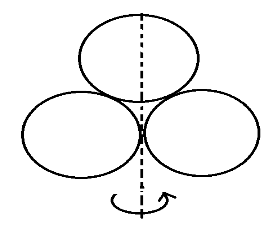
Three rings each of mass $m$ and radius $r$ are so placed that they touch each other. The radius of gyration of the system about the axis as shown in the figure is:
Answer
 Verified
579.6k+ views
Hint:In the question, we are provided with three identical rings of given mass and radius. We have to find the radius of gyration of the system. For that we need to find the total moment of inertia. Moment of inertia about its diameter is $\dfrac{1}{2}m{r^2}$ and moment of inertia about its axis perpendicular to the plane passing through radius is $m{r^2}$.
Complete step by step answer:
Consider three identical rings as shown in the diagram each having mass $m$ and radius $r$. We have to find the radius of gyration of the system about its axis. For that we need to find the total moment of inertia of the system.Firstly, finding the moment of inertia of the upper ring about its axis ${I_1} = \dfrac{1}{2}m{r^2}$
Moment of inertia of one of the lower rings about its axis ${I_2} = \dfrac{1}{2}m{r^2} + m{r^2} = \dfrac{3}{2}m{r^2}$ (adding Moment of inertia about its axis and along the perpendicular to the plane)
Similarly, moment of inertia of the other ring be ${I_3} = \dfrac{3}{2}m{r^2}$
Total moment of inertia be $I = {I_1} + {I_2} + {I_3}$
$
I = \dfrac{1}{2}m{r^2} + \dfrac{3}{2}m{r^2} + \dfrac{3}{2}mr \\
\Rightarrow I = \dfrac{7}{2}m{r^2} \\ $
Radius of gyration $\left( k \right)$:
$k = \sqrt {\dfrac{I}{M}} $
where $I$ is the total moment of inertia of the system
$M$ is the total mass of the system.
$
M = m + m + m \\
\Rightarrow M = 3m \\ $
$\Rightarrow k = \sqrt {\dfrac{{\dfrac{7}{2}m{r^2}}}{{3m}}} = \sqrt {\dfrac{{7{r^2}}}{6}} $
$\therefore k = r\sqrt {\dfrac{7}{6}} $
This is our required answer.
Note:Ring has greater moment of inertia than the circular disc having the same mass and radius, about its axis passing through its center of mass perpendicular to the plane.Because the entire mass is concentrated at a maximum distance about its axis.
Complete step by step answer:
Consider three identical rings as shown in the diagram each having mass $m$ and radius $r$. We have to find the radius of gyration of the system about its axis. For that we need to find the total moment of inertia of the system.Firstly, finding the moment of inertia of the upper ring about its axis ${I_1} = \dfrac{1}{2}m{r^2}$
Moment of inertia of one of the lower rings about its axis ${I_2} = \dfrac{1}{2}m{r^2} + m{r^2} = \dfrac{3}{2}m{r^2}$ (adding Moment of inertia about its axis and along the perpendicular to the plane)
Similarly, moment of inertia of the other ring be ${I_3} = \dfrac{3}{2}m{r^2}$
Total moment of inertia be $I = {I_1} + {I_2} + {I_3}$
$
I = \dfrac{1}{2}m{r^2} + \dfrac{3}{2}m{r^2} + \dfrac{3}{2}mr \\
\Rightarrow I = \dfrac{7}{2}m{r^2} \\ $
Radius of gyration $\left( k \right)$:
$k = \sqrt {\dfrac{I}{M}} $
where $I$ is the total moment of inertia of the system
$M$ is the total mass of the system.
$
M = m + m + m \\
\Rightarrow M = 3m \\ $
$\Rightarrow k = \sqrt {\dfrac{{\dfrac{7}{2}m{r^2}}}{{3m}}} = \sqrt {\dfrac{{7{r^2}}}{6}} $
$\therefore k = r\sqrt {\dfrac{7}{6}} $
This is our required answer.
Note:Ring has greater moment of inertia than the circular disc having the same mass and radius, about its axis passing through its center of mass perpendicular to the plane.Because the entire mass is concentrated at a maximum distance about its axis.
Recently Updated Pages
Master Class 11 English: Engaging Questions & Answers for Success

Master Class 11 Maths: Engaging Questions & Answers for Success
Class 11 Question and Answer - Your Ultimate Solutions Guide
Master Class 11 Biology: Engaging Questions & Answers for Success
Master Class 11 Physics: Engaging Questions & Answers for Success
Master Class 11 Accountancy: Engaging Questions & Answers for Success
Trending doubts
Differentiate between an exothermic and an endothermic class 11 chemistry CBSE
One Metric ton is equal to kg A 10000 B 1000 C 100 class 11 physics CBSE
In what year Guru Nanak Dev ji was born A15 April 1469 class 11 social science CBSE
Difference Between Prokaryotic Cells and Eukaryotic Cells
Draw a diagram of a plant cell and label at least eight class 11 biology CBSE
1 Quintal is equal to a 110 kg b 10 kg c 100kg d 1000 class 11 physics CBSE