




When three resistances are connected individually with one battery, we get electric currents 1A, 2A and 4A respectively. Now all these resistors are connected in series and the same battery is applied across them. What will be the electric current in the circuit?
a) 2/7A
b) 3/7A
c) 4/7A
d) 5/7A
Answer
 Verified
584.1k+ views
Hint: It is given to us that the resistances initially are connected individually to the battery. The corresponding current in the circuit is given and hence using ohm's law we will determine the resistance of the individual resistors in the circuit. Electric current in series circuits remains the same. Hence again using ohm's law since they are connected to the same battery we will determine the current in the circuit.
Formula used:
$V=IR$
$R={{R}_{1}}+{{R}_{2}}+{{R}_{3}}$
Complete answer:
To begin with let us first define ohm's law.
The ohms law is defined as current flowing through the metallic wire is directly proportional to the potential difference provided the temperature remains the same. If a battery is connected across a resistor of resistance (R) and the current in the circuit is(I), than by ohm's law the potential difference (V)is given by,
$V=IR$
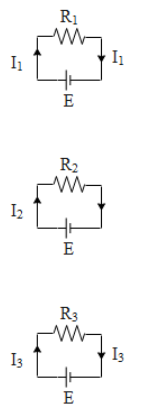
Initially it is given to us that the resistances are connected individually across the battery. Let the resistance of the three resistors be,${{R}_{1}},{{R}_{2}}\text{ and }{{R}_{3}}.$ Let the emf of the battery be (E) with negligible internal resistance. Therefore from ohms law the current in individual resistances is equal to,
$\begin{align}
& E={{I}_{1}}{{R}_{1}},\Rightarrow {{R}_{1}}=\dfrac{E}{{{I}_{1}}}=\dfrac{E}{1}=E\Omega \\
& E={{I}_{2}}{{R}_{2}},\Rightarrow {{R}_{2}}=\dfrac{E}{{{I}_{2}}}=\dfrac{E}{2}=\dfrac{E}{2}\Omega \\
& E={{I}_{3}}{{R}_{3}},\Rightarrow {{R}_{3}}=\dfrac{E}{{{I}_{3}}}=\dfrac{E}{4}=\dfrac{E}{4}\Omega \\
\end{align}$
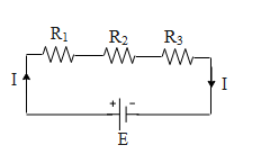
Further it is given to us all the above resistances are connected in series across the same battery. The equivalent resistance of the resistors in series gets added up. Hence equivalent resistance of all the three resistors in series is,
$\begin{align}
& R={{R}_{1}}+{{R}_{2}}+{{R}_{3}} \\
& R=E+\dfrac{E}{2}+\dfrac{E}{4} \\
& \Rightarrow R=\dfrac{14E}{8}\Omega =\dfrac{7E}{4}\Omega \\
\end{align}$
Hence by ohm's law the current in the circuit(I$I$) is equal to,
$\begin{align}
& E=IR \\
& \Rightarrow E=I\dfrac{7E}{4} \\
& \Rightarrow 1=I\dfrac{7}{4} \\
& \Rightarrow I=\dfrac{4}{7}A \\
\end{align}$
Hence the correct answer of the above question is option c.
Note:
It is to be noted that the internal resistance of the battery is taken to be negligible. If the battery has finite internal resistance then we will not be able to ignore the internal resistance of the battery. As a result the potential difference across each of the resistors will not be the same.
Formula used:
$V=IR$
$R={{R}_{1}}+{{R}_{2}}+{{R}_{3}}$
Complete answer:
To begin with let us first define ohm's law.
The ohms law is defined as current flowing through the metallic wire is directly proportional to the potential difference provided the temperature remains the same. If a battery is connected across a resistor of resistance (R) and the current in the circuit is(I), than by ohm's law the potential difference (V)is given by,
$V=IR$
Initially it is given to us that the resistances are connected individually across the battery. Let the resistance of the three resistors be,${{R}_{1}},{{R}_{2}}\text{ and }{{R}_{3}}.$ Let the emf of the battery be (E) with negligible internal resistance. Therefore from ohms law the current in individual resistances is equal to,
$\begin{align}
& E={{I}_{1}}{{R}_{1}},\Rightarrow {{R}_{1}}=\dfrac{E}{{{I}_{1}}}=\dfrac{E}{1}=E\Omega \\
& E={{I}_{2}}{{R}_{2}},\Rightarrow {{R}_{2}}=\dfrac{E}{{{I}_{2}}}=\dfrac{E}{2}=\dfrac{E}{2}\Omega \\
& E={{I}_{3}}{{R}_{3}},\Rightarrow {{R}_{3}}=\dfrac{E}{{{I}_{3}}}=\dfrac{E}{4}=\dfrac{E}{4}\Omega \\
\end{align}$
Further it is given to us all the above resistances are connected in series across the same battery. The equivalent resistance of the resistors in series gets added up. Hence equivalent resistance of all the three resistors in series is,
$\begin{align}
& R={{R}_{1}}+{{R}_{2}}+{{R}_{3}} \\
& R=E+\dfrac{E}{2}+\dfrac{E}{4} \\
& \Rightarrow R=\dfrac{14E}{8}\Omega =\dfrac{7E}{4}\Omega \\
\end{align}$
Hence by ohm's law the current in the circuit(I$I$) is equal to,
$\begin{align}
& E=IR \\
& \Rightarrow E=I\dfrac{7E}{4} \\
& \Rightarrow 1=I\dfrac{7}{4} \\
& \Rightarrow I=\dfrac{4}{7}A \\
\end{align}$
Hence the correct answer of the above question is option c.
Note:
It is to be noted that the internal resistance of the battery is taken to be negligible. If the battery has finite internal resistance then we will not be able to ignore the internal resistance of the battery. As a result the potential difference across each of the resistors will not be the same.
Recently Updated Pages
Master Class 11 Computer Science: Engaging Questions & Answers for Success

Master Class 11 Business Studies: Engaging Questions & Answers for Success
Master Class 11 Economics: Engaging Questions & Answers for Success
Master Class 11 English: Engaging Questions & Answers for Success
Master Class 11 Maths: Engaging Questions & Answers for Success
Master Class 11 Biology: Engaging Questions & Answers for Success
Trending doubts
One Metric ton is equal to kg A 10000 B 1000 C 100 class 11 physics CBSE
There are 720 permutations of the digits 1 2 3 4 5 class 11 maths CBSE
Discuss the various forms of bacteria class 11 biology CBSE
Draw a diagram of a plant cell and label at least eight class 11 biology CBSE
State the laws of reflection of light
Explain zero factorial class 11 maths CBSE