




Three particles, each of mass \[200{\text{ g}}\] , are kept at the corner of an equilateral triangle of side \[{\text{10 cm}}\].Find the moment of inertia of the system about an axis
(a) joining two of the particles and
(b) passing through one of the particles and perpendicular to the plane of the particles
Answer
 Verified
564.9k+ views
Hint:To solve this question we will use concepts of moment of inertia and perpendicular axis theorem. There are three particles each of mass situated at corners of the equilateral triangle of the side. For the first part of the question we take an axis passing through two particles so the moment of inertia across these particles will be zero. The resultant moment of inertia will be the moment of inertia of the remaining particle. For the second part we also use a similar method.
Complete step by step answer:
Let us consider the particles to be A , B ,and C and mass was given as mass \[ = 200{\text{ g}} = 0.2kg\] \[(1kg = 1000g)\].
Side of the equilateral triangle was given \[{\text{ = 10 cm}} = 0.1\,m\].
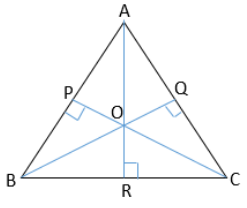
(a) Let us take the axis passing through B and C. Moment of inertia I is the rotational analogue of mass. In rotation of a body about a fixed axis, the moment of inertia plays a similar role as mass does in linear motion. It is a measure of inertia of the body for rotational motion (rotational inertia).
The moment of inertia of a body about a given axis of rotation is defined as the sum of the product of the masses of the particles in the body and square of the distance from the axis of rotation.
\[I = M{R^2}\]
The perpendicular distances of the center of masses of particles B and C are zero as the axis is passing through them itself.The perpendicular distance of particle A from axis is given by
\[{\text{AR}} = \dfrac{{\sqrt 3 }}{2} \times 0.1\]
\[\Rightarrow {\text{AR}} = 0.05\sqrt 3 \,m\]
This is the perpendicular distance of the center of mass of A from the axis.Now resultant moment of inertia will be
\[I = M{R^2}\]
\[\Rightarrow I = \left( {0.2} \right){\left( {0.05\sqrt 3 } \right)^2}\]
\[ \therefore I = 1.5 \times {10^{ - 3}}\,kg{m^2}\]
Therefore,the moment of inertia of the system about an axis joining two of the particles
is $1.5 \times {10^{ - 3}}\,kg{m^2}$.
(b) Let the axis be passing through A ,now as the perpendicular distance of center of mass from A to axis will be 0 .Therefore the resultant moment of inertia will be the sum of moment inertias of particles B and C .
\[I = M{R^2} + M{R^2}\]
where R is the distance of B and C from A (as the axis is passing through .
As the particles are on an equilateral triangle they are equidistant from each other.
\[R = side = 0.1m\]
\[\Rightarrow I = 2M{R^2}\]
\[ \Rightarrow I = 2\left( {0.2} \right){\left( {0.1} \right)^2} \\
\therefore I= 4 \times {10^{ - 3}}\,kg{m^2}\]
Therefore,the moment of inertia of the system about an axis passing through one of the particles and perpendicular to the plane of the particles is $4 \times {10^{ - 3}}\,kg{m^2}$.
Note:Moment of inertia is nothing but the property by which a body opposes changes while rotating about an axis. The factors on which moment of inertia depends are the mass of the body, the shape and size and also mass distribution manner of the given body and the axis of rotation position.
Complete step by step answer:
Let us consider the particles to be A , B ,and C and mass was given as mass \[ = 200{\text{ g}} = 0.2kg\] \[(1kg = 1000g)\].
Side of the equilateral triangle was given \[{\text{ = 10 cm}} = 0.1\,m\].
(a) Let us take the axis passing through B and C. Moment of inertia I is the rotational analogue of mass. In rotation of a body about a fixed axis, the moment of inertia plays a similar role as mass does in linear motion. It is a measure of inertia of the body for rotational motion (rotational inertia).
The moment of inertia of a body about a given axis of rotation is defined as the sum of the product of the masses of the particles in the body and square of the distance from the axis of rotation.
\[I = M{R^2}\]
The perpendicular distances of the center of masses of particles B and C are zero as the axis is passing through them itself.The perpendicular distance of particle A from axis is given by
\[{\text{AR}} = \dfrac{{\sqrt 3 }}{2} \times 0.1\]
\[\Rightarrow {\text{AR}} = 0.05\sqrt 3 \,m\]
This is the perpendicular distance of the center of mass of A from the axis.Now resultant moment of inertia will be
\[I = M{R^2}\]
\[\Rightarrow I = \left( {0.2} \right){\left( {0.05\sqrt 3 } \right)^2}\]
\[ \therefore I = 1.5 \times {10^{ - 3}}\,kg{m^2}\]
Therefore,the moment of inertia of the system about an axis joining two of the particles
is $1.5 \times {10^{ - 3}}\,kg{m^2}$.
(b) Let the axis be passing through A ,now as the perpendicular distance of center of mass from A to axis will be 0 .Therefore the resultant moment of inertia will be the sum of moment inertias of particles B and C .
\[I = M{R^2} + M{R^2}\]
where R is the distance of B and C from A (as the axis is passing through .
As the particles are on an equilateral triangle they are equidistant from each other.
\[R = side = 0.1m\]
\[\Rightarrow I = 2M{R^2}\]
\[ \Rightarrow I = 2\left( {0.2} \right){\left( {0.1} \right)^2} \\
\therefore I= 4 \times {10^{ - 3}}\,kg{m^2}\]
Therefore,the moment of inertia of the system about an axis passing through one of the particles and perpendicular to the plane of the particles is $4 \times {10^{ - 3}}\,kg{m^2}$.
Note:Moment of inertia is nothing but the property by which a body opposes changes while rotating about an axis. The factors on which moment of inertia depends are the mass of the body, the shape and size and also mass distribution manner of the given body and the axis of rotation position.
Recently Updated Pages
If x a + bt + ct2 where x is in meters and t is in class 11 physics CBSE

A car covers the first half distance between two places class 11 physics CBSE
The resultant of two vectors overrightarrow P and overrightarrow class 11 physics CBSE
Find the value of cos 135 class 11 maths CBSE
A mass M is held in place by an applied force F and class 11 physics CBSE
A solution of glucose in water is labelled as 10 dfracwv class 11 chemistry CBSE
Trending doubts
One Metric ton is equal to kg A 10000 B 1000 C 100 class 11 physics CBSE
Find the value of the expression given below sin 30circ class 11 maths CBSE
Draw a diagram of nephron and explain its structur class 11 biology CBSE
10 examples of friction in our daily life
Proton was discovered by A Thomson B Rutherford C Chadwick class 11 chemistry CBSE
Bond order ofO2 O2+ O2 and O22 is in order A O2 langle class 11 chemistry CBSE