




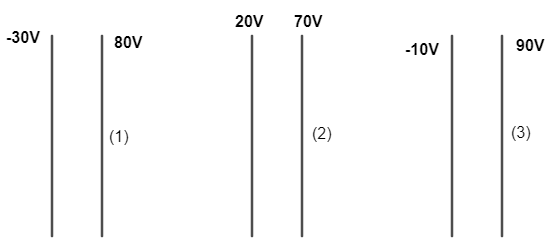
Three pairs of large conducting plates are charged to different potentials as shown in figure. The separation between each pair of plates is the same. The pair of plates according to the magnitude of the electric field between them, from highest to the least is
Answer
 Verified
478.8k+ views
Hint: In order to solve this question, we will first find the net potential difference between these two plates in each of given case and then using general relation between electric field and potential difference we will figure out the relation between electric field strength in each of three cases.
Complete Step By Step Answer:
According to the given diagram we can see that,
for pair of plates in case $(1)$ the net potential difference is just the difference between higher and lower potential of plates so potential difference between these plates is ${V_1} = 80 - ( - 30)$ so, ${V_1} = 110V$
Similarly, for case $(2)$ the potential difference between these plates can be calculated as ${V_2} = 70 - 20$ so, ${V_2} = 50V$
Similarly for case $(3)$ the potential difference between these plates can be calculated as ${V_3} = 90 - ( - 10)$ so, ${V_3} = 100V$
Now, as we know that potential difference V, electric field E and separation between the potential plates d is related as $V = Ed$ so, as distance between the plates is same in all three cases so, keeping d constant, we observe that $E \propto V$ so larger the value of V larger the value of E will be so, calculated potential differences are related as ${V_1} > {V_3} > {V_2}$ hence, the order of electric field strength will also be in same order from highest to lowest.
Hence, order of electric field highest to lowest is ${E_1} > {E_3} > {E_2}.$
Note:
It should be remembered that the distance between the plates in each of the three cases remains the same which gives the derived order of strength of electric field and from the relation $V = Ed$ we can also say that electric field is the rate of change of potential difference with distance.
Complete Step By Step Answer:
According to the given diagram we can see that,
for pair of plates in case $(1)$ the net potential difference is just the difference between higher and lower potential of plates so potential difference between these plates is ${V_1} = 80 - ( - 30)$ so, ${V_1} = 110V$
Similarly, for case $(2)$ the potential difference between these plates can be calculated as ${V_2} = 70 - 20$ so, ${V_2} = 50V$
Similarly for case $(3)$ the potential difference between these plates can be calculated as ${V_3} = 90 - ( - 10)$ so, ${V_3} = 100V$
Now, as we know that potential difference V, electric field E and separation between the potential plates d is related as $V = Ed$ so, as distance between the plates is same in all three cases so, keeping d constant, we observe that $E \propto V$ so larger the value of V larger the value of E will be so, calculated potential differences are related as ${V_1} > {V_3} > {V_2}$ hence, the order of electric field strength will also be in same order from highest to lowest.
Hence, order of electric field highest to lowest is ${E_1} > {E_3} > {E_2}.$
Note:
It should be remembered that the distance between the plates in each of the three cases remains the same which gives the derived order of strength of electric field and from the relation $V = Ed$ we can also say that electric field is the rate of change of potential difference with distance.
Recently Updated Pages
Master Class 12 Economics: Engaging Questions & Answers for Success

Master Class 12 Physics: Engaging Questions & Answers for Success
Master Class 12 English: Engaging Questions & Answers for Success
Master Class 12 Social Science: Engaging Questions & Answers for Success
Master Class 12 Maths: Engaging Questions & Answers for Success
Master Class 12 Business Studies: Engaging Questions & Answers for Success
Trending doubts
Which are the Top 10 Largest Countries of the World?
What are the major means of transport Explain each class 12 social science CBSE
Draw a labelled sketch of the human eye class 12 physics CBSE
Differentiate between insitu conservation and exsitu class 12 biology CBSE
Draw a neat and well labeled diagram of TS of ovary class 12 biology CBSE
Give 10 examples of unisexual and bisexual flowers