




Three of six vertices of a regular hexagon are chosen at random. The probability that the triangle with three vertices is equilateral, is equal to
Answer
 Verified
647.7k+ views
Hint:First of all, find the total number of triangles that is possible by taking 3 points of a regular hexagon which has 6 vertices. Total number of triangles is \[^{6}{{C}_{3}}\] . \[\Delta DFB\] and \[\Delta AEC\]are those triangles which have all of three sides equal to each other. So, there are two equilateral triangles possible in a regular hexagon. Probability can be calculated using the formula , \[\text{Probability}=\dfrac{\text{total number of equilateral triangles}}{\text{total number of triangles possible}}\].
Complete step-by-step answer:
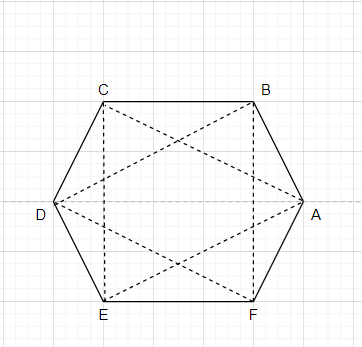
We have connected the vertex A,E and C and can see that we got an equilateral triangle.
Similarly, We have connected the vertex D,F and B and can see that we got an equilateral triangle.
Suppose if we connect the vertex A,D and E, we don’t get an equilateral triangle. Because, according to the diagram we can see that all three sides are not equal to each other.
We have only two equilateral triangles to be formed using a regular hexagon. Out of six points in a hexagon, we have to select only three points at a time.
The total number of triangles to be formed using a regular hexagon=
${}^{6}{{C}_{3}}\ ways$
\[\begin{align}
& =\dfrac{6\times5\times4}{1\times2\times3} \\
& =\dfrac{120}{6} \\
& =20 \\
\end{align}\]
Out of 20 triangles, there are only two equilateral triangles that are \[\Delta \]DFB and $\Delta$ AEC.
Probability of choosing equilateral triangle \[=\dfrac{2}{20}=\dfrac{1}{10}\] .
Note: In this question, one can make mistakes in taking the number of equilateral triangles. One can think that there can be six equilateral triangles that are
\[\Delta DEF\], \[\Delta DCB\] , \[\Delta EFA\] , \[\Delta FAB\] , \[\Delta CBA\] and \[\Delta DEC\]. But in these triangles the third side is not equal to the remaining two sides.
Complete step-by-step answer:
We have connected the vertex A,E and C and can see that we got an equilateral triangle.
Similarly, We have connected the vertex D,F and B and can see that we got an equilateral triangle.
Suppose if we connect the vertex A,D and E, we don’t get an equilateral triangle. Because, according to the diagram we can see that all three sides are not equal to each other.
We have only two equilateral triangles to be formed using a regular hexagon. Out of six points in a hexagon, we have to select only three points at a time.
The total number of triangles to be formed using a regular hexagon=
${}^{6}{{C}_{3}}\ ways$
\[\begin{align}
& =\dfrac{6\times5\times4}{1\times2\times3} \\
& =\dfrac{120}{6} \\
& =20 \\
\end{align}\]
Out of 20 triangles, there are only two equilateral triangles that are \[\Delta \]DFB and $\Delta$ AEC.
Probability of choosing equilateral triangle \[=\dfrac{2}{20}=\dfrac{1}{10}\] .
Note: In this question, one can make mistakes in taking the number of equilateral triangles. One can think that there can be six equilateral triangles that are
\[\Delta DEF\], \[\Delta DCB\] , \[\Delta EFA\] , \[\Delta FAB\] , \[\Delta CBA\] and \[\Delta DEC\]. But in these triangles the third side is not equal to the remaining two sides.
Recently Updated Pages
Master Class 11 English: Engaging Questions & Answers for Success

Master Class 11 Social Science: Engaging Questions & Answers for Success
Master Class 11 Maths: Engaging Questions & Answers for Success
Master Class 11 Biology: Engaging Questions & Answers for Success
Master Class 11 Physics: Engaging Questions & Answers for Success
Master Class 11 Chemistry: Engaging Questions & Answers for Success
Trending doubts
One Metric ton is equal to kg A 10000 B 1000 C 100 class 11 physics CBSE
Difference Between Prokaryotic Cells and Eukaryotic Cells
Find the value of the expression given below sin 30circ class 11 maths CBSE
Difference between physical and chemical change class 11 chemistry CBSE
Two of the body parts which do not appear in MRI are class 11 biology CBSE
Draw a diagram of a plant cell and label at least eight class 11 biology CBSE