




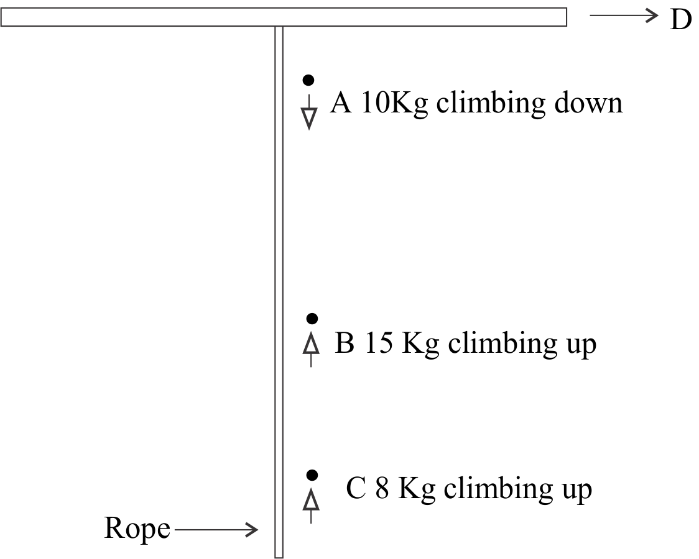
: Three monkeys A, B and C with masses of \[10,{\text{ }}15{\text{ }}and{\text{ }}8Kg\] respectively are climbing up and down the rope suspended from D at the instant represented, A is descending the rope with an acceleration \[2m/s\] and C is pulling himself up with an acceleration of \[1m/s\]. monkey B is climbing up with a constant speed of \[0.8{\text{ }}m/s.\] Calculate the tension T in the rope at D. \[\left( {g = 10m/s} \right)\]
Answer
 Verified
607.8k+ views
Hint: Use the tension formula to get the individual tension acting on the three monkeys. Sum up the three values of tension to get the tension at the point D.
Complete step by step answer
Formula used
\[T{\text{ }} = {\text{ }}mg{\text{ }} + {\text{ }}ma\]
\[T{\text{ }} = {\text{ }}mg{\text{ }}-{\text{ }}ma\]
\[T{\text{ }} = {\text{ }}mg\]
Where,
$T$ = Tension \[\left( {N{\text{ }}or{\text{ }}kg - m/s2} \right)\]
$g$ = Acceleration due to gravity \[\left( {9.8{\text{ }}m/{s^2}} \right)\]
$m$ = Mass of the body \[\left( {Kg} \right)\]
$a$ = Acceleration of the moving body $(m/{s^2})$
Acceleration: It is defined as the rate of change of velocity with respect to time.
Tension: it is a force that acts on a body when it is extended especially when it hangs on something. The body may hang from a chain rope string etc...
When the body is moving upward, then the tension will be \[T{\text{ }} = {\text{ }}mg{\text{ }} + {\text{ }}ma\]
When the body is moving downward, then the tension will be \[T{\text{ }} = {\text{ }}mg{\text{ }}-{\text{ }}ma\]
When the body is moving in uniform speed, then the tension will be \[T{\text{ }} = {\text{ }}mg\]
When the body is just suspended then the tension will be \[T{\text{ }} = {\text{ }}mg\]
Given,
Since monkey C hung on the rope in the last place so, we start from monkey C
For monkey C,
The mass of the monkey c is $8Kg$
The acceleration at which the monkey B climbing up is $1.5m/{s^2}$
The tension due to the body moving upward is, \[T{\text{ }} = {\text{ }}mg{\text{ }} + {\text{ }}ma\]
The tension exerted on the rope due to the monkey B is, ${{\text{T}}_C}{\text{ = (8}} \times 10{\text{)}} - (8 \times 1.5)$
$ \Rightarrow {\text{ }}{{\text{T}}_C}{\text{ = 92N}}$
For monkey B,
The mass of the monkey B is $15Kg$
The monkey B is climbing the rope with a constant speed of $0.8m/s$
We know that the tension due to the body moving in uniform speed is \[T{\text{ }} = {\text{ }}mg\]
$ \Rightarrow {T_B} = 15 \times 10$
$ \Rightarrow {T_B} = 150N$
For monkey A,
The mass of the monkey A is $10Kg$
The acceleration at which the monkey A climbing down is $2m/{s^2}$
The tension due to the body moving downwards is, \[T{\text{ }} = {\text{ }}mg{\text{ }}-{\text{ }}ma\]
$ \Rightarrow {T_A} = (10 \times 10) - (10 \times 2)$
$ \Rightarrow {T_A}{\text{ = 80N}}$
The tension on rope at the point D is the sum of three tensions acting on the rope.
$ \Rightarrow {T_{ABC}} = {T_A} + {T_B} + {T_C}$
$ \Rightarrow {T_{ABC}} = 80 + 150 + 92$
$ \Rightarrow {T_{ABC}} = 322N$
Hence the tension exerted on the point D is $322N.$
Note: In this question they have given the value of the acceleration due to gravity as $10m/{s^2}.$use the acceleration value given in the question other than using the standard value of acceleration due to gravity \[\left( {9.8{\text{ }}m/{s^2}} \right)\]
Complete step by step answer
Formula used
\[T{\text{ }} = {\text{ }}mg{\text{ }} + {\text{ }}ma\]
\[T{\text{ }} = {\text{ }}mg{\text{ }}-{\text{ }}ma\]
\[T{\text{ }} = {\text{ }}mg\]
Where,
$T$ = Tension \[\left( {N{\text{ }}or{\text{ }}kg - m/s2} \right)\]
$g$ = Acceleration due to gravity \[\left( {9.8{\text{ }}m/{s^2}} \right)\]
$m$ = Mass of the body \[\left( {Kg} \right)\]
$a$ = Acceleration of the moving body $(m/{s^2})$
Acceleration: It is defined as the rate of change of velocity with respect to time.
Tension: it is a force that acts on a body when it is extended especially when it hangs on something. The body may hang from a chain rope string etc...
When the body is moving upward, then the tension will be \[T{\text{ }} = {\text{ }}mg{\text{ }} + {\text{ }}ma\]
When the body is moving downward, then the tension will be \[T{\text{ }} = {\text{ }}mg{\text{ }}-{\text{ }}ma\]
When the body is moving in uniform speed, then the tension will be \[T{\text{ }} = {\text{ }}mg\]
When the body is just suspended then the tension will be \[T{\text{ }} = {\text{ }}mg\]
Given,
Since monkey C hung on the rope in the last place so, we start from monkey C
For monkey C,
The mass of the monkey c is $8Kg$
The acceleration at which the monkey B climbing up is $1.5m/{s^2}$
The tension due to the body moving upward is, \[T{\text{ }} = {\text{ }}mg{\text{ }} + {\text{ }}ma\]
The tension exerted on the rope due to the monkey B is, ${{\text{T}}_C}{\text{ = (8}} \times 10{\text{)}} - (8 \times 1.5)$
$ \Rightarrow {\text{ }}{{\text{T}}_C}{\text{ = 92N}}$
For monkey B,
The mass of the monkey B is $15Kg$
The monkey B is climbing the rope with a constant speed of $0.8m/s$
We know that the tension due to the body moving in uniform speed is \[T{\text{ }} = {\text{ }}mg\]
$ \Rightarrow {T_B} = 15 \times 10$
$ \Rightarrow {T_B} = 150N$
For monkey A,
The mass of the monkey A is $10Kg$
The acceleration at which the monkey A climbing down is $2m/{s^2}$
The tension due to the body moving downwards is, \[T{\text{ }} = {\text{ }}mg{\text{ }}-{\text{ }}ma\]
$ \Rightarrow {T_A} = (10 \times 10) - (10 \times 2)$
$ \Rightarrow {T_A}{\text{ = 80N}}$
The tension on rope at the point D is the sum of three tensions acting on the rope.
$ \Rightarrow {T_{ABC}} = {T_A} + {T_B} + {T_C}$
$ \Rightarrow {T_{ABC}} = 80 + 150 + 92$
$ \Rightarrow {T_{ABC}} = 322N$
Hence the tension exerted on the point D is $322N.$
Note: In this question they have given the value of the acceleration due to gravity as $10m/{s^2}.$use the acceleration value given in the question other than using the standard value of acceleration due to gravity \[\left( {9.8{\text{ }}m/{s^2}} \right)\]
Recently Updated Pages
Master Class 11 Social Science: Engaging Questions & Answers for Success

Master Class 11 English: Engaging Questions & Answers for Success
Master Class 11 Maths: Engaging Questions & Answers for Success
Master Class 11 Chemistry: Engaging Questions & Answers for Success
Master Class 11 Biology: Engaging Questions & Answers for Success
Master Class 11 Physics: Engaging Questions & Answers for Success
Trending doubts
One Metric ton is equal to kg A 10000 B 1000 C 100 class 11 physics CBSE
Difference Between Prokaryotic Cells and Eukaryotic Cells
How many of the following diseases can be studied with class 11 biology CBSE
Which of the following enzymes is used for carboxylation class 11 biology CBSE
Draw a diagram of a plant cell and label at least eight class 11 biology CBSE
Two of the body parts which do not appear in MRI are class 11 biology CBSE