




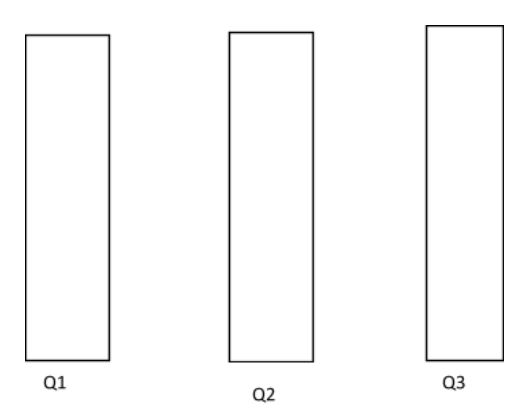
Three metallic plates each of area A are kept as shown in figure and charges $Q_1, Q_2, Q_3$ are given to them to find the resulting charge distribution on the six surfaces, neglecting edge effect?
Answer
 Verified
614.1k+ views
Hint: In the system of large isolated parallel metal plates, the charges are distributed in such a way that always the facing surfaces of the plates carry equal and opposite charges and outer surfaces of the system carry equal charges.
Complete step by step answer:
Given: Area of each plate is A.
Charges on the three metallic plates are Q1, Q2 and Q3 respectively.
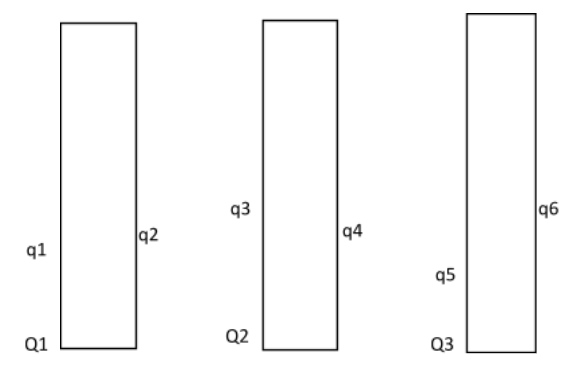
Let the charges distributed on each plate be $q_1, q_2, q_3, q_4, q_5$ and $q_6$ as shown in the figure below
According to redistribution and charge conservation, we have
\[{q_1} = {q_6} = \dfrac{{{Q_1} + {Q_2} + {Q_3}}}{2}\], \[{q_3} = - {\text{ }}{q_2}\]and \[{q_4} = - {\text{ }}{q_5}\]
\[{q_2}{\text{ }} = {\text{ }}{Q_1} - {\text{ }}{q_1}\]
\[ \Rightarrow {q_2}{\text{ }} = {\text{ }}{Q_1} - {\text{ }}{q_1} = \;{Q_1} - \dfrac{{{Q_1} + {Q_2} + {Q_3}}}{2}\]
\[\therefore {q_2}{\text{ }} = \dfrac{{{Q_1} - {Q_2} - {Q_3}}}{2}\].
Note: Whenever a charge is given to a conducting body, or on a metallic body, the charge will spread on the outer surface of the body due to the mutual repulsion. The charge is automatically distributed in such a way that the net electric field intensity at every interior point of the body after the distribution becomes zero. The final charge distribution on all the plates can be directly calculated by using two facts. One is that all facing surfaces of the plates have equal and opposite polarity charges and the second one is that the total charges on the outermost surface of side plates of the system are always equal and half of the sum of all the charges on the plates. This second statement can also be deduced by considering zero electric fields at the interior points of the side metal plates.
Complete step by step answer:
Given: Area of each plate is A.
Charges on the three metallic plates are Q1, Q2 and Q3 respectively.
Let the charges distributed on each plate be $q_1, q_2, q_3, q_4, q_5$ and $q_6$ as shown in the figure below
According to redistribution and charge conservation, we have
\[{q_1} = {q_6} = \dfrac{{{Q_1} + {Q_2} + {Q_3}}}{2}\], \[{q_3} = - {\text{ }}{q_2}\]and \[{q_4} = - {\text{ }}{q_5}\]
\[{q_2}{\text{ }} = {\text{ }}{Q_1} - {\text{ }}{q_1}\]
\[ \Rightarrow {q_2}{\text{ }} = {\text{ }}{Q_1} - {\text{ }}{q_1} = \;{Q_1} - \dfrac{{{Q_1} + {Q_2} + {Q_3}}}{2}\]
\[\therefore {q_2}{\text{ }} = \dfrac{{{Q_1} - {Q_2} - {Q_3}}}{2}\].
Note: Whenever a charge is given to a conducting body, or on a metallic body, the charge will spread on the outer surface of the body due to the mutual repulsion. The charge is automatically distributed in such a way that the net electric field intensity at every interior point of the body after the distribution becomes zero. The final charge distribution on all the plates can be directly calculated by using two facts. One is that all facing surfaces of the plates have equal and opposite polarity charges and the second one is that the total charges on the outermost surface of side plates of the system are always equal and half of the sum of all the charges on the plates. This second statement can also be deduced by considering zero electric fields at the interior points of the side metal plates.
Recently Updated Pages
Explain the structure of megasporangium class 12 biology CBSE

Why is chloroform kept in dark coloured bottles class 12 chemistry CBSE
Derive the balancing condition of a Wheatstone bri class 12 physics CBSE
Draw VI characteristics of a pn junction diode Explain class 12 physics CBSE
Is it possible to carry pride in ones language too class 12 english CBSE
In a population at Hardy Weinberg equilibrium the allele class 12 biology CBSE
Trending doubts
Draw a labelled sketch of the human eye class 12 physics CBSE
Which are the Top 10 Largest Countries of the World?
Draw ray diagrams each showing i myopic eye and ii class 12 physics CBSE
Which is the correct genotypic ratio of mendel dihybrid class 12 biology CBSE
Differentiate between homogeneous and heterogeneous class 12 chemistry CBSE
Which animal never drinks water in its entire life class 12 biology CBSE