




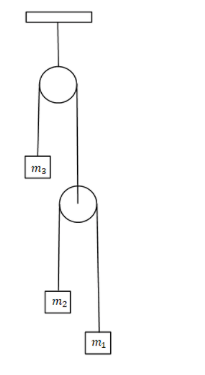
Three masses ${m_1}$,${m_2}$ and ${m_3}$ are attached to a string as shown in the figure. All three masses are held at rest and then released. To keep ${m_3}$ at rest, the condition is:
A) $\dfrac{1}{{{m_3}}} = \dfrac{1}{{{m_1}}} + \dfrac{1}{{{m_2}}}$.
B) ${m_1} + {m_2} = {m_3}$.
C) $\dfrac{4}{{{m_3}}} = \dfrac{1}{{{m_1}}} + \dfrac{1}{{{m_2}}}$.
D) $\dfrac{1}{{{m_1}}} + \dfrac{2}{{{m_2}}} = \dfrac{3}{{{m_3}}}$.
Answer
 Verified
600.9k+ views
Hint:The tension in the string always acts away from the body so the tension on the string is always equal to the weight of the mass if the mass is in rest. The tension in the pulley is T then the tension in the string holding that pulley has double tension.
Complete step by step solution:
It is given in the problem that the masses ${m_1}$,${m_2}$ and ${m_3}$ are attached to a string and all the three masses are rest and then released also it is given that the mass ${m_3}$ will be at rest. The free body diagram will be.
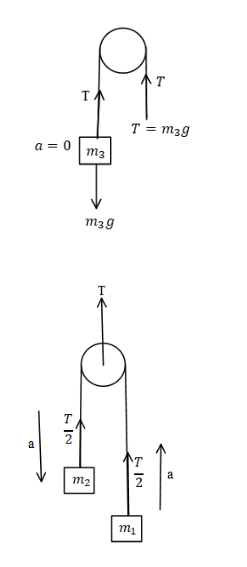
The tension in the string is equal to,
$ \Rightarrow T = 2{T_1}$………eq. (1)
The equation involving the mass ${m_1}$ is equal to,
$ \Rightarrow {T_1} - {m_1}g = {m_1}a$
Since, $T = 2{T_1}$
$ \Rightarrow \dfrac{T}{2} - {m_1}g = {m_1}a$………eq. (2)
The equation involving the mass ${m_2}$ is equal to,
$ \Rightarrow - {T_1} - {m_2}g = {m_2}a$
Since, $T = 2{T_1}$ therefore we get,
$ \Rightarrow - \dfrac{T}{2} + {m_2}g = {m_2}a$………eq. (3)
Dividing equation (2) by equation (3) we get,
$ \Rightarrow \dfrac{{\dfrac{T}{2} - {m_1}g}}{{ - \dfrac{T}{2} + {m_2}g}} = \dfrac{{{m_1}a}}{{{m_2}a}}$
$ \Rightarrow \dfrac{{\dfrac{T}{2} - {m_1}g}}{{ - \dfrac{T}{2} + {m_2}g}} = \dfrac{{{m_1}}}{{{m_2}}}$………eq. (4)
As the mass ${m_3}$ is at rest is given by,
$ \Rightarrow T = {m_3}g$………eq (5)
Replacing the value of equation (5) in equation (4) we get,
$ \Rightarrow \dfrac{{\dfrac{T}{2} - {m_1}g}}{{ - \dfrac{T}{2} + {m_2}g}} = \dfrac{{{m_1}}}{{{m_2}}}$
$ \Rightarrow \dfrac{{\left( {\dfrac{{{m_3}g}}{2}} \right) - {m_1}g}}{{ - \left( {\dfrac{{{m_3}g}}{2}} \right) + {m_2}g}} = \dfrac{{{m_1}}}{{{m_2}}}$
$ \Rightarrow \dfrac{{\left( {\dfrac{{{m_3}g - 2{m_1}g}}{2}} \right)}}{{\left( {\dfrac{{ - {m_3}g + 2{m_2}g}}{2}} \right)}} = \dfrac{{{m_1}}}{{{m_2}}}$
\[ \Rightarrow {m_2} \times \left( {\dfrac{{{m_3}g - 2{m_1}g}}{2}} \right) = {m_1} \times \left( {\dfrac{{ - {m_3}g + 2{m_2}g}}{2}} \right)\]
\[ \Rightarrow {m_2} \times \left( {{m_3}g - 2{m_1}g} \right) = {m_1} \times \left( { - {m_3}g + 2{m_2}g} \right)\]
\[ \Rightarrow {m_2}{m_3}g - 2{m_1}{m_2}g = - {m_3}{m_1}g + 2{m_1}{m_2}g\]
\[ \Rightarrow {m_2}{m_3} - 2{m_1}{m_2} = - {m_3}{m_1} + 2{m_1}{m_2}\]
\[ \Rightarrow {m_2}{m_3} + {m_3}{m_1} = 4{m_1}{m_2}\]
\[ \Rightarrow \dfrac{1}{{{m_1}{m_2}}}\left( {{m_2}{m_3} + {m_3}{m_1}} \right) = 4\]
\[ \Rightarrow \left( {\dfrac{{{m_3}}}{{{m_1}}} + \dfrac{{{m_3}}}{{{m_2}}}} \right) = 4\]
\[ \Rightarrow \dfrac{4}{{{m_3}}} = \dfrac{1}{{{m_1}}} + \dfrac{1}{{{m_2}}}\].
The relation of the masses${m_1}$,${m_2}$ and ${m_3}$ is equal to\[\dfrac{4}{{{m_3}}} = \dfrac{1}{{{m_1}}} + \dfrac{1}{{{m_2}}}\].
The correct answer for this problem is option C.
Note: The masses ${m_1}$ and ${m_2}$ will move with acceleration a but the acceleration of the mass ${m_3}$ will be given as zero therefore the tension is equal to the weight of the mass${m_3}$. It is advised to the students that the equation should be designed very carefully as the equations only will help us to solve this problem.
Complete step by step solution:
It is given in the problem that the masses ${m_1}$,${m_2}$ and ${m_3}$ are attached to a string and all the three masses are rest and then released also it is given that the mass ${m_3}$ will be at rest. The free body diagram will be.
The tension in the string is equal to,
$ \Rightarrow T = 2{T_1}$………eq. (1)
The equation involving the mass ${m_1}$ is equal to,
$ \Rightarrow {T_1} - {m_1}g = {m_1}a$
Since, $T = 2{T_1}$
$ \Rightarrow \dfrac{T}{2} - {m_1}g = {m_1}a$………eq. (2)
The equation involving the mass ${m_2}$ is equal to,
$ \Rightarrow - {T_1} - {m_2}g = {m_2}a$
Since, $T = 2{T_1}$ therefore we get,
$ \Rightarrow - \dfrac{T}{2} + {m_2}g = {m_2}a$………eq. (3)
Dividing equation (2) by equation (3) we get,
$ \Rightarrow \dfrac{{\dfrac{T}{2} - {m_1}g}}{{ - \dfrac{T}{2} + {m_2}g}} = \dfrac{{{m_1}a}}{{{m_2}a}}$
$ \Rightarrow \dfrac{{\dfrac{T}{2} - {m_1}g}}{{ - \dfrac{T}{2} + {m_2}g}} = \dfrac{{{m_1}}}{{{m_2}}}$………eq. (4)
As the mass ${m_3}$ is at rest is given by,
$ \Rightarrow T = {m_3}g$………eq (5)
Replacing the value of equation (5) in equation (4) we get,
$ \Rightarrow \dfrac{{\dfrac{T}{2} - {m_1}g}}{{ - \dfrac{T}{2} + {m_2}g}} = \dfrac{{{m_1}}}{{{m_2}}}$
$ \Rightarrow \dfrac{{\left( {\dfrac{{{m_3}g}}{2}} \right) - {m_1}g}}{{ - \left( {\dfrac{{{m_3}g}}{2}} \right) + {m_2}g}} = \dfrac{{{m_1}}}{{{m_2}}}$
$ \Rightarrow \dfrac{{\left( {\dfrac{{{m_3}g - 2{m_1}g}}{2}} \right)}}{{\left( {\dfrac{{ - {m_3}g + 2{m_2}g}}{2}} \right)}} = \dfrac{{{m_1}}}{{{m_2}}}$
\[ \Rightarrow {m_2} \times \left( {\dfrac{{{m_3}g - 2{m_1}g}}{2}} \right) = {m_1} \times \left( {\dfrac{{ - {m_3}g + 2{m_2}g}}{2}} \right)\]
\[ \Rightarrow {m_2} \times \left( {{m_3}g - 2{m_1}g} \right) = {m_1} \times \left( { - {m_3}g + 2{m_2}g} \right)\]
\[ \Rightarrow {m_2}{m_3}g - 2{m_1}{m_2}g = - {m_3}{m_1}g + 2{m_1}{m_2}g\]
\[ \Rightarrow {m_2}{m_3} - 2{m_1}{m_2} = - {m_3}{m_1} + 2{m_1}{m_2}\]
\[ \Rightarrow {m_2}{m_3} + {m_3}{m_1} = 4{m_1}{m_2}\]
\[ \Rightarrow \dfrac{1}{{{m_1}{m_2}}}\left( {{m_2}{m_3} + {m_3}{m_1}} \right) = 4\]
\[ \Rightarrow \left( {\dfrac{{{m_3}}}{{{m_1}}} + \dfrac{{{m_3}}}{{{m_2}}}} \right) = 4\]
\[ \Rightarrow \dfrac{4}{{{m_3}}} = \dfrac{1}{{{m_1}}} + \dfrac{1}{{{m_2}}}\].
The relation of the masses${m_1}$,${m_2}$ and ${m_3}$ is equal to\[\dfrac{4}{{{m_3}}} = \dfrac{1}{{{m_1}}} + \dfrac{1}{{{m_2}}}\].
The correct answer for this problem is option C.
Note: The masses ${m_1}$ and ${m_2}$ will move with acceleration a but the acceleration of the mass ${m_3}$ will be given as zero therefore the tension is equal to the weight of the mass${m_3}$. It is advised to the students that the equation should be designed very carefully as the equations only will help us to solve this problem.
Recently Updated Pages
Master Class 11 Social Science: Engaging Questions & Answers for Success

Master Class 11 English: Engaging Questions & Answers for Success
Master Class 11 Maths: Engaging Questions & Answers for Success
Master Class 11 Chemistry: Engaging Questions & Answers for Success
Master Class 11 Biology: Engaging Questions & Answers for Success
Master Class 11 Physics: Engaging Questions & Answers for Success
Trending doubts
One Metric ton is equal to kg A 10000 B 1000 C 100 class 11 physics CBSE
Difference Between Prokaryotic Cells and Eukaryotic Cells
How many of the following diseases can be studied with class 11 biology CBSE
Draw a diagram of a plant cell and label at least eight class 11 biology CBSE
Two of the body parts which do not appear in MRI are class 11 biology CBSE
Which gas is abundant in air class 11 chemistry CBSE