




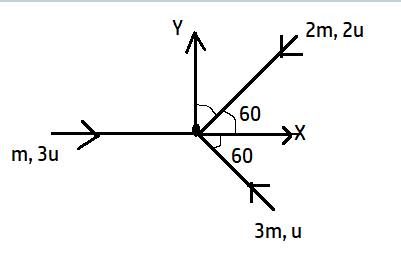
Three masses m, 2m and 3m are moving in the x-y plane with speeds 3u, 2u and u respectively as shown in the figure. The three masses collide at the same point at P and stick together. Find the velocity of the resulting mass?
A. \[\dfrac{u}{12}(\widehat{i}+\sqrt{3}\widehat{j})\]
B. \[\dfrac{u}{12}(\widehat{i}-\sqrt{3}\widehat{j})\]
C. \[\dfrac{u}{12}(-\widehat{i}-\sqrt{3}\widehat{j})\]
D. \[\dfrac{u}{12}(-\widehat{i}+\sqrt{3}\widehat{j})\]
Answer
 Verified
592.5k+ views
Hint: This problem involves collision and there is no loss of energy during the collision. Also, there is no friction present on the ground. It makes a simple problem of energy conservation. We have to also consider the directions since it is of 2-dimension collision.
Complete step by step answer:
We will do this problem by separating components.
For X component:
For first mass:
Mass= m
Velocity= 3u
For second mass:
Mass= 2m
Velocity can be resolved as -2ucos60 = \[-2u\times \dfrac{1}{2}=-u\]
For third mass:
Mass= 3m
Velocity= -ucos60= \[-u\times \dfrac{1}{2}=-\dfrac{u}{2}\]
So, initial x component of linear momentum is \[{{m}_{1}}{{u}_{x1}}+{{m}_{2}}{{u}_{x2}}+{{m}_{3}}{{u}_{x3}}\]
\[\begin{align}
& =3mu-2mu-\dfrac{3mu}{2} \\
& \\
& =mu-\dfrac{3mu}{2} \\
& =\dfrac{-mu}{2} \\
\end{align}\]
For Y component:
For first mass:
Mass= m
Velocity= 0
For second mass:
Mass= 2m
Velocity can be resolved as -2usin60 = \[-2u\times \dfrac{\sqrt{3}}{2}=-u\sqrt{3}\]
For third mass:
Mass= 3m
Velocity= usin60= \[2u\times \dfrac{\sqrt{3}}{2}=u\sqrt{3}\]
So, initial y component of linear momentum is \[{{m}_{1}}{{u}_{y1}}+{{m}_{2}}{{u}_{y2}}+{{m}_{3}}{{u}_{y3}}\]
\[\begin{align}
& =0-2mu\sqrt{3}+3mu\sqrt{3} \\
& =mu\sqrt{3} \\
\end{align}\]
Now after the collision all the masses stick together, so total mass will be 6m
Let the x component of final velocity be \[{{V}_{x}}\]and y component be \[{{V}_{y}}\]
So, by law of conservation of linear momentum,
6m \[{{V}_{x}}\]= \[\dfrac{-mu}{2}\]
\[{{V}_{x}}=\dfrac{-u}{12}\]
For y component:
\[\begin{align}
& 6m{{V}_{y}}=mu\sqrt{3} \\
& {{V}_{y}}=\dfrac{u}{6}\sqrt{3} \\
\end{align}\]
So, the velocity of the resulting mass is
$
\dfrac{-u}{12}\widehat{i}-\dfrac{u}{12}\sqrt{3}\widehat{j} \\
\therefore \dfrac{u}{12}(-\widehat{i}-\sqrt{3}\overset\frown{j}) \\
$
So, the correct answer is “Option C”.
Note:
It is possible to resolve components only when the body is moving with constant velocity that is zero acceleration or with a constant value of acceleration.
If the body moves with varying acceleration then it is not possible to resolve the vectors.
Complete step by step answer:
We will do this problem by separating components.
For X component:
For first mass:
Mass= m
Velocity= 3u
For second mass:
Mass= 2m
Velocity can be resolved as -2ucos60 = \[-2u\times \dfrac{1}{2}=-u\]
For third mass:
Mass= 3m
Velocity= -ucos60= \[-u\times \dfrac{1}{2}=-\dfrac{u}{2}\]
So, initial x component of linear momentum is \[{{m}_{1}}{{u}_{x1}}+{{m}_{2}}{{u}_{x2}}+{{m}_{3}}{{u}_{x3}}\]
\[\begin{align}
& =3mu-2mu-\dfrac{3mu}{2} \\
& \\
& =mu-\dfrac{3mu}{2} \\
& =\dfrac{-mu}{2} \\
\end{align}\]
For Y component:
For first mass:
Mass= m
Velocity= 0
For second mass:
Mass= 2m
Velocity can be resolved as -2usin60 = \[-2u\times \dfrac{\sqrt{3}}{2}=-u\sqrt{3}\]
For third mass:
Mass= 3m
Velocity= usin60= \[2u\times \dfrac{\sqrt{3}}{2}=u\sqrt{3}\]
So, initial y component of linear momentum is \[{{m}_{1}}{{u}_{y1}}+{{m}_{2}}{{u}_{y2}}+{{m}_{3}}{{u}_{y3}}\]
\[\begin{align}
& =0-2mu\sqrt{3}+3mu\sqrt{3} \\
& =mu\sqrt{3} \\
\end{align}\]
Now after the collision all the masses stick together, so total mass will be 6m
Let the x component of final velocity be \[{{V}_{x}}\]and y component be \[{{V}_{y}}\]
So, by law of conservation of linear momentum,
6m \[{{V}_{x}}\]= \[\dfrac{-mu}{2}\]
\[{{V}_{x}}=\dfrac{-u}{12}\]
For y component:
\[\begin{align}
& 6m{{V}_{y}}=mu\sqrt{3} \\
& {{V}_{y}}=\dfrac{u}{6}\sqrt{3} \\
\end{align}\]
So, the velocity of the resulting mass is
$
\dfrac{-u}{12}\widehat{i}-\dfrac{u}{12}\sqrt{3}\widehat{j} \\
\therefore \dfrac{u}{12}(-\widehat{i}-\sqrt{3}\overset\frown{j}) \\
$
So, the correct answer is “Option C”.
Note:
It is possible to resolve components only when the body is moving with constant velocity that is zero acceleration or with a constant value of acceleration.
If the body moves with varying acceleration then it is not possible to resolve the vectors.
Recently Updated Pages
Basicity of sulphurous acid and sulphuric acid are

Master Class 11 Business Studies: Engaging Questions & Answers for Success
Master Class 11 Computer Science: Engaging Questions & Answers for Success
Master Class 11 Economics: Engaging Questions & Answers for Success
Master Class 11 Social Science: Engaging Questions & Answers for Success
Master Class 11 English: Engaging Questions & Answers for Success
Trending doubts
One Metric ton is equal to kg A 10000 B 1000 C 100 class 11 physics CBSE
The largest wind power cluster is located in the state class 11 social science CBSE
Explain zero factorial class 11 maths CBSE
State and prove Bernoullis theorem class 11 physics CBSE
Which among the following are examples of coming together class 11 social science CBSE
Draw a diagram of a plant cell and label at least eight class 11 biology CBSE