




What were the three major observations Rutherford made in the gold foil experiment?
Answer
 Verified
623.4k+ views
Hint: Ernest Rutherford was a British scientist who suggested an experiment and based on the observations of this experiment, he proposed the atomic structure of elements and gave the Rutherford Atomic Model.
This model was a big step towards describing the structure of an atom.
Complete answer:
Rutherford was a former research student of J.J. Thomson (who proposed the plum pudding model of the atom in 1904). He was engaged with alpha-particles emitted by radioactive elements. In 1906, he proposed an experiment of scattering alpha-particles to determine the structure of atoms.
On his suggestion, in 1911, H. Geiger and E. Marsden directed a beam of alpha particles emitted from a radioactive source at a thin foil made of gold. They used lead bricks to narrow the beam. The scattered particles were observed through a rotatable detector consisting of zinc sulphide screen as shown in figure. When the alpha particles struck on the screen, the screen produced light flashes which were viewed through a microscope. The distribution of the number of scattered particles was studied as a function of angle of scattering.
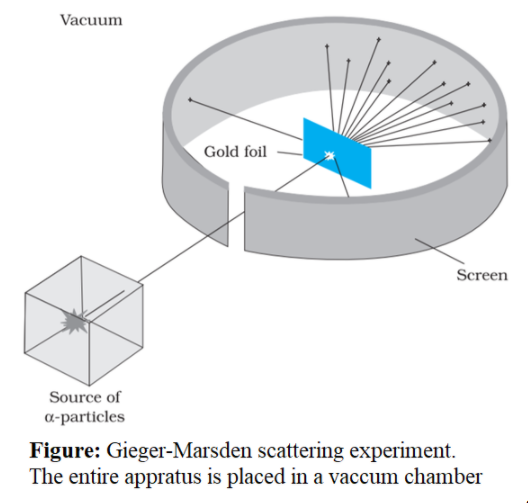
It was observed that,
1.Major fraction of alpha particles pass through the foil undeflected.
2.A few alpha-particles were scattered by very small angles.
3.A very small number of particles were deflected back by 1800.
Note:
From the observations of Rutherford’s experiment it was concluded that positively charged particles and most of an atom was concentrated in a very small volume known as nucleus. Electrons surrounding the nucleus of an atom revolve around it with very high speed.
This model was a big step towards describing the structure of an atom.
Complete answer:
Rutherford was a former research student of J.J. Thomson (who proposed the plum pudding model of the atom in 1904). He was engaged with alpha-particles emitted by radioactive elements. In 1906, he proposed an experiment of scattering alpha-particles to determine the structure of atoms.
On his suggestion, in 1911, H. Geiger and E. Marsden directed a beam of alpha particles emitted from a radioactive source at a thin foil made of gold. They used lead bricks to narrow the beam. The scattered particles were observed through a rotatable detector consisting of zinc sulphide screen as shown in figure. When the alpha particles struck on the screen, the screen produced light flashes which were viewed through a microscope. The distribution of the number of scattered particles was studied as a function of angle of scattering.
It was observed that,
1.Major fraction of alpha particles pass through the foil undeflected.
2.A few alpha-particles were scattered by very small angles.
3.A very small number of particles were deflected back by 1800.
Note:
From the observations of Rutherford’s experiment it was concluded that positively charged particles and most of an atom was concentrated in a very small volume known as nucleus. Electrons surrounding the nucleus of an atom revolve around it with very high speed.
Recently Updated Pages
Master Class 11 English: Engaging Questions & Answers for Success

Master Class 11 Social Science: Engaging Questions & Answers for Success
Master Class 11 Maths: Engaging Questions & Answers for Success
Master Class 11 Biology: Engaging Questions & Answers for Success
Master Class 11 Physics: Engaging Questions & Answers for Success
Master Class 11 Chemistry: Engaging Questions & Answers for Success
Trending doubts
One Metric ton is equal to kg A 10000 B 1000 C 100 class 11 physics CBSE
Difference Between Prokaryotic Cells and Eukaryotic Cells
1 ton equals to A 100 kg B 1000 kg C 10 kg D 10000 class 11 physics CBSE
Find the value of the expression given below sin 30circ class 11 maths CBSE
Two of the body parts which do not appear in MRI are class 11 biology CBSE
What are hard magnetic materials class 11 physics CBSE