




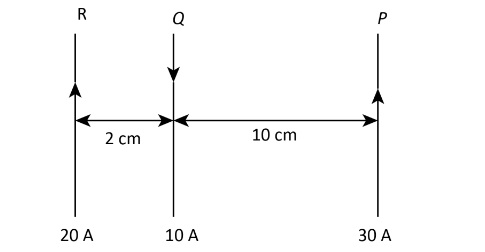
Three long, straight and parallel wires are arranged as shown in figure. The force
experienced by 10 cm length of wire $Q$ is
A. $1.4 \times {10^{ - 4}}\;{\rm{N}}$ toward the right
B. $1.4 \times {10^{ - 4}}\;{\rm{N}}$ towards the left
C. $2.6 \times {10^{ - 4}}\;{\rm{N}}$ toward the right
D. $2.6 \times {10^{ - 4}}\;{\rm{N}}$ toward the left
Answer
 Verified
579.3k+ views
Hint: Find the magnetic field due to $R$ on Q and due to $P$on $Q$ and use this expression to find the force and when the current are in opposite direction in the straight conductor, then the force is repulsive in nature.
Formula used: The magnetic field due to infinitely long straight conductor: $B = \dfrac{{{\mu
_0}I}}{{2\pi a}}$
Complete step by step answer:
From the given question, we know that the current in wire $P.\;Q$ and $R$ are ${I_P} =
30\;{\rm{A}}$, ${I_Q} = 10{\rm{A}}$ and ${I_R} = 20\;{\rm{A}}$, the distance between the wire
$R\;$ and $Q$ is ${a_{RQ}} = 0.02\;{\rm{m}}$, the distance between the wire $P$ and $Q$ is
${a_{PQ}} = 0.1\;{\rm{m}}$ and the length of the wire $Q$ is $L = 0.1\;{\rm{m}}$
The magnetic field produced by wire $R$ at $Q$ is expressed as,
${B_{RQ}} = \dfrac{{{\mu _0}{I_R}}}{{2\pi {a_{RQ}}}}$
Since the force experienced by wire $Q$ is in left direction (repulsion) as the directions of the
current are anti parallel and it is calculated as,
$
{F_{RQ}} = {I_Q}L{B_{RQ}}\\
{F_{RQ}} = {I_Q}L\dfrac{{{\mu _0}{I_R}}}{{2\pi {a_{RQ}}}}
$
Similarly, the magnetic field produced by wire $P$ at $Q$ is expressed as,
${B_{PQ}} = \dfrac{{{\mu _0}{I_P}}}{{2\pi {a_{PQ}}}}$
Since the force experienced by wire $Q$ is in right direction (repulsion) as the directions of the
current are anti parallel and it is calculated as,
$
{F_{PQ}} = {I_Q}L{B_{PQ}}\\
{F_{PQ}} = {I_Q}L\dfrac{{{\mu _0}{I_P}}}{{2\pi {a_{PQ}}}}
$
The net force experienced by the wire $Q$ is calculated as,
$
F = {F_{RQ}} - {F_{PQ}}\\
= {I_Q}L\dfrac{{{\mu _0}{I_R}}}{{2\pi {a_{RQ}}}} - {I_Q}L\dfrac{{{\mu _0}{I_P}}}{{2\pi {a_{PQ}}}}\\
= \dfrac{{{I_Q}L{\mu _0}}}{{2\pi }}\left[ {\dfrac{{{I_R}}}{{{a_{RQ}}}} - \dfrac{{{I_P}}}{{{a_{PQ}}}}}
\right]\\
= \dfrac{{10 \times 0.1 \times 4\pi \times {{10}^{ - 7}}}}{{2\pi }}\left[ {\dfrac{{20}}{{0.02}} -
\dfrac{{30}}{{0.1}}} \right]\\
= 1.4 \times {10^{ - 4}}\;{\rm{N}}\;\;{\rm{towards}}\;{\rm{right}}
$
Thus, the force experienced by the wire $Q$ is $1.4 \times {10^{ - 4}}\;{\rm{N}}$ toward right
direction and option (A) is correct.
Note: Be careful while answering, because the formula for finite straight wire and infinite
straight are completely different.
When wire has finite length: \[B = \dfrac{{{\mu _0}I}}{{4\pi a}}\left( {\sin {\phi _2} + \sin {\phi
_1}} \right)\]
When wire has infinite length, ${\phi _1} = {\phi _2} = 90^\circ $: \[B = \dfrac{{{\mu _0}I}}{{2\pi
a}}\]
When wire has infinite length and point $P$ lies at near wire’s end, ${\phi _1} = 90^\circ
\;{\rm{and}}\;{\phi _2} = 0$:
\[B = \dfrac{{{\mu _0}I}}{{4\pi a}}\]
Formula used: The magnetic field due to infinitely long straight conductor: $B = \dfrac{{{\mu
_0}I}}{{2\pi a}}$
Complete step by step answer:
From the given question, we know that the current in wire $P.\;Q$ and $R$ are ${I_P} =
30\;{\rm{A}}$, ${I_Q} = 10{\rm{A}}$ and ${I_R} = 20\;{\rm{A}}$, the distance between the wire
$R\;$ and $Q$ is ${a_{RQ}} = 0.02\;{\rm{m}}$, the distance between the wire $P$ and $Q$ is
${a_{PQ}} = 0.1\;{\rm{m}}$ and the length of the wire $Q$ is $L = 0.1\;{\rm{m}}$
The magnetic field produced by wire $R$ at $Q$ is expressed as,
${B_{RQ}} = \dfrac{{{\mu _0}{I_R}}}{{2\pi {a_{RQ}}}}$
Since the force experienced by wire $Q$ is in left direction (repulsion) as the directions of the
current are anti parallel and it is calculated as,
$
{F_{RQ}} = {I_Q}L{B_{RQ}}\\
{F_{RQ}} = {I_Q}L\dfrac{{{\mu _0}{I_R}}}{{2\pi {a_{RQ}}}}
$
Similarly, the magnetic field produced by wire $P$ at $Q$ is expressed as,
${B_{PQ}} = \dfrac{{{\mu _0}{I_P}}}{{2\pi {a_{PQ}}}}$
Since the force experienced by wire $Q$ is in right direction (repulsion) as the directions of the
current are anti parallel and it is calculated as,
$
{F_{PQ}} = {I_Q}L{B_{PQ}}\\
{F_{PQ}} = {I_Q}L\dfrac{{{\mu _0}{I_P}}}{{2\pi {a_{PQ}}}}
$
The net force experienced by the wire $Q$ is calculated as,
$
F = {F_{RQ}} - {F_{PQ}}\\
= {I_Q}L\dfrac{{{\mu _0}{I_R}}}{{2\pi {a_{RQ}}}} - {I_Q}L\dfrac{{{\mu _0}{I_P}}}{{2\pi {a_{PQ}}}}\\
= \dfrac{{{I_Q}L{\mu _0}}}{{2\pi }}\left[ {\dfrac{{{I_R}}}{{{a_{RQ}}}} - \dfrac{{{I_P}}}{{{a_{PQ}}}}}
\right]\\
= \dfrac{{10 \times 0.1 \times 4\pi \times {{10}^{ - 7}}}}{{2\pi }}\left[ {\dfrac{{20}}{{0.02}} -
\dfrac{{30}}{{0.1}}} \right]\\
= 1.4 \times {10^{ - 4}}\;{\rm{N}}\;\;{\rm{towards}}\;{\rm{right}}
$
Thus, the force experienced by the wire $Q$ is $1.4 \times {10^{ - 4}}\;{\rm{N}}$ toward right
direction and option (A) is correct.
Note: Be careful while answering, because the formula for finite straight wire and infinite
straight are completely different.
When wire has finite length: \[B = \dfrac{{{\mu _0}I}}{{4\pi a}}\left( {\sin {\phi _2} + \sin {\phi
_1}} \right)\]
When wire has infinite length, ${\phi _1} = {\phi _2} = 90^\circ $: \[B = \dfrac{{{\mu _0}I}}{{2\pi
a}}\]
When wire has infinite length and point $P$ lies at near wire’s end, ${\phi _1} = 90^\circ
\;{\rm{and}}\;{\phi _2} = 0$:
\[B = \dfrac{{{\mu _0}I}}{{4\pi a}}\]
Recently Updated Pages
Master Class 12 Social Science: Engaging Questions & Answers for Success

Master Class 12 Physics: Engaging Questions & Answers for Success
Master Class 12 Maths: Engaging Questions & Answers for Success
Master Class 12 Economics: Engaging Questions & Answers for Success
Master Class 12 Chemistry: Engaging Questions & Answers for Success
Master Class 12 Business Studies: Engaging Questions & Answers for Success
Trending doubts
Which are the Top 10 Largest Countries of the World?
Draw a labelled sketch of the human eye class 12 physics CBSE
Explain the structure of megasporangium class 12 biology CBSE
What are the major means of transport Explain each class 12 social science CBSE
How many chromosomes are found in human ovum a 46 b class 12 biology CBSE
The diagram of the section of a maize grain is given class 12 biology CBSE