




Three identical Styrofoam balls each of mass $ 10g $ are suspended from a fixed point by three non-conducting threads, each with a length of $ 1m $ and negligible mass. At equilibrium, the three balls form an equilateral triangle with sides of $ 10cm $ . If the common charge on each ball is $ n \times {10^{ - 8}}C $ , then find $ n $ .
Answer
 Verified
584.1k+ views
Hint :To solve this question, we will first draw the diagram of the given situation. We know that each charge experiences two repelling forces by the other two charges. First we will find this force and then equate it and the weight of the balls with the horizontal and vertical components of tension.
Complete Step By Step Answer:
Let us first draw the diagram for the given situation.
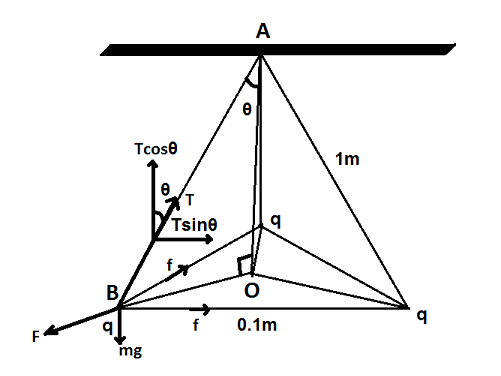
Let $ f $ be the repelling force of two other balls acting on the charge of the ball as shown in the diagram.
As it is given that the three balls form an equilateral triangle, the angle between these two forces will be $ {60^ \circ } $ . Thus, the resultant force is given by:
$ F = \sqrt {{f^2} + {f^2} + 2{f^2}\cos 60} = \sqrt {3{f^2}} = \sqrt 3 f $
Now, let us consider triangle AOB. We can write
$ \tan \theta = \dfrac{{OB}}{{OA}} $
We know that for equilateral triangles the distance of the vertex to its centroid will be $ \dfrac{1}{{\sqrt 3 }} $ times its side. Therefore, $ OB = \dfrac{{0.1}}{{\sqrt 3 }}m $ .
OA will be the length of the thread which is given as $ 1m $ .
$ \Rightarrow \tan \theta = \dfrac{{0.1}}{{\sqrt 3 }} $
We can see from the figure that tension and repelling force, both are in the same plane.
We will equate the horizontal and vertical forces acting on one of the charges for equilibrium condition as shown in the diagram.
$
\Rightarrow T\sin \theta = F \\
\Rightarrow T\sin \theta = \sqrt 3 f \\
$
and
$ \Rightarrow T\cos \theta = mg $
We are given $ m = 10g = {10^{ - 2}}kg $ and we will take $ g = 10m/{s^2} $
$ \Rightarrow T\cos \theta = {10^{ - 2}} \times 10 = {10^{ - 1}} = 0.1 $
Now we will decide both this equation.
$
\Rightarrow \dfrac{{T\sin \theta }}{{T\cos \theta }} = \dfrac{{\sqrt 3 f}}{{0.1}} \\
\Rightarrow \tan \theta = \dfrac{{\sqrt 3 f}}{{0.1}} \\
$
We have already determined that $ \tan \theta = \dfrac{{0.1}}{{\sqrt 3 }} $ .
$
\Rightarrow \dfrac{{0.1}}{{\sqrt 3 }} = \dfrac{{\sqrt 3 f}}{{0.1}} \\
\Rightarrow f = \dfrac{{{{10}^{ - 2}}}}{3} \\
$
We know that the force between two similar charges is given by
$ f = \dfrac{{k{q^2}}}{{{l^2}}} $ , where , $ k $ is the constant whose value is $ 9 \times {10^9} $ , $ q $ is the charge and $ l $ is the distance between two charges. Therefore, we can write
$
\Rightarrow {q^2} = \dfrac{{f{l^2}}}{k} \\
\Rightarrow {q^2} = \dfrac{{{{10}^{ - 2}} \times {{10}^{ - 2}}}}{{3 \times 9 \times {{10}^9}}} \\
\Rightarrow {q^2} = 0.0370 \times {10^{ - 13}} \\
\Rightarrow {q^2} = 37 \times {10^{ - 16}} \\
\Rightarrow q = 6.08 \times {10^{ - 8}}C \\
$
We are given that the common charge on each ball is $ n \times {10^{ - 8}}C $ .
Therefore $ n = 6.08 $ .
Note :
In this question, the most important step is to draw the diagram carefully. This is because we will know the directions of forces properly by doing this. The consideration of the plane in which the forces are acting is very important to determine the correct answer.
Complete Step By Step Answer:
Let us first draw the diagram for the given situation.
Let $ f $ be the repelling force of two other balls acting on the charge of the ball as shown in the diagram.
As it is given that the three balls form an equilateral triangle, the angle between these two forces will be $ {60^ \circ } $ . Thus, the resultant force is given by:
$ F = \sqrt {{f^2} + {f^2} + 2{f^2}\cos 60} = \sqrt {3{f^2}} = \sqrt 3 f $
Now, let us consider triangle AOB. We can write
$ \tan \theta = \dfrac{{OB}}{{OA}} $
We know that for equilateral triangles the distance of the vertex to its centroid will be $ \dfrac{1}{{\sqrt 3 }} $ times its side. Therefore, $ OB = \dfrac{{0.1}}{{\sqrt 3 }}m $ .
OA will be the length of the thread which is given as $ 1m $ .
$ \Rightarrow \tan \theta = \dfrac{{0.1}}{{\sqrt 3 }} $
We can see from the figure that tension and repelling force, both are in the same plane.
We will equate the horizontal and vertical forces acting on one of the charges for equilibrium condition as shown in the diagram.
$
\Rightarrow T\sin \theta = F \\
\Rightarrow T\sin \theta = \sqrt 3 f \\
$
and
$ \Rightarrow T\cos \theta = mg $
We are given $ m = 10g = {10^{ - 2}}kg $ and we will take $ g = 10m/{s^2} $
$ \Rightarrow T\cos \theta = {10^{ - 2}} \times 10 = {10^{ - 1}} = 0.1 $
Now we will decide both this equation.
$
\Rightarrow \dfrac{{T\sin \theta }}{{T\cos \theta }} = \dfrac{{\sqrt 3 f}}{{0.1}} \\
\Rightarrow \tan \theta = \dfrac{{\sqrt 3 f}}{{0.1}} \\
$
We have already determined that $ \tan \theta = \dfrac{{0.1}}{{\sqrt 3 }} $ .
$
\Rightarrow \dfrac{{0.1}}{{\sqrt 3 }} = \dfrac{{\sqrt 3 f}}{{0.1}} \\
\Rightarrow f = \dfrac{{{{10}^{ - 2}}}}{3} \\
$
We know that the force between two similar charges is given by
$ f = \dfrac{{k{q^2}}}{{{l^2}}} $ , where , $ k $ is the constant whose value is $ 9 \times {10^9} $ , $ q $ is the charge and $ l $ is the distance between two charges. Therefore, we can write
$
\Rightarrow {q^2} = \dfrac{{f{l^2}}}{k} \\
\Rightarrow {q^2} = \dfrac{{{{10}^{ - 2}} \times {{10}^{ - 2}}}}{{3 \times 9 \times {{10}^9}}} \\
\Rightarrow {q^2} = 0.0370 \times {10^{ - 13}} \\
\Rightarrow {q^2} = 37 \times {10^{ - 16}} \\
\Rightarrow q = 6.08 \times {10^{ - 8}}C \\
$
We are given that the common charge on each ball is $ n \times {10^{ - 8}}C $ .
Therefore $ n = 6.08 $ .
Note :
In this question, the most important step is to draw the diagram carefully. This is because we will know the directions of forces properly by doing this. The consideration of the plane in which the forces are acting is very important to determine the correct answer.
Recently Updated Pages
Master Class 12 Business Studies: Engaging Questions & Answers for Success

Master Class 12 Chemistry: Engaging Questions & Answers for Success
Master Class 12 Biology: Engaging Questions & Answers for Success
Class 12 Question and Answer - Your Ultimate Solutions Guide
Master Class 11 English: Engaging Questions & Answers for Success
Master Class 11 Social Science: Engaging Questions & Answers for Success
Trending doubts
Which are the Top 10 Largest Countries of the World?
Draw a labelled sketch of the human eye class 12 physics CBSE
Differentiate between homogeneous and heterogeneous class 12 chemistry CBSE
Why is the cell called the structural and functional class 12 biology CBSE
When was the first election held in India a 194748 class 12 sst CBSE
Draw ray diagrams each showing i myopic eye and ii class 12 physics CBSE