




Three identical stars, each of mass M, form an equilateral triangle (stars are positioned at the corners) that rotates around the center of the triangle. The system is isolated and the edge of the triangle is L. The amount of work done, that is required to dismantle the system is:
A.$\dfrac {G{M}^{2}} {2L}$
B.$\dfrac {3G{M}^{2}} {2L}$
C.$\dfrac {3G{M}^{2}} {4L}$
D.$\dfrac {3G{M}^{2}} {L}$
Answer
 Verified
583.5k+ views
Hint: Firstly, use the formula for gravitational potential energy of the system. Multiply the energy by 3 as there are 3 stars. Divide this obtained potential energy by 2 to get the total energy. As in circular motion, potential energy is twice the total energy in the system. Negative energy will be required to dismantle the system, hence, negate the obtained total energy. This obtained energy will be the amount of work done to dismantle the system.
Formula used:
$P.E.= -N \times \dfrac {G{m}_{1}{m}_{2}}{R}$
$P.E.=2E$
Complete answer:
Given: Number of particles (N) =3
Particles have same mass $({m}_{1} ={m}_{2}={m}_{3})= M $
Distance (R) = L
Gravitational potential energy of the system is given by,
$P.E.= -N \times \dfrac {G{m}_{1}{m}_{2}}{R}$
$\therefore P.E.=-3 \times \dfrac {G{M}^{2}} {L}$ ...(1)
In uniform circular motion, potential energy is given by,
$P.E.=2E$ ...(2)
Where, E is the total energy in the system
Rearranging equation. (2) we get,
$\Rightarrow E= \dfrac {P.E.}{2}$
Substituting equation. (1) in above equation we get,
$\Rightarrow E= -3 \times \dfrac {G{M}^{2}} {2L}$
Energy required to dismantle the system is equal to -E.
$\therefore Energy \quad required=3 \times \dfrac {G{M}^{2}} {2L}$
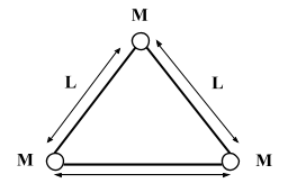
Thus,the amount of work done that is required to dismantle the system is $\dfrac {3G{M}^{2}} {2L}$.
Hence, the correct answer is option B i.e. $\dfrac {3G{M}^{2}} {2L}$.
Note:
If the system was at some height then the equation would have changed. Gravitational potential energy of the system at height his given by,
$P.E.= -N \times \dfrac {G{m}_{1}{m}_{2}}{R+h}$
In the above equation, h is the height from the surface of the earth and not from the center of the earth.
If you consider the height from the center of the earth then the equation would change to,
$P.E.= -N \times \dfrac {G{m}_{1}{m}_{2}}{R-h}$
Formula used:
$P.E.= -N \times \dfrac {G{m}_{1}{m}_{2}}{R}$
$P.E.=2E$
Complete answer:
Given: Number of particles (N) =3
Particles have same mass $({m}_{1} ={m}_{2}={m}_{3})= M $
Distance (R) = L
Gravitational potential energy of the system is given by,
$P.E.= -N \times \dfrac {G{m}_{1}{m}_{2}}{R}$
$\therefore P.E.=-3 \times \dfrac {G{M}^{2}} {L}$ ...(1)
In uniform circular motion, potential energy is given by,
$P.E.=2E$ ...(2)
Where, E is the total energy in the system
Rearranging equation. (2) we get,
$\Rightarrow E= \dfrac {P.E.}{2}$
Substituting equation. (1) in above equation we get,
$\Rightarrow E= -3 \times \dfrac {G{M}^{2}} {2L}$
Energy required to dismantle the system is equal to -E.
$\therefore Energy \quad required=3 \times \dfrac {G{M}^{2}} {2L}$
Thus,the amount of work done that is required to dismantle the system is $\dfrac {3G{M}^{2}} {2L}$.
Hence, the correct answer is option B i.e. $\dfrac {3G{M}^{2}} {2L}$.
Note:
If the system was at some height then the equation would have changed. Gravitational potential energy of the system at height his given by,
$P.E.= -N \times \dfrac {G{m}_{1}{m}_{2}}{R+h}$
In the above equation, h is the height from the surface of the earth and not from the center of the earth.
If you consider the height from the center of the earth then the equation would change to,
$P.E.= -N \times \dfrac {G{m}_{1}{m}_{2}}{R-h}$
Recently Updated Pages
Master Class 11 Computer Science: Engaging Questions & Answers for Success

Master Class 11 Business Studies: Engaging Questions & Answers for Success
Master Class 11 Economics: Engaging Questions & Answers for Success
Master Class 11 English: Engaging Questions & Answers for Success
Master Class 11 Maths: Engaging Questions & Answers for Success
Master Class 11 Biology: Engaging Questions & Answers for Success
Trending doubts
One Metric ton is equal to kg A 10000 B 1000 C 100 class 11 physics CBSE
There are 720 permutations of the digits 1 2 3 4 5 class 11 maths CBSE
Discuss the various forms of bacteria class 11 biology CBSE
Draw a diagram of a plant cell and label at least eight class 11 biology CBSE
State the laws of reflection of light
Explain zero factorial class 11 maths CBSE