




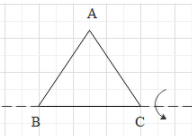
Three identical rods, each of mass m and length l, form an equilateral triangle. Moment of inertia about one of the sides is
$\begin{align}
& \text{A}\text{. }\dfrac{m{{l}^{2}}}{4} \\
& \text{B}\text{. }\dfrac{m{{l}^{2}}}{2} \\
& \text{C}\text{. }\dfrac{3m{{l}^{2}}}{4} \\
& \text{D}\text{. }\dfrac{2m{{l}^{2}}}{3} \\
\end{align}$
Answer
 Verified
608.1k+ views
Hint: To solve this question we need to use the concept of moment of inertia. Since, the rods in the triangle are of equal length, the angles in the triangle are also equal. Find the effective length of the rod about the axis of rotation. Then use the moment of inertia formula to find the moment of inertia of each of the rod and then add them to find the total moment of inertia of the system.
Complete answer:
The moment of inertia of the system can be found by finding the moment of inertia of each rod in the system.
Now, a moment of inertia of the system is needed about one of the sides made by the rod of the triangle.
The rods of which the triangle is made of are of equal length and equal mass. Since, the length of the rods are equal, the triangle formed is an equilateral triangle and the angle of the triangle formed are also equal and each of the angle is equal to ${{60}^{0}}$
Now, the total moment of inertia of the system will be equal to the moment of inertia of each roda in the triangle.
Mathematically we can express it as,
$I={{I}_{AB}}+{{I}_{BC}}+{{I}_{CA}}$
Now, the moment of inertia due to the rod BC is zero, because the axis of rotation of the triangle is in BC itself.
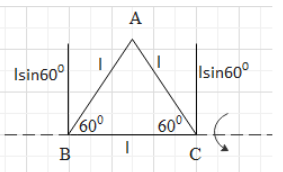
Now, the moment of inertia of the rod AB and BC can be found out as,
$\begin{align}
& {{I}_{AB}}=\dfrac{1}{3}ml_{eff}^{2}=\dfrac{1}{3}m{{\left( l\sin {{60}^{0}} \right)}^{2}} \\
& {{I}_{AB}}=\dfrac{1}{3}m{{l}^{2}}{{\left( \dfrac{\sqrt{3}}{2} \right)}^{2}} \\
& {{I}_{AB}}=\dfrac{1}{4}m{{l}^{2}} \\
\end{align}$
Similarly,
${{I}_{CA}}=\dfrac{1}{4}m{{l}^{2}}$
So, the total moment of inertia of the system will be,
$\begin{align}
& I=\dfrac{1}{4}m{{l}^{2}}+0+\dfrac{1}{4}m{{l}^{2}} \\
& I=\dfrac{1}{2}m{{l}^{2}} \\
\end{align}$
The correct option is (B).
Note:
For different objects the moment of inertia can be different. The moment of inertia of a body depends on the shape and size of the body and also depends on the position of the axis of rotation of the object.
Complete answer:
The moment of inertia of the system can be found by finding the moment of inertia of each rod in the system.
Now, a moment of inertia of the system is needed about one of the sides made by the rod of the triangle.
The rods of which the triangle is made of are of equal length and equal mass. Since, the length of the rods are equal, the triangle formed is an equilateral triangle and the angle of the triangle formed are also equal and each of the angle is equal to ${{60}^{0}}$
Now, the total moment of inertia of the system will be equal to the moment of inertia of each roda in the triangle.
Mathematically we can express it as,
$I={{I}_{AB}}+{{I}_{BC}}+{{I}_{CA}}$
Now, the moment of inertia due to the rod BC is zero, because the axis of rotation of the triangle is in BC itself.
Now, the moment of inertia of the rod AB and BC can be found out as,
$\begin{align}
& {{I}_{AB}}=\dfrac{1}{3}ml_{eff}^{2}=\dfrac{1}{3}m{{\left( l\sin {{60}^{0}} \right)}^{2}} \\
& {{I}_{AB}}=\dfrac{1}{3}m{{l}^{2}}{{\left( \dfrac{\sqrt{3}}{2} \right)}^{2}} \\
& {{I}_{AB}}=\dfrac{1}{4}m{{l}^{2}} \\
\end{align}$
Similarly,
${{I}_{CA}}=\dfrac{1}{4}m{{l}^{2}}$
So, the total moment of inertia of the system will be,
$\begin{align}
& I=\dfrac{1}{4}m{{l}^{2}}+0+\dfrac{1}{4}m{{l}^{2}} \\
& I=\dfrac{1}{2}m{{l}^{2}} \\
\end{align}$
The correct option is (B).
Note:
For different objects the moment of inertia can be different. The moment of inertia of a body depends on the shape and size of the body and also depends on the position of the axis of rotation of the object.
Recently Updated Pages
Master Class 11 Social Science: Engaging Questions & Answers for Success

Master Class 11 English: Engaging Questions & Answers for Success
Master Class 11 Maths: Engaging Questions & Answers for Success
Master Class 11 Chemistry: Engaging Questions & Answers for Success
Master Class 11 Biology: Engaging Questions & Answers for Success
Master Class 11 Physics: Engaging Questions & Answers for Success
Trending doubts
One Metric ton is equal to kg A 10000 B 1000 C 100 class 11 physics CBSE
Difference Between Prokaryotic Cells and Eukaryotic Cells
Draw a diagram of a plant cell and label at least eight class 11 biology CBSE
Two of the body parts which do not appear in MRI are class 11 biology CBSE
Which gas is abundant in air class 11 chemistry CBSE
10 examples of friction in our daily life