




Three identical bodies of mass $ M $ are located at the vertices of an equilateral triangle of side $ L $ . They revolve under the effect of mutual gravitational force in circles circumscribing the triangle. The speed of each body is ……
(A) $ \sqrt {\dfrac{{GM}}{L}} $
(B) $ \sqrt {\dfrac{{3GM}}{{2L}}} $
(C) $ \sqrt {\dfrac{{3GM}}{L}} $
(D) Zero
Answer
 Verified
586.5k+ views
Hint : Here the force balancing the gravitational force is the centripetal force. Hence by equating both the forces we can find the speed of each body. The total gravitational force is thrice of the sum of the gravitational force of two bodies on the third body.
Complete Step By Step Answer:
To understand the arrangement of the bodies, let us draw a figure as shown below
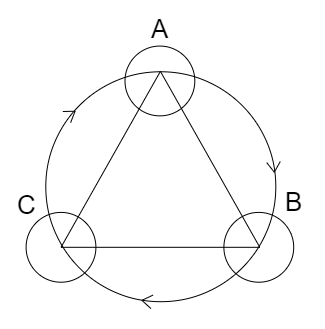
Here, the mass of all the bodies is the same and equal to $ M $ and the distance between the centers of the body which is also the side of the equilateral triangle is $ L $ .
We know that the gravitational force between two bodies can be shown as
$ F = \dfrac{{G{M_1}{M_2}}}{{{R^2}}} $ , where $ G $ is the gravitational constant, $ {M_1} $ and $ {M_2} $ are the masses of both bodies, $ R $ is the distance between the bodies.
Now, the gravitational force applied by the body B on body A is
$ \therefore {F_1} = \dfrac{{GMM}}{{{L^2}}} $
$ \therefore {F_1} = \dfrac{{G{M^2}}}{{{L^2}}} $
As the masses of the bodies and the distance between them is the same, the gravitational force exerted by the body C on body A is
$ \therefore {F_2} = {F_1} = \dfrac{{G{M^2}}}{{{L^2}}} $
Now, the gravitational force is along the length of the triangle.
Hence, the angle between the gravitational forces exerting on body A is $ 60^\circ $ .
Now, the total force acting on body A due to the gravitational force of body B and body C is
$ {F_{net}} = \sqrt {{F_1}^2 + {F_2}^2 + 2{F_1}{F_2}\cos 60^\circ } $
Substituting the values of the forces
$ \therefore {F_{net}} = \sqrt {{{\left( {\dfrac{{G{M^2}}}{{{L^2}}}} \right)}^2} + {{\left( {\dfrac{{G{M^2}}}{{{L^2}}}} \right)}^2} + 2\left( {\dfrac{{G{M^2}}}{{{L^2}}}} \right)\left( {\dfrac{{G{M^2}}}{{{L^2}}}} \right)\cos 60^\circ } $
$ \therefore {F_{net}} = \sqrt {{{\left( {\dfrac{{G{M^2}}}{{{L^2}}}} \right)}^2} + {{\left( {\dfrac{{G{M^2}}}{{{L^2}}}} \right)}^2} + 2{{\left( {\dfrac{{G{M^2}}}{{{L^2}}}} \right)}^2} \times \dfrac{1}{2}} $
On further simplification,
$ \therefore {F_{net}} = \sqrt {{{\left( {\dfrac{{G{M^2}}}{{{L^2}}}} \right)}^2} + {{\left( {\dfrac{{G{M^2}}}{{{L^2}}}} \right)}^2} + {{\left( {\dfrac{{G{M^2}}}{{{L^2}}}} \right)}^2}} $
$ \therefore {F_{net}} = \sqrt {3{{\left( {\dfrac{{G{M^2}}}{{{L^2}}}} \right)}^2}} $
Applying the root,
$ \therefore {F_{net}} = \sqrt 3 \left( {\dfrac{{G{M^2}}}{{{L^2}}}} \right) $
This is the total force acting on the body A
Now, as the bodies are the same, the force acting on each body is also the same.
Here, we are given that the bodies start to revolve due to the gravitational force.
Due to the gravitational force, the bodies tend to attract each other and come closer.
But their distance is maintained by the centripetal force generated due to revolution which tends to throw the bodies away from each other.
Hence, both the forces balance each other.
Hence, we can compare both forces as
$ {F_c} = {F_{net}} $
$ \therefore \dfrac{{m{v^2}}}{r} = \sqrt 3 \left( {\dfrac{{G{M^2}}}{{{L^2}}}} \right) $
Here, $ m $ = mass of each body
$ v $ = speed of each body
$ r $ = distance of the body from the center of rotation
In this case, $ r $ is the distance from the center of the equilateral triangle to the vertices of the triangle.
We know that the distance between the center of the equilateral triangle and vertices is $ \dfrac{L}{{\sqrt 3 }} $ .
Substituting the values,
$ \therefore \dfrac{{M{v^2}}}{{\dfrac{L}{{\sqrt 3 }}}} = \sqrt 3 \left( {\dfrac{{G{M^2}}}{{{L^2}}}} \right) $
We know that denominator’s denominator is a numerator
$ \therefore \dfrac{{\sqrt 3 M{v^2}}}{L} = \sqrt 3 \left( {\dfrac{{G{M^2}}}{{{L^2}}}} \right) $
Canceling the common terms on both sides
$ \therefore {v^2} = \dfrac{{GM}}{L} $
$ \therefore v = \sqrt {\dfrac{{GM}}{L}} $
Hence, the correct answer is option $ (A) $ .
Note :
Gravitational force is a vector quantity, hence it depends upon the direction of the force. Hence while considering the net force acting on the body by two other bodies, we must include the angle between the line of action of the force.
Complete Step By Step Answer:
To understand the arrangement of the bodies, let us draw a figure as shown below
Here, the mass of all the bodies is the same and equal to $ M $ and the distance between the centers of the body which is also the side of the equilateral triangle is $ L $ .
We know that the gravitational force between two bodies can be shown as
$ F = \dfrac{{G{M_1}{M_2}}}{{{R^2}}} $ , where $ G $ is the gravitational constant, $ {M_1} $ and $ {M_2} $ are the masses of both bodies, $ R $ is the distance between the bodies.
Now, the gravitational force applied by the body B on body A is
$ \therefore {F_1} = \dfrac{{GMM}}{{{L^2}}} $
$ \therefore {F_1} = \dfrac{{G{M^2}}}{{{L^2}}} $
As the masses of the bodies and the distance between them is the same, the gravitational force exerted by the body C on body A is
$ \therefore {F_2} = {F_1} = \dfrac{{G{M^2}}}{{{L^2}}} $
Now, the gravitational force is along the length of the triangle.
Hence, the angle between the gravitational forces exerting on body A is $ 60^\circ $ .
Now, the total force acting on body A due to the gravitational force of body B and body C is
$ {F_{net}} = \sqrt {{F_1}^2 + {F_2}^2 + 2{F_1}{F_2}\cos 60^\circ } $
Substituting the values of the forces
$ \therefore {F_{net}} = \sqrt {{{\left( {\dfrac{{G{M^2}}}{{{L^2}}}} \right)}^2} + {{\left( {\dfrac{{G{M^2}}}{{{L^2}}}} \right)}^2} + 2\left( {\dfrac{{G{M^2}}}{{{L^2}}}} \right)\left( {\dfrac{{G{M^2}}}{{{L^2}}}} \right)\cos 60^\circ } $
$ \therefore {F_{net}} = \sqrt {{{\left( {\dfrac{{G{M^2}}}{{{L^2}}}} \right)}^2} + {{\left( {\dfrac{{G{M^2}}}{{{L^2}}}} \right)}^2} + 2{{\left( {\dfrac{{G{M^2}}}{{{L^2}}}} \right)}^2} \times \dfrac{1}{2}} $
On further simplification,
$ \therefore {F_{net}} = \sqrt {{{\left( {\dfrac{{G{M^2}}}{{{L^2}}}} \right)}^2} + {{\left( {\dfrac{{G{M^2}}}{{{L^2}}}} \right)}^2} + {{\left( {\dfrac{{G{M^2}}}{{{L^2}}}} \right)}^2}} $
$ \therefore {F_{net}} = \sqrt {3{{\left( {\dfrac{{G{M^2}}}{{{L^2}}}} \right)}^2}} $
Applying the root,
$ \therefore {F_{net}} = \sqrt 3 \left( {\dfrac{{G{M^2}}}{{{L^2}}}} \right) $
This is the total force acting on the body A
Now, as the bodies are the same, the force acting on each body is also the same.
Here, we are given that the bodies start to revolve due to the gravitational force.
Due to the gravitational force, the bodies tend to attract each other and come closer.
But their distance is maintained by the centripetal force generated due to revolution which tends to throw the bodies away from each other.
Hence, both the forces balance each other.
Hence, we can compare both forces as
$ {F_c} = {F_{net}} $
$ \therefore \dfrac{{m{v^2}}}{r} = \sqrt 3 \left( {\dfrac{{G{M^2}}}{{{L^2}}}} \right) $
Here, $ m $ = mass of each body
$ v $ = speed of each body
$ r $ = distance of the body from the center of rotation
In this case, $ r $ is the distance from the center of the equilateral triangle to the vertices of the triangle.
We know that the distance between the center of the equilateral triangle and vertices is $ \dfrac{L}{{\sqrt 3 }} $ .
Substituting the values,
$ \therefore \dfrac{{M{v^2}}}{{\dfrac{L}{{\sqrt 3 }}}} = \sqrt 3 \left( {\dfrac{{G{M^2}}}{{{L^2}}}} \right) $
We know that denominator’s denominator is a numerator
$ \therefore \dfrac{{\sqrt 3 M{v^2}}}{L} = \sqrt 3 \left( {\dfrac{{G{M^2}}}{{{L^2}}}} \right) $
Canceling the common terms on both sides
$ \therefore {v^2} = \dfrac{{GM}}{L} $
$ \therefore v = \sqrt {\dfrac{{GM}}{L}} $
Hence, the correct answer is option $ (A) $ .
Note :
Gravitational force is a vector quantity, hence it depends upon the direction of the force. Hence while considering the net force acting on the body by two other bodies, we must include the angle between the line of action of the force.
Recently Updated Pages
Basicity of sulphurous acid and sulphuric acid are

Master Class 11 English: Engaging Questions & Answers for Success
Master Class 11 Physics: Engaging Questions & Answers for Success
Master Class 11 Computer Science: Engaging Questions & Answers for Success
Master Class 11 Chemistry: Engaging Questions & Answers for Success
Master Class 11 Social Science: Engaging Questions & Answers for Success
Trending doubts
Difference Between Prokaryotic Cells and Eukaryotic Cells
Two of the body parts which do not appear in MRI are class 11 biology CBSE
One Metric ton is equal to kg A 10000 B 1000 C 100 class 11 physics CBSE
10 examples of friction in our daily life
Draw a diagram of nephron and explain its structur class 11 biology CBSE
What will happen if the mucus is not secreted by the class 11 biology CBSE