




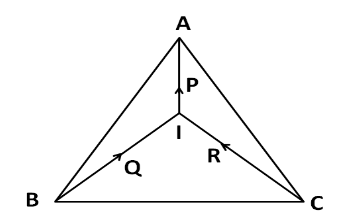
Three forces $ \vec P $ , $ \vec Q $ and $ \vec R $ acting along $ IA $ , $ IB $ and $ IC $ , where $ I $ is the incentre of a $ \Delta ABC $ , are in equilibrium. Then $ \vec P:\vec Q:\vec R $ is:
(A) $ \cos \dfrac{A}{2}:\cos \dfrac{B}{2}:\cos \dfrac{C}{2} $
(B) $ \sin \dfrac{A}{2}:\sin \dfrac{B}{2}:\sin \dfrac{C}{2} $
(C) $ \sec \dfrac{A}{2}:\sec \dfrac{B}{2}:\sec \dfrac{C}{2} $
(D) $ cosec\dfrac{A}{2}:cosec\dfrac{B}{2}:cosec\dfrac{C}{2} $
Answer
 Verified
568.8k+ views
Hint : To solve this question, we need to analyse the properties of incentre. Then we have to apply these properties to get the relation between the lengths and the angles of the triangle given.
Complete step by step answer
We know that the incircle of a triangle is the centre of the circle, known as the incircle which is inscribed in that triangle. Let the radius of the incircle be $ k $ .
So, the incentre is shown in the figure below
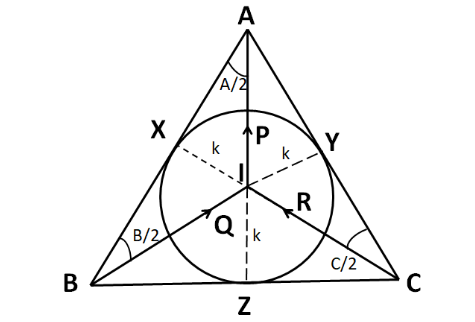
We know that the incentre is the intersection of the angular bisectors of a triangle.
Since all the sides of the triangle are the tangents to the incircle, so the dotted lines shown above are perpendicular to the respective sides.
In triangle BIX, we have
$\Rightarrow \sin \left( {\dfrac{B}{2}} \right) = \dfrac{{IX}}{{IB}} $
$\Rightarrow \sin \left( {\dfrac{B}{2}} \right) = \dfrac{k}{Q} $
So the magnitude of the vector $ \vec Q $ is
$\Rightarrow Q = \dfrac{k}{{\sin \left( {\dfrac{B}{2}} \right)}} $
$\Rightarrow Q = kcosec\dfrac{B}{2} $ ……………………….(1)
Now, in triangle CIY we have
$\Rightarrow \sin \left( {\dfrac{C}{2}} \right) = \dfrac{{IY}}{{IC}} $
$\Rightarrow \sin \left( {\dfrac{C}{2}} \right) = \dfrac{k}{R} $
So the magnitude of the vector $ \vec R $ is
$\Rightarrow R = \dfrac{k}{{\sin \left( {\dfrac{C}{2}} \right)}} $
$\Rightarrow R = kcosec\dfrac{C}{2} $ ……………………….(2)
Now, in triangle AIX
$\Rightarrow \sin \left( {\dfrac{A}{2}} \right) = \dfrac{{IX}}{{IA}} $
$\Rightarrow \sin \left( {\dfrac{A}{2}} \right) = \dfrac{k}{P} $
So the magnitude of the vector $ \vec P $ is
$\Rightarrow P = \dfrac{k}{{\sin \left( {\dfrac{A}{2}} \right)}} $
$\Rightarrow P = kcosec\dfrac{A}{2} $ ……………………….(3)
Now from (1) (2) and (3) we have
$\Rightarrow P:Q:R = kcosec\dfrac{A}{2}:kcosec\dfrac{B}{2}:kcosec\dfrac{C}{2} $
Cancelling out $ k $ we get
$\Rightarrow P:Q:R = cosec\dfrac{A}{2}:cosec\dfrac{B}{2}:cosec\dfrac{C}{2} $
Hence, the correct answer is option D.
Note
These types of questions are very much easy, but only if we follow the right approach. And avoiding ourselves from following the wrong approach is even more necessary. For example, if we would have tried to resolve the forces into perpendicular components, then the question would have turned into a disaster. This is because applying the properties of the incentre, and simultaneously working with the components make the question very much complicated. So, it is always recommended to think from the point of view of the information given in the question.
Complete step by step answer
We know that the incircle of a triangle is the centre of the circle, known as the incircle which is inscribed in that triangle. Let the radius of the incircle be $ k $ .
So, the incentre is shown in the figure below
We know that the incentre is the intersection of the angular bisectors of a triangle.
Since all the sides of the triangle are the tangents to the incircle, so the dotted lines shown above are perpendicular to the respective sides.
In triangle BIX, we have
$\Rightarrow \sin \left( {\dfrac{B}{2}} \right) = \dfrac{{IX}}{{IB}} $
$\Rightarrow \sin \left( {\dfrac{B}{2}} \right) = \dfrac{k}{Q} $
So the magnitude of the vector $ \vec Q $ is
$\Rightarrow Q = \dfrac{k}{{\sin \left( {\dfrac{B}{2}} \right)}} $
$\Rightarrow Q = kcosec\dfrac{B}{2} $ ……………………….(1)
Now, in triangle CIY we have
$\Rightarrow \sin \left( {\dfrac{C}{2}} \right) = \dfrac{{IY}}{{IC}} $
$\Rightarrow \sin \left( {\dfrac{C}{2}} \right) = \dfrac{k}{R} $
So the magnitude of the vector $ \vec R $ is
$\Rightarrow R = \dfrac{k}{{\sin \left( {\dfrac{C}{2}} \right)}} $
$\Rightarrow R = kcosec\dfrac{C}{2} $ ……………………….(2)
Now, in triangle AIX
$\Rightarrow \sin \left( {\dfrac{A}{2}} \right) = \dfrac{{IX}}{{IA}} $
$\Rightarrow \sin \left( {\dfrac{A}{2}} \right) = \dfrac{k}{P} $
So the magnitude of the vector $ \vec P $ is
$\Rightarrow P = \dfrac{k}{{\sin \left( {\dfrac{A}{2}} \right)}} $
$\Rightarrow P = kcosec\dfrac{A}{2} $ ……………………….(3)
Now from (1) (2) and (3) we have
$\Rightarrow P:Q:R = kcosec\dfrac{A}{2}:kcosec\dfrac{B}{2}:kcosec\dfrac{C}{2} $
Cancelling out $ k $ we get
$\Rightarrow P:Q:R = cosec\dfrac{A}{2}:cosec\dfrac{B}{2}:cosec\dfrac{C}{2} $
Hence, the correct answer is option D.
Note
These types of questions are very much easy, but only if we follow the right approach. And avoiding ourselves from following the wrong approach is even more necessary. For example, if we would have tried to resolve the forces into perpendicular components, then the question would have turned into a disaster. This is because applying the properties of the incentre, and simultaneously working with the components make the question very much complicated. So, it is always recommended to think from the point of view of the information given in the question.
Recently Updated Pages
Master Class 11 Computer Science: Engaging Questions & Answers for Success

Master Class 11 Business Studies: Engaging Questions & Answers for Success
Master Class 11 Economics: Engaging Questions & Answers for Success
Master Class 11 English: Engaging Questions & Answers for Success
Master Class 11 Maths: Engaging Questions & Answers for Success
Master Class 11 Biology: Engaging Questions & Answers for Success
Trending doubts
One Metric ton is equal to kg A 10000 B 1000 C 100 class 11 physics CBSE
There are 720 permutations of the digits 1 2 3 4 5 class 11 maths CBSE
Discuss the various forms of bacteria class 11 biology CBSE
Draw a diagram of a plant cell and label at least eight class 11 biology CBSE
State the laws of reflection of light
Explain zero factorial class 11 maths CBSE