




Three forces of 3N, 2N and 1N act on a particle as shown in the figure.
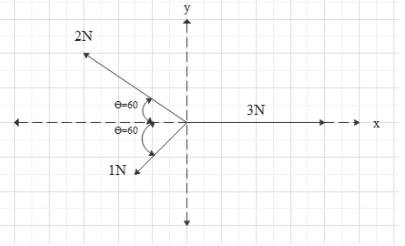
Obtain the net force along the x axis
A. ${F_x} = 2N$
B. ${F_x} = \dfrac{1}{2}N$
C. ${F_x} = \dfrac{3}{2}N$
D. ${F_x} = \dfrac{5}{2}N$
Answer
 Verified
585.6k+ views
Hint: These kind of questions to be solved by resolution of vectors. Every vector can be resolved into two components along the perpendicular axes. Here perpendicular axes are the x axis and the y axis. We have the angle made by the vector with x axis hence we can resolve the vector components along the x axis and finally add them to get net force along x axis.
Complete answer:
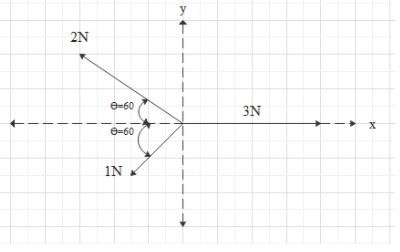
In the given question
2N vector is making ${60^0}$ with the x axis and 1N vector is making same ${60^0}$ with the x axis and 3N vector is along the x axis
Now component of 2N vector along x axis is $2\cos ({60^0})$ in negative x axis direction
Let it be A = $ - 2\cos ({60^0}) = - 2 \times \dfrac{1}{2} = - 1N$
Now component of 1N vector along x axis is $1\cos ({60^0})$ in negative x axis direction
Let it be B = $ - 1\cos ({60^0}) = - 1 \times \dfrac{1}{2} = \dfrac{{ - 1}}{2}N$
Now component of 3N vector along x axis is $3\cos ({0^0})$ in positive x axis direction
Let it be C = $3\cos ({0^0}) = 3 \times 1 = 3N$
Now adding all the components along x axis we get
$A + B + C = - 1 + \dfrac{{ - 1}}{2} + 3 = \dfrac{3}{2}$
Hence the answer would be option C.
Additional information:
We can resolve a vector along any two perpendicular axes. But standard reference axes we take are x and y axes in two dimensions and x,y,z axes in three dimensions.
Note:
Generally the angle we take with reference to the x-axis must be taken in an anticlockwise direction to get the correct answer. Here in case of 2N and 1N vectors we took in the clockwise direction and we compensated it later by multiplying that x component with negative sign. If angle is already taken anticlockwise then no need to multiply with a negative sign.
Complete answer:
In the given question
2N vector is making ${60^0}$ with the x axis and 1N vector is making same ${60^0}$ with the x axis and 3N vector is along the x axis
Now component of 2N vector along x axis is $2\cos ({60^0})$ in negative x axis direction
Let it be A = $ - 2\cos ({60^0}) = - 2 \times \dfrac{1}{2} = - 1N$
Now component of 1N vector along x axis is $1\cos ({60^0})$ in negative x axis direction
Let it be B = $ - 1\cos ({60^0}) = - 1 \times \dfrac{1}{2} = \dfrac{{ - 1}}{2}N$
Now component of 3N vector along x axis is $3\cos ({0^0})$ in positive x axis direction
Let it be C = $3\cos ({0^0}) = 3 \times 1 = 3N$
Now adding all the components along x axis we get
$A + B + C = - 1 + \dfrac{{ - 1}}{2} + 3 = \dfrac{3}{2}$
Hence the answer would be option C.
Additional information:
We can resolve a vector along any two perpendicular axes. But standard reference axes we take are x and y axes in two dimensions and x,y,z axes in three dimensions.
Note:
Generally the angle we take with reference to the x-axis must be taken in an anticlockwise direction to get the correct answer. Here in case of 2N and 1N vectors we took in the clockwise direction and we compensated it later by multiplying that x component with negative sign. If angle is already taken anticlockwise then no need to multiply with a negative sign.
Recently Updated Pages
Master Class 11 Computer Science: Engaging Questions & Answers for Success

Master Class 11 Business Studies: Engaging Questions & Answers for Success
Master Class 11 Economics: Engaging Questions & Answers for Success
Master Class 11 English: Engaging Questions & Answers for Success
Master Class 11 Maths: Engaging Questions & Answers for Success
Master Class 11 Biology: Engaging Questions & Answers for Success
Trending doubts
One Metric ton is equal to kg A 10000 B 1000 C 100 class 11 physics CBSE
There are 720 permutations of the digits 1 2 3 4 5 class 11 maths CBSE
Discuss the various forms of bacteria class 11 biology CBSE
Draw a diagram of a plant cell and label at least eight class 11 biology CBSE
State the laws of reflection of light
10 examples of friction in our daily life