




Three forces are acting on a particle of mass, initially in equilibrium. If the first two forces (${R_1}$ and ${R_2}$) perpendicular to each other and suddenly the third force (${R_3}$) is removed, then the acceleration of the particle is:
$ {\text{A}}{\text{. }}\dfrac{{{R_3}}}{m} \\
{\text{B}}{\text{. }}\dfrac{{{R_1} + {R_2}}}{m} \\
{\text{C}}{\text{. }}\dfrac{{{R_1} - {R_2}}}{m} \\
{\text{D}}{\text{. }}\dfrac{{{R_1}}}{m} \\ $
Answer
 Verified
615.6k+ views
Hint: First we should draw a diagram showing the three forces with the first two forces perpendicular to each other. The three forces cancel each other which means that the resultant of any two forces is equal and opposite to the third force and removing one force results in the resultant of the other two forces acting on the particle.
Complete step-by-step answer:
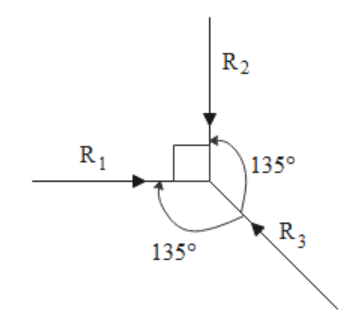
If we diagrammatically visualize the given forces and we get the above diagram. We have three forces ${R_1},{\text{ }}{R_2}$ and ${R_3}$ which act on a particle of mass m in such a way that all the forces cancel each other and the particle stays in equilibrium. The two forces ${R_1}$ and ${R_2}$ are acting on the particle at right angles to each other.
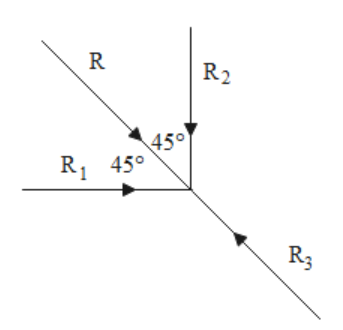
The particle is in equilibrium which means that the three forces cancel each other or more precisely, we can say that the resultant of any two forces cancels the third force. Therefore, we can say that the resultant of forces ${R_1}$ and ${R_2}$ cancels the force ${R_3}$. This implies that the resultant we are talking about is equal in magnitude and in the opposite direction to the force ${R_3}$. This situation can be seen in the following diagram where we have taken the resultant of forces ${R_1}$ and ${R_2}$ to be R and this force is acting in direction opposite to that of the force ${R_3}$.
Now if we remove the third force ${R_3}$, the system will lose its equilibrium and only the resultant of forces ${R_1}$ and ${R_2}$ will act on the particle which is R and the magnitude of R is equal to the magnitude of ${R_3}$. Therefore, the acceleration of the particle is given as $\dfrac{{{R_3}}}{m}$. Hence, the correct answer is option A.
Note: The state of equilibrium does not mean that there is nothing happening in the system. It just means that there are forces acting on the system but they all cancel each other leading to zero net motion in the system.
Complete step-by-step answer:
If we diagrammatically visualize the given forces and we get the above diagram. We have three forces ${R_1},{\text{ }}{R_2}$ and ${R_3}$ which act on a particle of mass m in such a way that all the forces cancel each other and the particle stays in equilibrium. The two forces ${R_1}$ and ${R_2}$ are acting on the particle at right angles to each other.
The particle is in equilibrium which means that the three forces cancel each other or more precisely, we can say that the resultant of any two forces cancels the third force. Therefore, we can say that the resultant of forces ${R_1}$ and ${R_2}$ cancels the force ${R_3}$. This implies that the resultant we are talking about is equal in magnitude and in the opposite direction to the force ${R_3}$. This situation can be seen in the following diagram where we have taken the resultant of forces ${R_1}$ and ${R_2}$ to be R and this force is acting in direction opposite to that of the force ${R_3}$.
Now if we remove the third force ${R_3}$, the system will lose its equilibrium and only the resultant of forces ${R_1}$ and ${R_2}$ will act on the particle which is R and the magnitude of R is equal to the magnitude of ${R_3}$. Therefore, the acceleration of the particle is given as $\dfrac{{{R_3}}}{m}$. Hence, the correct answer is option A.
Note: The state of equilibrium does not mean that there is nothing happening in the system. It just means that there are forces acting on the system but they all cancel each other leading to zero net motion in the system.
Recently Updated Pages
Three beakers labelled as A B and C each containing 25 mL of water were taken A small amount of NaOH anhydrous CuSO4 and NaCl were added to the beakers A B and C respectively It was observed that there was an increase in the temperature of the solutions contained in beakers A and B whereas in case of beaker C the temperature of the solution falls Which one of the following statements isarecorrect i In beakers A and B exothermic process has occurred ii In beakers A and B endothermic process has occurred iii In beaker C exothermic process has occurred iv In beaker C endothermic process has occurred

Master Class 11 Social Science: Engaging Questions & Answers for Success
Master Class 11 Physics: Engaging Questions & Answers for Success
Master Class 11 Maths: Engaging Questions & Answers for Success
Master Class 11 Economics: Engaging Questions & Answers for Success
Master Class 11 Computer Science: Engaging Questions & Answers for Success
Three beakers labelled as A B and C each containing 25 mL of water were taken A small amount of NaOH anhydrous CuSO4 and NaCl were added to the beakers A B and C respectively It was observed that there was an increase in the temperature of the solutions contained in beakers A and B whereas in case of beaker C the temperature of the solution falls Which one of the following statements isarecorrect i In beakers A and B exothermic process has occurred ii In beakers A and B endothermic process has occurred iii In beaker C exothermic process has occurred iv In beaker C endothermic process has occurred
Master Class 11 Social Science: Engaging Questions & Answers for Success
Master Class 11 Physics: Engaging Questions & Answers for Success
Trending doubts
One Metric ton is equal to kg A 10000 B 1000 C 100 class 11 physics CBSE
There are 720 permutations of the digits 1 2 3 4 5 class 11 maths CBSE
State and prove Bernoullis theorem class 11 physics CBSE
Draw a diagram of a plant cell and label at least eight class 11 biology CBSE
Difference Between Prokaryotic Cells and Eukaryotic Cells
1 Quintal is equal to a 110 kg b 10 kg c 100kg d 1000 class 11 physics CBSE