




Three forces A, B, C act at a point are in equilibrium. The ratio of the angle between A and B; B and C; and A and C is 1:2:3. Then, A:B:C is
A. \[1:\dfrac{{\sqrt 3 }}{2}:\dfrac{1}{2}\]
B. \[\dfrac{1}{2}:\dfrac{{\sqrt 3 }}{2}:1\]
C. \[1:\dfrac{1}{2}:\dfrac{1}{3}\]
D. \[1:\dfrac{1}{{\sqrt 2 }}:\dfrac{1}{{\sqrt 3 }}\]
E. None of these.
Answer
 Verified
595.5k+ views
Hint: To calculate the value of A:B:C we have to figure out the angles between each force. Then after we will apply Lamis's theorem for mechanical equilibrium to get the required ratio.
Complete step-by-step answer:
Let α,β and γ are the angles between the forces A, B and C
as seen in the figure.
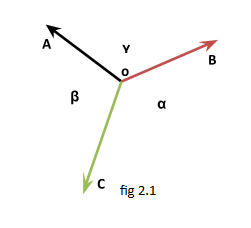
According to question, \[\gamma {\text{ }}:{\text{ }}\alpha {\text{ }}:{\text{ }}\beta \; = {\text{ }}1{\text{ }}:{\text{ }}2{\text{ }}:{\text{ }}3\]
Calculating the values for\[\alpha ,{\text{ }}\beta {\text{ }}and{\text{ }}\gamma \].
Let the required multiple of angles be\[x\].
So, \[\gamma = x,{\text{ }}\alpha = 2x\;and\;\beta = 3x\]
Since all these angles are making a complete angle at point O.
Therefore,
\[\alpha + \beta {\text{ }} + \gamma = {360^0}\]
\[\begin{gathered}
\Rightarrow x + 2x + 3x = {360^0} \\
\Rightarrow 6x = {360^0} \\
\Rightarrow x = {60^0} \\
\end{gathered} \]
We get, \[\gamma = {60^0},\alpha = {120^0}{\text{ and }}\beta = {180^0}\]
Under equilibrium condition:-
\[ \Rightarrow \dfrac{{\text{A}}}{{{\text{sin12}}{0^0}}}{\text{ = }}\dfrac{{\text{B}}}{{{\text{sin18}}{0^0}}}{\text{ = }}\dfrac{{\text{C}}}{{{\text{sin}}{{60}^0}}}\]
Hence, Option (E) is the correct answer.
Note:In order to tackle such types of questions we should have to practice more questions based on the concept of the mechanical equilibrium state of a system. Since in mechanical equilibrium, the value of net torque and the net applied force is zero but we use Lami's theorem only for a mechanical system possessing state of equilibrium with zero value of net applied force.
Complete step-by-step answer:
Let α,β and γ are the angles between the forces A, B and C
as seen in the figure.
According to question, \[\gamma {\text{ }}:{\text{ }}\alpha {\text{ }}:{\text{ }}\beta \; = {\text{ }}1{\text{ }}:{\text{ }}2{\text{ }}:{\text{ }}3\]
Calculating the values for\[\alpha ,{\text{ }}\beta {\text{ }}and{\text{ }}\gamma \].
Let the required multiple of angles be\[x\].
So, \[\gamma = x,{\text{ }}\alpha = 2x\;and\;\beta = 3x\]
Since all these angles are making a complete angle at point O.
Therefore,
\[\alpha + \beta {\text{ }} + \gamma = {360^0}\]
\[\begin{gathered}
\Rightarrow x + 2x + 3x = {360^0} \\
\Rightarrow 6x = {360^0} \\
\Rightarrow x = {60^0} \\
\end{gathered} \]
We get, \[\gamma = {60^0},\alpha = {120^0}{\text{ and }}\beta = {180^0}\]
Under equilibrium condition:-
\[ \Rightarrow \dfrac{{\text{A}}}{{{\text{sin12}}{0^0}}}{\text{ = }}\dfrac{{\text{B}}}{{{\text{sin18}}{0^0}}}{\text{ = }}\dfrac{{\text{C}}}{{{\text{sin}}{{60}^0}}}\]
Hence, Option (E) is the correct answer.
Note:In order to tackle such types of questions we should have to practice more questions based on the concept of the mechanical equilibrium state of a system. Since in mechanical equilibrium, the value of net torque and the net applied force is zero but we use Lami's theorem only for a mechanical system possessing state of equilibrium with zero value of net applied force.
Recently Updated Pages
Master Class 11 Business Studies: Engaging Questions & Answers for Success

Master Class 11 Economics: Engaging Questions & Answers for Success
Master Class 11 Computer Science: Engaging Questions & Answers for Success
Master Class 11 English: Engaging Questions & Answers for Success
Master Class 11 Maths: Engaging Questions & Answers for Success
Master Class 11 Biology: Engaging Questions & Answers for Success
Trending doubts
One Metric ton is equal to kg A 10000 B 1000 C 100 class 11 physics CBSE
Discuss the various forms of bacteria class 11 biology CBSE
Draw a diagram of a plant cell and label at least eight class 11 biology CBSE
State the laws of reflection of light
Explain zero factorial class 11 maths CBSE
10 examples of friction in our daily life