




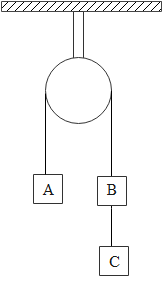
Three equal weights A, B and C of mass 2kg each are hanging on a string passing over a fixed frictionless pulley as shown in the figure. The tension in the string connecting weights B and C is:
A. Zero
B. 13N
C. 3.3N
D. 19.6N
Answer
 Verified
657.9k+ views
Hint: First we need to draw a free body diagram for the given pulley system which shows the various forces acting on the masses hanging on the pulley. Then we need to write various equations of motion for the various blocks using the free body diagram.
Detailed step by step solution:
The free body diagram showing all forces acting on the pulley is as given below:
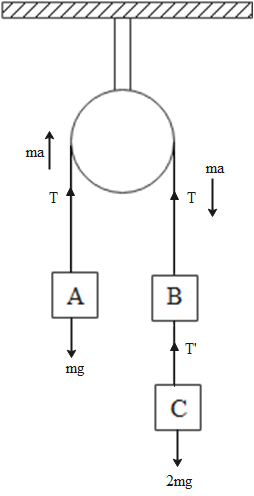
In the diagram, T represents the tension in the string between block A and block B. Between block B and C, the tension is given as T’. The weights of the blocks act in down wards directions as shown.
All blocks weigh the same given as m = 2 kg. The weight is more on the B and C side therefore the block will move upwards and the other two blocks will move downwards. Consider block A first. Depending on the direction of various forces, its equation of motion of terms of various force can be written as
$
T + ma = mg \\
\Rightarrow T = mg - ma \\
T = 2g - 2a{\text{ }}...{\text{(i)}} \\
$
For system of block B and C together, we have following equation
$
2mg + 2ma = T \\
\Rightarrow 4g + 4a = T{\text{ }}...{\text{(ii)}} \\
$
Solving equation (i) and (ii) simultaneously, we get
$a = - \dfrac{g}{3}{\text{ }}...{\text{(iii)}}$
Now for the single block C, we can write the equation of motion as follows:
$
T' = mg + ma \\
= 2g + 2a \\
$
Using equation (iii) here, we get
$T' = 2g - \dfrac{{2g}}{3} = \dfrac{4}{3}g$
Taking $g = 10m/{s^2}$, we get tension in the string between B and C to be
$T' = \dfrac{4}{3} \times 10 = 13.33N \simeq 13N$
Hence, the correct answer is option B.
Note: We are given a single fixed pulley which is fixed to the ceiling and the wheel can rotate about the axle. The force applied is in the direction opposite to the direction of motion of the load. Thus pulley helps in reversing the direction of applied force.
Detailed step by step solution:
The free body diagram showing all forces acting on the pulley is as given below:
In the diagram, T represents the tension in the string between block A and block B. Between block B and C, the tension is given as T’. The weights of the blocks act in down wards directions as shown.
All blocks weigh the same given as m = 2 kg. The weight is more on the B and C side therefore the block will move upwards and the other two blocks will move downwards. Consider block A first. Depending on the direction of various forces, its equation of motion of terms of various force can be written as
$
T + ma = mg \\
\Rightarrow T = mg - ma \\
T = 2g - 2a{\text{ }}...{\text{(i)}} \\
$
For system of block B and C together, we have following equation
$
2mg + 2ma = T \\
\Rightarrow 4g + 4a = T{\text{ }}...{\text{(ii)}} \\
$
Solving equation (i) and (ii) simultaneously, we get
$a = - \dfrac{g}{3}{\text{ }}...{\text{(iii)}}$
Now for the single block C, we can write the equation of motion as follows:
$
T' = mg + ma \\
= 2g + 2a \\
$
Using equation (iii) here, we get
$T' = 2g - \dfrac{{2g}}{3} = \dfrac{4}{3}g$
Taking $g = 10m/{s^2}$, we get tension in the string between B and C to be
$T' = \dfrac{4}{3} \times 10 = 13.33N \simeq 13N$
Hence, the correct answer is option B.
Note: We are given a single fixed pulley which is fixed to the ceiling and the wheel can rotate about the axle. The force applied is in the direction opposite to the direction of motion of the load. Thus pulley helps in reversing the direction of applied force.
Recently Updated Pages
Master Class 11 Social Science: Engaging Questions & Answers for Success

Master Class 11 English: Engaging Questions & Answers for Success
Master Class 11 Accountancy: Engaging Questions & Answers for Success
Master Class 11 Physics: Engaging Questions & Answers for Success
Master Class 11 Computer Science: Engaging Questions & Answers for Success
Master Class 11 Business Studies: Engaging Questions & Answers for Success
Trending doubts
Find the value of the expression given below sin 30circ class 11 maths CBSE
One Metric ton is equal to kg A 10000 B 1000 C 100 class 11 physics CBSE
Draw a diagram of nephron and explain its structur class 11 biology CBSE
10 examples of friction in our daily life
Proton was discovered by A Thomson B Rutherford C Chadwick class 11 chemistry CBSE
The teeth used for biting and cutting food are called class 11 biology CBSE