



Three equal cubes are placed adjacently in a row. Find the ratio of the total surface area of the resulting cuboid to that of the sum of the total surface areas of the three cubes.
$
{\text{A}}{\text{. 7:13}} \\
{\text{B}}{\text{. 7:3}} \\
{\text{C}}{\text{. 7:9}} \\
{\text{D}}{\text{. 7:5}} \\
$
Answer
 Verified
611.1k+ views
Hint: Use the fact only the length of the new cube will be twice the length of the old cubes , rest that is breadth and height will remain the same. Now use respective formulas to get the ratio.
The surface area of a cube with side a is $6{a^2}$.
The total surface area of a cuboid with length, breadth, and height as l, b, h is:
2( l*b + b*h + h*l) .
Try to find the edges of the cuboid in terms of the edge of cube
Edge of cube = a
Complete step-by-step answer:
Total surface area of 1 cube = $6{a^2}$
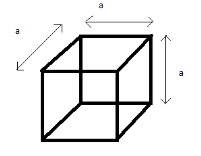
Total Surface area of 3 cubes = 3*$6{a^2}$= $18{a^2}$
So, ${S_{cube}} = 18{a^2}$
Now , on joining the 3 cubes adjacently in a row:
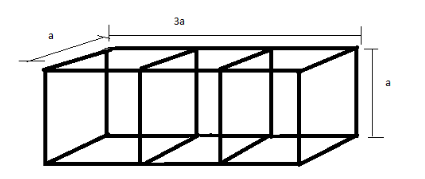
The dimensions of the cuboid become:
l = 3a
b= a
h=a
So, the total surface area of cuboid is: 2( l*b + b*h + h*l)
\[2\left( {3a*a{\text{ }} + {\text{ }}a*a{\text{ }} + 3a*a} \right) = 14{a^2}\]
${S_{cuboid}} = 14{a^2}$
Now, ratio of ${S_{cuboid}}:{S_{cube}} = 14{a^2}:18{a^2} = 7:9$
The correct option is (C).
NOTE: In this question, it is important to get the dimensions of the cuboid in terms of the edge of the cube so that in finding the ratio, the edge “a” of the cube is not present.
The total surface area should not be confused with the lateral surface area.
The surface area of a cube with side a is $6{a^2}$.
The total surface area of a cuboid with length, breadth, and height as l, b, h is:
2( l*b + b*h + h*l) .
Try to find the edges of the cuboid in terms of the edge of cube
Edge of cube = a
Complete step-by-step answer:
Total surface area of 1 cube = $6{a^2}$
Total Surface area of 3 cubes = 3*$6{a^2}$= $18{a^2}$
So, ${S_{cube}} = 18{a^2}$
Now , on joining the 3 cubes adjacently in a row:
The dimensions of the cuboid become:
l = 3a
b= a
h=a
So, the total surface area of cuboid is: 2( l*b + b*h + h*l)
\[2\left( {3a*a{\text{ }} + {\text{ }}a*a{\text{ }} + 3a*a} \right) = 14{a^2}\]
${S_{cuboid}} = 14{a^2}$
Now, ratio of ${S_{cuboid}}:{S_{cube}} = 14{a^2}:18{a^2} = 7:9$
The correct option is (C).
NOTE: In this question, it is important to get the dimensions of the cuboid in terms of the edge of the cube so that in finding the ratio, the edge “a” of the cube is not present.
The total surface area should not be confused with the lateral surface area.

Recently Updated Pages
Master Class 9 General Knowledge: Engaging Questions & Answers for Success

Master Class 9 Social Science: Engaging Questions & Answers for Success
Master Class 9 English: Engaging Questions & Answers for Success
Master Class 9 Maths: Engaging Questions & Answers for Success
Master Class 9 Science: Engaging Questions & Answers for Success
Class 9 Question and Answer - Your Ultimate Solutions Guide
Trending doubts
Difference Between Plant Cell and Animal Cell
Fill the blanks with the suitable prepositions 1 The class 9 english CBSE
Who is eligible for RTE class 9 social science CBSE
Which places in India experience sunrise first and class 9 social science CBSE
What is pollution? How many types of pollution? Define it
Name 10 Living and Non living things class 9 biology CBSE