




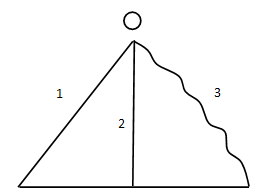
Three different objects of masses $m_1^{}$ , $m_2^{}$and $m_3^{}$ are allowed to fall from rest and from the same point '$O$' along three different frictionless paths. The speeds of the three objects on reaching the ground will be in the ratio of
a.$m_1^{}:m_2^{}:m_3^{}$
b.$m_1^{}:2m_2^{}:m_3^{}$
c.$1:1:1$
d.$\dfrac{1}{{m_1^{}}}:\dfrac{1}{{m_2^{}}}:\dfrac{1}{{m_3^{}}}$
Answer
 Verified
504.6k+ views
Hint: In question, they have asked about the speed of masses on reaching the ground, and given that bodies are at rest, and the path which they follow is a frictionless path. It simply implies that the question is related not to the kinetic energy of the body but the potential energy of bodies as they are at rest.
Formula Used:
\[v = \sqrt {2gh} \]
Where $v$ is the speed of an object, $g$ is the gravitational force, and $h$ is the height from the point at which the object is released
Complete Answer :
The kinematic equation for an object’s speed falling from rest to just before hitting the ground is given as
\[v_{}^2 = 2gh\]
\[v = \sqrt {2gh} \]
Three objects of different masses $m_1^{}$ , $m_2^{}$and $m_3^{}$fall from a point $O$. But according to the concept of potential energy, the speed $v$ will be the same as it does not depend on the path taken or the angle of inclination.
From the above equation, we get,
\[v_1^{} = \sqrt {2gh} \]
\[v_2^{} = \sqrt {2gh} \]
\[v_3^{} = \sqrt {2gh} \]
where $v_1^{},v_2^{},v_3^{}$ is the speed of masses $m_1^{}$ , $m_2^{}$ and $m_3^{}$ respectively, and $g$,$h$ is constant for all three objects.
Taking the ratio of $v_1^{}:v_2^{}$,
\[v_1^{}:{v_2} = \dfrac{{v_1^{}}}{{v_2^{}}} = \dfrac{{\sqrt {2gh} }}{{\sqrt {2gh} }}\]
\[v_1^{}:{v_2} = 1:1\]
Similarly for $v_2^{}$ and $v_3^{}$,
\[v_2^{}:v_3^{} = 1:1\]
We know that,
\[a:b = p:q\]
\[b:c = q:r\]
\[a:b:c = p:q:r\]
From the above equations, we get,
\[v_1^{}:v_2^{}:v_3^{} = 1:1:1\]
Hence the correct option is c) $1:1:1$
Note:
The equation $v_{}^2 = 2gh$ can be written as $\dfrac{1}{2}mv_{}^2 = mgh$ implies that the potential energy of an object from height h when released converts to the kinetic energy of the object when it reaches the ground
S.I unit of potential energy is the joule (J) and its dimensions are $[M_{}^{}L_{}^2T_{}^{ - 2}]$.
Work done by conservative forces depends only on initial and final positions. If it depended on velocity or path taken then forces would be non-conservative.
Formula Used:
\[v = \sqrt {2gh} \]
Where $v$ is the speed of an object, $g$ is the gravitational force, and $h$ is the height from the point at which the object is released
Complete Answer :
The kinematic equation for an object’s speed falling from rest to just before hitting the ground is given as
\[v_{}^2 = 2gh\]
\[v = \sqrt {2gh} \]
Three objects of different masses $m_1^{}$ , $m_2^{}$and $m_3^{}$fall from a point $O$. But according to the concept of potential energy, the speed $v$ will be the same as it does not depend on the path taken or the angle of inclination.
From the above equation, we get,
\[v_1^{} = \sqrt {2gh} \]
\[v_2^{} = \sqrt {2gh} \]
\[v_3^{} = \sqrt {2gh} \]
where $v_1^{},v_2^{},v_3^{}$ is the speed of masses $m_1^{}$ , $m_2^{}$ and $m_3^{}$ respectively, and $g$,$h$ is constant for all three objects.
Taking the ratio of $v_1^{}:v_2^{}$,
\[v_1^{}:{v_2} = \dfrac{{v_1^{}}}{{v_2^{}}} = \dfrac{{\sqrt {2gh} }}{{\sqrt {2gh} }}\]
\[v_1^{}:{v_2} = 1:1\]
Similarly for $v_2^{}$ and $v_3^{}$,
\[v_2^{}:v_3^{} = 1:1\]
We know that,
\[a:b = p:q\]
\[b:c = q:r\]
\[a:b:c = p:q:r\]
From the above equations, we get,
\[v_1^{}:v_2^{}:v_3^{} = 1:1:1\]
Hence the correct option is c) $1:1:1$
Note:
The equation $v_{}^2 = 2gh$ can be written as $\dfrac{1}{2}mv_{}^2 = mgh$ implies that the potential energy of an object from height h when released converts to the kinetic energy of the object when it reaches the ground
S.I unit of potential energy is the joule (J) and its dimensions are $[M_{}^{}L_{}^2T_{}^{ - 2}]$.
Work done by conservative forces depends only on initial and final positions. If it depended on velocity or path taken then forces would be non-conservative.
Recently Updated Pages
Master Class 11 Social Science: Engaging Questions & Answers for Success

Master Class 11 English: Engaging Questions & Answers for Success
Master Class 11 Maths: Engaging Questions & Answers for Success
Master Class 11 Chemistry: Engaging Questions & Answers for Success
Master Class 11 Biology: Engaging Questions & Answers for Success
Master Class 11 Physics: Engaging Questions & Answers for Success
Trending doubts
One Metric ton is equal to kg A 10000 B 1000 C 100 class 11 physics CBSE
Difference Between Prokaryotic Cells and Eukaryotic Cells
How many of the following diseases can be studied with class 11 biology CBSE
Draw a diagram of a plant cell and label at least eight class 11 biology CBSE
Two of the body parts which do not appear in MRI are class 11 biology CBSE
Which gas is abundant in air class 11 chemistry CBSE