




Three Centre two electron bond is present in:
(A).$N{{H}_{3}}$
(B).${{B}_{2}}{{H}_{6}}$
(C).$BC{{l}_{3}}$
(D).$AlC{{l}_{3}}$
Answer
 Verified
607.8k+ views
Hint: In a three center two electron bond the two electrons are shared by three separate nuclei. .Elements that are able to form electron deficient bonds are involved.In banana bond, the probability of distribution of this bond is in shape of banana.
Complete answer:
- A three-center two-electron ($3c–2e$) bond is an electron-deficient chemical bond where three atoms share two electrons.
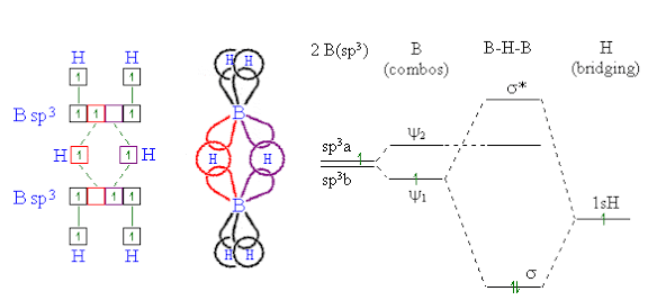
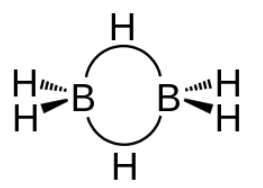
-As boron atom has an empty p-orbital so the monomer $B{{H}_{3}}$ is unstable.when a boron atom shares electrons with a $B−H$ bond on another boron atom, $A B−H−B$ 3-center-2-electron bond is formed . across three internuclear spaces, the two electrons (corresponding to one bond) in a $B−H−B$ bonding molecular orbital are spread out .In diborane (${{B}_{2}}{{H}_{6}}$ ), two $H$ atoms bridge the two $B$ atoms, leaving two additional H atoms in ordinary $B−H$ bonds on each .There are two such $3c-2e$ bonds: As each boron atom participates in a total of four bonds and there is filling of all bonding molecular orbitals and two of the four bonds are 3-centre $B−H−B$ bonds, so the molecule is stable.
Option B is the correct answer.
Note:
In trimethylaluminum, this Three Centre two electron bonding pattern is seen, which leads to formation of a dimer. $A{{l}_{2}}{{(C{{H}_{3}})}_{6}}$ involving bridges with the carbon atoms of two of the methyl groups . This type of bond also occurs in carbon compounds, which is referred to as hyperconjugation.
Complete answer:
- A three-center two-electron ($3c–2e$) bond is an electron-deficient chemical bond where three atoms share two electrons.
-As boron atom has an empty p-orbital so the monomer $B{{H}_{3}}$ is unstable.when a boron atom shares electrons with a $B−H$ bond on another boron atom, $A B−H−B$ 3-center-2-electron bond is formed . across three internuclear spaces, the two electrons (corresponding to one bond) in a $B−H−B$ bonding molecular orbital are spread out .In diborane (${{B}_{2}}{{H}_{6}}$ ), two $H$ atoms bridge the two $B$ atoms, leaving two additional H atoms in ordinary $B−H$ bonds on each .There are two such $3c-2e$ bonds: As each boron atom participates in a total of four bonds and there is filling of all bonding molecular orbitals and two of the four bonds are 3-centre $B−H−B$ bonds, so the molecule is stable.
Option B is the correct answer.
Note:
In trimethylaluminum, this Three Centre two electron bonding pattern is seen, which leads to formation of a dimer. $A{{l}_{2}}{{(C{{H}_{3}})}_{6}}$ involving bridges with the carbon atoms of two of the methyl groups . This type of bond also occurs in carbon compounds, which is referred to as hyperconjugation.
Recently Updated Pages
Master Class 11 Social Science: Engaging Questions & Answers for Success

Master Class 11 English: Engaging Questions & Answers for Success
Master Class 11 Maths: Engaging Questions & Answers for Success
Master Class 11 Chemistry: Engaging Questions & Answers for Success
Master Class 11 Biology: Engaging Questions & Answers for Success
Master Class 11 Physics: Engaging Questions & Answers for Success
Trending doubts
One Metric ton is equal to kg A 10000 B 1000 C 100 class 11 physics CBSE
Difference Between Prokaryotic Cells and Eukaryotic Cells
Draw a diagram of a plant cell and label at least eight class 11 biology CBSE
Two of the body parts which do not appear in MRI are class 11 biology CBSE
Which gas is abundant in air class 11 chemistry CBSE
10 examples of friction in our daily life