




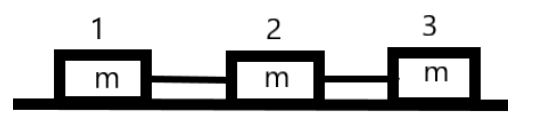
Three blocks 1,2, and 3 rest on a horizontal frictionless surface, as shown. Each block has a mass ‘m’ and the blocks are connected by massless strings. Block 3 is pulled to the right by a force F. The resultant force on block 2 is:
\[\begin{align}
& \text{A) Zero} \\
& \text{B) }\dfrac{1}{3}F \\
& \text{C) }\dfrac{1}{2}F \\
& \text{D) }\dfrac{2}{3}F \\
\end{align}\]
Answer
 Verified
577.5k+ views
Hint: The resultant force acting on the block 2 due to the force acting on the block 3 can be computed easily using the appropriate relations. The floor is given to be frictionless so we have to consider just the forces due to the external force F and the masses.
Complete step by step answer:
We are given three equal masses connected by massless strings as shown in the figure. They are pulled to the right by a force F acting on the mass 3. The other two masses are pulled by the resultant force acting on each of the blocks.
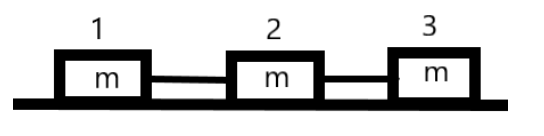
Now, let us consider the force acting on the block 3 which pulls the three blocks with equal acceleration and therefore, equal force as the masses are equal. The net force acting on the system is given by F. We can derive the acceleration on the system using the Newton’s second law of motion –
\[F=Ma\]
Where M is the total mass of the system which is equal to 3m,
a is the acceleration of the system.
The acceleration is given by –
\[\begin{align}
& F=3m.a \\
& \therefore a=\dfrac{F}{3m} \\
\end{align}\]
Now, let us consider the force acting on block 2. The resultant force is given by –
\[\begin{align}
& {{F}_{2}}=ma \\
& \text{but,} \\
& a=\dfrac{F}{3m} \\
& \Rightarrow {{F}_{2}}=m.\dfrac{F}{3m} \\
& \therefore {{F}_{2}}=\dfrac{F}{3} \\
\end{align}\]
The force acting on block 2 is one-third of the total force in the system.
So, the correct answer is “Option B”.
Note: We can understand from the above example that the force on a body is related to its mass if it is in a system of masses. The absence of friction removes any additional reduction of the force applied. This is an impractical situation as friction is non-negligible in most cases.
Complete step by step answer:
We are given three equal masses connected by massless strings as shown in the figure. They are pulled to the right by a force F acting on the mass 3. The other two masses are pulled by the resultant force acting on each of the blocks.
Now, let us consider the force acting on the block 3 which pulls the three blocks with equal acceleration and therefore, equal force as the masses are equal. The net force acting on the system is given by F. We can derive the acceleration on the system using the Newton’s second law of motion –
\[F=Ma\]
Where M is the total mass of the system which is equal to 3m,
a is the acceleration of the system.
The acceleration is given by –
\[\begin{align}
& F=3m.a \\
& \therefore a=\dfrac{F}{3m} \\
\end{align}\]
Now, let us consider the force acting on block 2. The resultant force is given by –
\[\begin{align}
& {{F}_{2}}=ma \\
& \text{but,} \\
& a=\dfrac{F}{3m} \\
& \Rightarrow {{F}_{2}}=m.\dfrac{F}{3m} \\
& \therefore {{F}_{2}}=\dfrac{F}{3} \\
\end{align}\]
The force acting on block 2 is one-third of the total force in the system.
So, the correct answer is “Option B”.
Note: We can understand from the above example that the force on a body is related to its mass if it is in a system of masses. The absence of friction removes any additional reduction of the force applied. This is an impractical situation as friction is non-negligible in most cases.
Recently Updated Pages
Master Class 11 Computer Science: Engaging Questions & Answers for Success

Master Class 11 Business Studies: Engaging Questions & Answers for Success
Master Class 11 Economics: Engaging Questions & Answers for Success
Master Class 11 English: Engaging Questions & Answers for Success
Master Class 11 Maths: Engaging Questions & Answers for Success
Master Class 11 Biology: Engaging Questions & Answers for Success
Trending doubts
One Metric ton is equal to kg A 10000 B 1000 C 100 class 11 physics CBSE
There are 720 permutations of the digits 1 2 3 4 5 class 11 maths CBSE
Discuss the various forms of bacteria class 11 biology CBSE
Draw a diagram of a plant cell and label at least eight class 11 biology CBSE
State the laws of reflection of light
Explain zero factorial class 11 maths CBSE