




Three bells, toll at interval 36 sec, 40 sec, and 48 sec respectively. They start ringing at a particular time. They toll together next after
a)18 minutes
b)12 minutes
c)6 minutes
d)24 minutes
Answer
 Verified
627.3k+ views
Hint: As in the question, it is asked at what time will all the balls toll together one should try to get LCM of all the time intervals to get the desired result.
Complete step-by-step answer:
We have been given three bells that commence tolling together and toll at intervals of 36, 40, and 48 seconds respectively.
Now, we are asked to find at a time will the all the bells toll together.
We will get the time at which all will toll together is by taking L.C.M or least common multiple all the six-time intervals.
At first, we will know what is LCM or the least common multiple and how to find it.
In arithmetic, the least common multiple, lowest common multiple or smallest common multiple of two integers a and b which is denoted by LCM $\left( a,b \right)$ is the smallest possible integer that is divisible by both a and b. Since the division of integers by zero is undefined, this definition has meaning only if a and b are both different from zero.
If there are more than two numbers, then L.C.M can be done by division method. The numbers will be operated simultaneously. The factors in the division method should divide the minimum of two numbers and it should be until the last term becomes 1 or a prime number to be divided.
Let’s take L.C.M of three bell’s time intervals which are 36, 40, and 48.
So, it can be represented as,
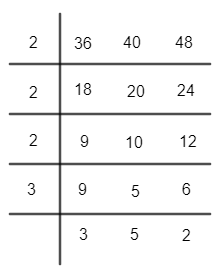
Now for finding the L.C.M we will multiply the divisors and the prime numbers which are left behind.
So, least common multiple $=2\times 2\times 2\times 3\times 3\times 5\times 2$
$=720$
Hence, the least common multiple is 720 sec.
So, all the bells will toll at 720 sec or 12 minutes.
Option ‘b’ is the correct answer.
Note: Students while dealing with application-related HCF, LCM problems they generally confuse themselves by which to choose and how to do it. So, they have to practice with this kind of problem to prevent confusion.
Complete step-by-step answer:
We have been given three bells that commence tolling together and toll at intervals of 36, 40, and 48 seconds respectively.
Now, we are asked to find at a time will the all the bells toll together.
We will get the time at which all will toll together is by taking L.C.M or least common multiple all the six-time intervals.
At first, we will know what is LCM or the least common multiple and how to find it.
In arithmetic, the least common multiple, lowest common multiple or smallest common multiple of two integers a and b which is denoted by LCM $\left( a,b \right)$ is the smallest possible integer that is divisible by both a and b. Since the division of integers by zero is undefined, this definition has meaning only if a and b are both different from zero.
If there are more than two numbers, then L.C.M can be done by division method. The numbers will be operated simultaneously. The factors in the division method should divide the minimum of two numbers and it should be until the last term becomes 1 or a prime number to be divided.
Let’s take L.C.M of three bell’s time intervals which are 36, 40, and 48.
So, it can be represented as,
Now for finding the L.C.M we will multiply the divisors and the prime numbers which are left behind.
So, least common multiple $=2\times 2\times 2\times 3\times 3\times 5\times 2$
$=720$
Hence, the least common multiple is 720 sec.
So, all the bells will toll at 720 sec or 12 minutes.
Option ‘b’ is the correct answer.
Note: Students while dealing with application-related HCF, LCM problems they generally confuse themselves by which to choose and how to do it. So, they have to practice with this kind of problem to prevent confusion.
Recently Updated Pages
Three beakers labelled as A B and C each containing 25 mL of water were taken A small amount of NaOH anhydrous CuSO4 and NaCl were added to the beakers A B and C respectively It was observed that there was an increase in the temperature of the solutions contained in beakers A and B whereas in case of beaker C the temperature of the solution falls Which one of the following statements isarecorrect i In beakers A and B exothermic process has occurred ii In beakers A and B endothermic process has occurred iii In beaker C exothermic process has occurred iv In beaker C endothermic process has occurred

Master Class 10 Social Science: Engaging Questions & Answers for Success
Master Class 10 Science: Engaging Questions & Answers for Success
Master Class 10 Maths: Engaging Questions & Answers for Success
Master Class 10 General Knowledge: Engaging Questions & Answers for Success
Master Class 10 Computer Science: Engaging Questions & Answers for Success
Three beakers labelled as A B and C each containing 25 mL of water were taken A small amount of NaOH anhydrous CuSO4 and NaCl were added to the beakers A B and C respectively It was observed that there was an increase in the temperature of the solutions contained in beakers A and B whereas in case of beaker C the temperature of the solution falls Which one of the following statements isarecorrect i In beakers A and B exothermic process has occurred ii In beakers A and B endothermic process has occurred iii In beaker C exothermic process has occurred iv In beaker C endothermic process has occurred
Master Class 10 Social Science: Engaging Questions & Answers for Success
Master Class 10 Science: Engaging Questions & Answers for Success
Trending doubts
Explain the Treaty of Vienna of 1815 class 10 social science CBSE
Who Won 36 Oscar Awards? Record Holder Revealed
What is the name of Japan Parliament?
What is the median of the first 10 natural numbers class 10 maths CBSE
Why is it 530 pm in india when it is 1200 afternoon class 10 social science CBSE
Why is there a time difference of about 5 hours between class 10 social science CBSE