




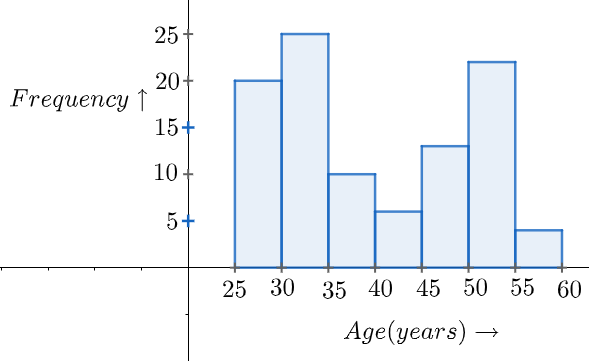
This chart shows the ages of $100$ people in seven age groups.
Find the age group that includes the median age.
Answer
 Verified
579k+ views
Hint: At first, we can draw a table for less than ogive. From this table, we can draw the less than ogive curve. Along the x axis will be the age in less than format and along the y axis will be the frequency of them. For the median, we need to locate the middle position or $\dfrac{100}{2}=50$ . We take a line perpendicular to the y axis at $y=50$ and then find where it intersects the ogive. From this point again, we drop a perpendicular to the x axis. The x value gives the median and then we need to find the age group.
Complete step by step answer:
In this problem, we are given information about the age groups and their frequency of appearing in the group. From this chart, we can draw a table for the less than ogive.
From this table, we can draw the less than ogive curve. Along the x axis will be the age in less than format and along the y axis will be the frequency of them. This ogive is analytical to the people in the group arranged in ascending order. If we pick a person from say the ${{40}^{th}}$ position, then the age of that person can be found out from the ogive. We will take a line perpendicular to the y axis at $y=40$ and then find where it intersects the ogive. From this point again, we drop a perpendicular to the x axis.
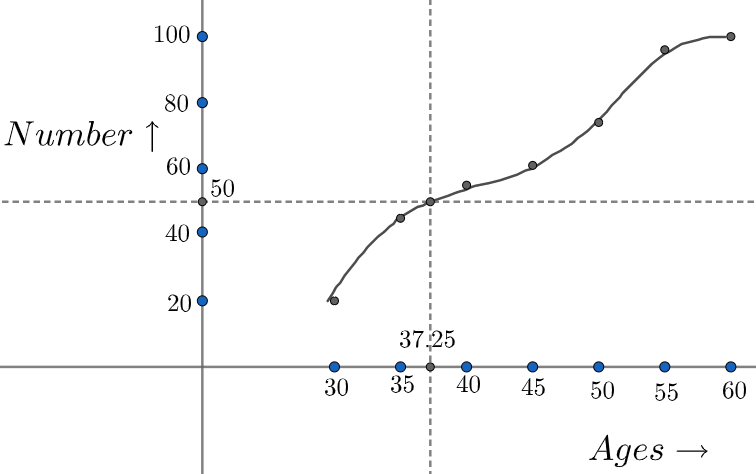
So, for the median, we need to locate the middle position or $\dfrac{100}{2}=50$ . We take a line perpendicular to the y axis at $y=50$ and then find where it intersects the ogive. From this point again, we drop a perpendicular to the x axis. Doing this gives the value $x=37.25$ .
Thus, we can conclude that the median is $37.25$ years and this belongs to the age group $35-40$ .
Note: We should be careful in drawing the table. We should take the cumulative frequency instead of copying the ordinate points from the bar graph. Also, we should remember that the ogive is a smooth curve and so, we should not simply join the points using straight lines.
Complete step by step answer:
In this problem, we are given information about the age groups and their frequency of appearing in the group. From this chart, we can draw a table for the less than ogive.
| Age | Less than $30$ | Less than $35$ | Less than $40$ | Less than $45$ | Less than $50$ | Less than $55$ | Less than $60$ |
| Frequency/Number | $20$ | $45$ | $55$ | $61$ | $74$ | $96$ | $100$ |
From this table, we can draw the less than ogive curve. Along the x axis will be the age in less than format and along the y axis will be the frequency of them. This ogive is analytical to the people in the group arranged in ascending order. If we pick a person from say the ${{40}^{th}}$ position, then the age of that person can be found out from the ogive. We will take a line perpendicular to the y axis at $y=40$ and then find where it intersects the ogive. From this point again, we drop a perpendicular to the x axis.
So, for the median, we need to locate the middle position or $\dfrac{100}{2}=50$ . We take a line perpendicular to the y axis at $y=50$ and then find where it intersects the ogive. From this point again, we drop a perpendicular to the x axis. Doing this gives the value $x=37.25$ .
Thus, we can conclude that the median is $37.25$ years and this belongs to the age group $35-40$ .
Note: We should be careful in drawing the table. We should take the cumulative frequency instead of copying the ordinate points from the bar graph. Also, we should remember that the ogive is a smooth curve and so, we should not simply join the points using straight lines.
Recently Updated Pages
Write any three differences between metals and nonmetals class 10 social science CBSE

Amit standing on a horizontal plane finds a bird flying class 10 maths CBSE
Two circles of radii 5 cm and 3 cm intersect at two class 10 maths CBSE
Solve the following i John and Jivanti together have class 10 maths CBSE
What is the relation between orthocenter circumcentre class 10 maths CBSE
Two plane mirrors are inclined at 70circ A ray incident class 10 physics CBSE
Trending doubts
Which country is known as "The land of Fire and Ice"?
1 GB equals how many MB?
Choose the feminine form of the given noun Fox AFoxess class 10 english CBSE
In which year voting age was reduced from 21 to 18?
Identify the feminine form of noun nephew a shenephew class 10 english CBSE
What is meant by the term constituency A Place where class 10 social science CBSE