




Thickening of collenchyma is due to-
A. Lignin
B. Pectin
C. Suberin
D. None of above
Answer
 Verified
633.3k+ views
Hint: It is a structural acidic heteropolysaccharide found in terrestrial plants' main and middle lamella and cell walls. Galacturonic acid, a galactose-derived sugar acid, is its key ingredient. Henri Braconnot first isolated it and described it in 1825.
Complete answer:
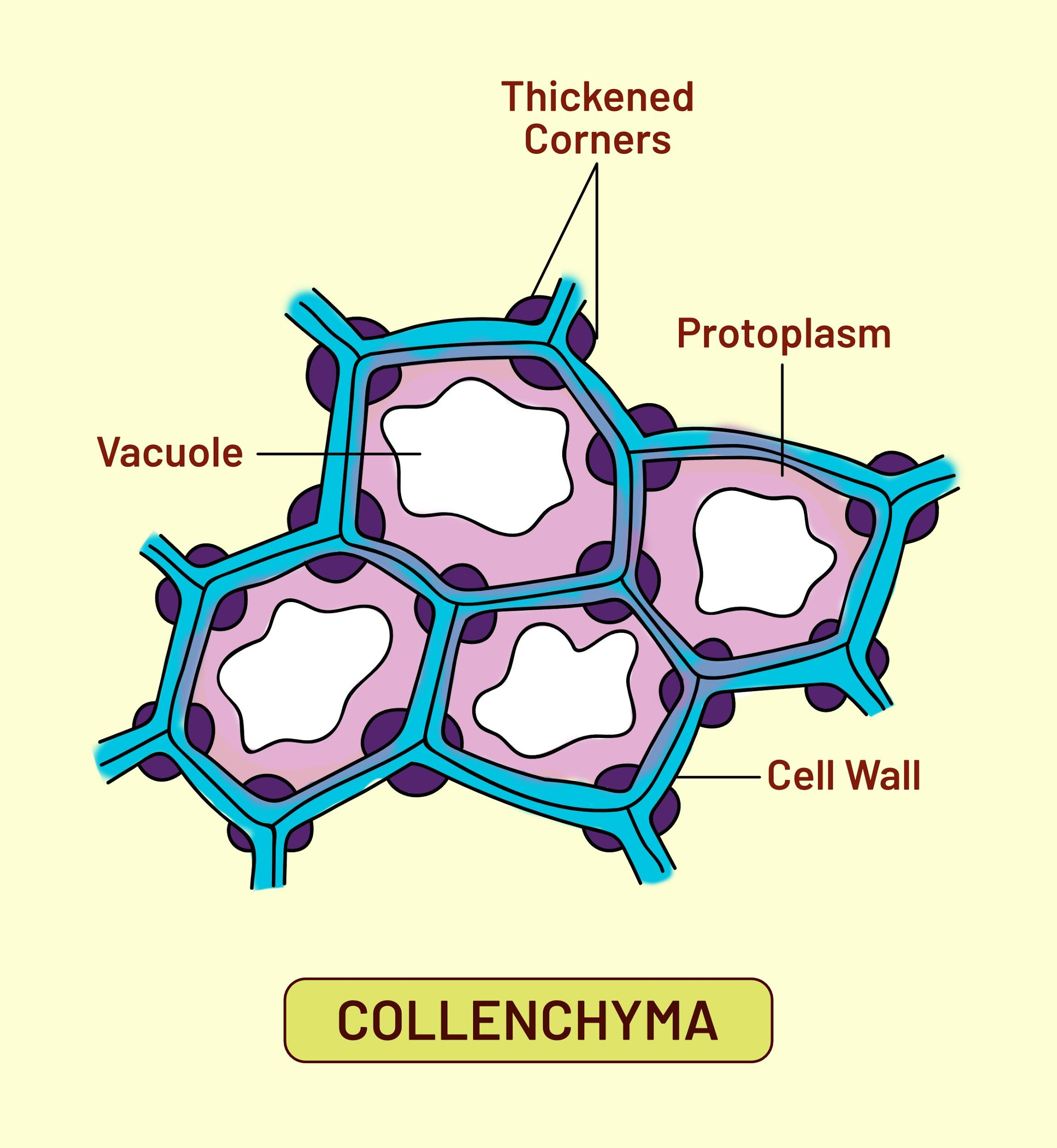
The tissue of Collenchyma is made up of elongated cells with irregularly thickened walls. In particular, in growing shoots and leaves, they provide structural support. The cells of Collenchyma normally live and have only a thick primary cell wall consisting of cellulose and pectin.
It is produced as a white to light brown powder commercially, mainly extracted from citrus fruits, and is used as a gelling agent in food, particularly in jams and jellies. It is also used as a stabiliser in fruit juices and milk drinks, and as a source of dietary fibre in cake fillings, medicines, and candy.
Additional Information: Lignin is a class of complex organic polymers which, in the support tissues of vascular plants and some algae, form key structural materials. In the formation of cell walls, especially in wood and bark, lignins are particularly important because they lend rigidity and do not easily rot.
Suberin is a lipophilic macromolecule found in specialised plant cell walls where the environment needs insulation or protection. The periderm, the tissue that envelops secondary stems as part of the bark, is produced by suberized cells, and grows after wounding or leaf abscission as the sealing tissue.
So, the correct answer is ‘pectin’.
Note: Pectin is an essential polysaccharide of the cell wall that enables extension of the primary cell wall and plant growth. Pectin is broken down by the enzymes pectinase and pectinesterase during fruit ripening, in which the fruit becomes softer when the middle lamellas break down and cells are isolated from each other.
Complete answer:
The tissue of Collenchyma is made up of elongated cells with irregularly thickened walls. In particular, in growing shoots and leaves, they provide structural support. The cells of Collenchyma normally live and have only a thick primary cell wall consisting of cellulose and pectin.
It is produced as a white to light brown powder commercially, mainly extracted from citrus fruits, and is used as a gelling agent in food, particularly in jams and jellies. It is also used as a stabiliser in fruit juices and milk drinks, and as a source of dietary fibre in cake fillings, medicines, and candy.
Additional Information: Lignin is a class of complex organic polymers which, in the support tissues of vascular plants and some algae, form key structural materials. In the formation of cell walls, especially in wood and bark, lignins are particularly important because they lend rigidity and do not easily rot.
Suberin is a lipophilic macromolecule found in specialised plant cell walls where the environment needs insulation or protection. The periderm, the tissue that envelops secondary stems as part of the bark, is produced by suberized cells, and grows after wounding or leaf abscission as the sealing tissue.
So, the correct answer is ‘pectin’.
Note: Pectin is an essential polysaccharide of the cell wall that enables extension of the primary cell wall and plant growth. Pectin is broken down by the enzymes pectinase and pectinesterase during fruit ripening, in which the fruit becomes softer when the middle lamellas break down and cells are isolated from each other.
Recently Updated Pages
Which will be the least stable resonating structure class 11 chemistry CBSE

How many 5 digit telephone numbers can be construc-class-11-maths-CBSE
How do you find the angle of the resultant vector class 11 physics CBSE
Draw labelled diagram of the following i Gram seed class 11 biology CBSE
What is the need and importance of classification class 11 biology CBSE
The way in which the sparrows expressed their sorrow class 11 english CBSE
Trending doubts
One Metric ton is equal to kg A 10000 B 1000 C 100 class 11 physics CBSE
1 Quintal is equal to a 110 kg b 10 kg c 100kg d 1000 class 11 physics CBSE
Draw a diagram of nephron and explain its structur class 11 biology CBSE
10 examples of friction in our daily life
Proton was discovered by A Thomson B Rutherford C Chadwick class 11 chemistry CBSE
Bond order ofO2 O2+ O2 and O22 is in order A O2 langle class 11 chemistry CBSE