




These questions are based on the following pre-chart
Arun’s monthly income is Rs $21,000$
If the rent is increased by ${\text{5% }}$ and the other expenditure and income are the same. So then by what percent does saving decrease?
${\text{a)60% }}$
${\text{b)75% }}$
${\text{c)25% }}$
${\text{d)40% }}$
Answer
 Verified
572.1k+ views
Hint: First, we have to find the original saving percentage by subtracting all the other expenses.
Then, we have to increase the rent by ${\text{5% }}$ and find a new saving percentage.
With that, we will have to apply a formula to find the decreased percentage of savings.
Formula used: Change in percentage $ = \dfrac{{{\text{old value - new value}}}}{{{\text{old value}}}} \times 100$
Complete step-by-step solution:
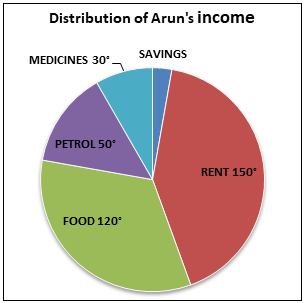
It is given that the pie chart stated as,
Rent = ${\text{150}}^\circ $
Food = ${\text{120}}^\circ $
Petrol = ${\text{50}}^\circ $
Medicines = ${\text{30}}^\circ $
Here, we will find the original old savings percentage.
As we know, the full circle is ${\text{360}}^\circ $ and savings percentage is one among the ${\text{360}}^\circ $
So we can write it as,
Old Savings = ${\text{360}}^\circ - $ rent – food – petrol – medicines.
On putting the values and we get
$ \Rightarrow 360^\circ - 150^\circ - 120^\circ - 50^\circ - 30^\circ $
On simplifying we get
Old savings $ = 10^\circ $
Now, it is given that the rent is increased by ${\text{5% }}$
We have to find the increased percentage of rent,
Old rent = ${\text{150}}^\circ $
Increased percent = ${\text{5% }}$
$\therefore $Increased rent percent = $150 \times \dfrac{5}{{100}}$
$ \Rightarrow \dfrac{{750}}{{100}}$
On dividing we get,
$ \Rightarrow 7.5^\circ $
So the new rent = ${\text{150}}^\circ + 7.5^\circ = 157.5^\circ $
Now we have to find out the new savings = ${\text{360}}^\circ - $ new rent – food – petrol – medicines.
$ \Rightarrow 360^\circ - 157.5^\circ - 120^\circ - 50^\circ - 30^\circ $
On simplifying we get
New savings $ = 2.5^\circ $
Now, we have both the old and new savings, from this we will find the decreased percent of savings.
Change in percentage $ = \dfrac{{{\text{old value - new value}}}}{{{\text{old value}}}} \times 100$
Putting the values and we get
$\therefore $ Decreased savings percent $ = \dfrac{{{\text{10 - 2}}{\text{.5}}}}{{{\text{10}}}} \times 100$
Let us subtract the numerator term and we get,
$ \Rightarrow \dfrac{{7.5}}{{10}} \times 100$
Let us multiply the terms and we get
$ = \dfrac{{750}}{{10}} = 75% $
Therefore, the savings percent is decreased by $75% $
Hence the correct option is $\left( B \right)$.
Note: Basically when we convert numbers into percentages or any data into percentages, nature will change, numbers have no end but percentage does have an end (e.g. ${\text{100% }}$).
When we simply subtract or add the changes, the base (or end) will change (e.g. ${\text{100% }}$ will change either below ${\text{100% }}$ or above ${\text{100% }}$).
Then, we have to increase the rent by ${\text{5% }}$ and find a new saving percentage.
With that, we will have to apply a formula to find the decreased percentage of savings.
Formula used: Change in percentage $ = \dfrac{{{\text{old value - new value}}}}{{{\text{old value}}}} \times 100$
Complete step-by-step solution:
It is given that the pie chart stated as,
Rent = ${\text{150}}^\circ $
Food = ${\text{120}}^\circ $
Petrol = ${\text{50}}^\circ $
Medicines = ${\text{30}}^\circ $
Here, we will find the original old savings percentage.
As we know, the full circle is ${\text{360}}^\circ $ and savings percentage is one among the ${\text{360}}^\circ $
So we can write it as,
Old Savings = ${\text{360}}^\circ - $ rent – food – petrol – medicines.
On putting the values and we get
$ \Rightarrow 360^\circ - 150^\circ - 120^\circ - 50^\circ - 30^\circ $
On simplifying we get
Old savings $ = 10^\circ $
Now, it is given that the rent is increased by ${\text{5% }}$
We have to find the increased percentage of rent,
Old rent = ${\text{150}}^\circ $
Increased percent = ${\text{5% }}$
$\therefore $Increased rent percent = $150 \times \dfrac{5}{{100}}$
$ \Rightarrow \dfrac{{750}}{{100}}$
On dividing we get,
$ \Rightarrow 7.5^\circ $
So the new rent = ${\text{150}}^\circ + 7.5^\circ = 157.5^\circ $
Now we have to find out the new savings = ${\text{360}}^\circ - $ new rent – food – petrol – medicines.
$ \Rightarrow 360^\circ - 157.5^\circ - 120^\circ - 50^\circ - 30^\circ $
On simplifying we get
New savings $ = 2.5^\circ $
Now, we have both the old and new savings, from this we will find the decreased percent of savings.
Change in percentage $ = \dfrac{{{\text{old value - new value}}}}{{{\text{old value}}}} \times 100$
Putting the values and we get
$\therefore $ Decreased savings percent $ = \dfrac{{{\text{10 - 2}}{\text{.5}}}}{{{\text{10}}}} \times 100$
Let us subtract the numerator term and we get,
$ \Rightarrow \dfrac{{7.5}}{{10}} \times 100$
Let us multiply the terms and we get
$ = \dfrac{{750}}{{10}} = 75% $
Therefore, the savings percent is decreased by $75% $
Hence the correct option is $\left( B \right)$.
Note: Basically when we convert numbers into percentages or any data into percentages, nature will change, numbers have no end but percentage does have an end (e.g. ${\text{100% }}$).
When we simply subtract or add the changes, the base (or end) will change (e.g. ${\text{100% }}$ will change either below ${\text{100% }}$ or above ${\text{100% }}$).
Recently Updated Pages
Master Class 11 English: Engaging Questions & Answers for Success

Master Class 11 Maths: Engaging Questions & Answers for Success
Master Class 11 Biology: Engaging Questions & Answers for Success
Master Class 11 Physics: Engaging Questions & Answers for Success
Master Class 11 Accountancy: Engaging Questions & Answers for Success
Class 11 Question and Answer - Your Ultimate Solutions Guide
Trending doubts
One Metric ton is equal to kg A 10000 B 1000 C 100 class 11 physics CBSE
Discuss the various forms of bacteria class 11 biology CBSE
Draw a diagram of a plant cell and label at least eight class 11 biology CBSE
State the laws of reflection of light
Explain zero factorial class 11 maths CBSE
10 examples of friction in our daily life