




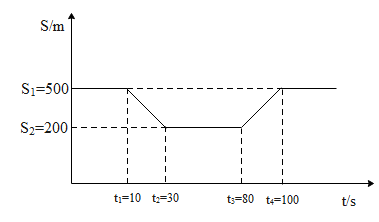
There is a narrow bridge somewhere on the roads connecting two towns. Two cars travel from one of the towns to the other with a constant speed ${{v}_{1}}$ everywhere on the road except the bridge, where they travel with another constant speed ${{v}_{2}}$ . How the separation between the cars varies with time t is shown in the following graph. What is the speed ${{v}_{1}}$ of the cars on the road.
Answer
 Verified
605.7k+ views
Hint: In the above question the variation of the separation (s) between the two cars with time is given in the graph. To determine the speed of the cars ${{v}_{1}}$ we will consider any one of the cars. Then with respect to one of the cars the obtained velocity will be equal to the velocity ${{v}_{1}}$ of the either cars on the road.
Formula used:
$s=\dfrac{d}{t}$
Complete answer:
Let us say a body covers distance ‘d’ in time ‘t’. Then the speed ‘s’ of the body is given by
$s=\dfrac{d}{t}$
In the above graph let us say there are two cars car ‘A’ and car ‘B’ such that A is ahead of B. Before time interval of 10 sec the distance of separation between the two cars is 500m As soon as the car ‘A’ reaches the bridge its speed changes. Hence the distance of separation after 10 sec decreases. Further when the car B reaches the bridge the speed of the car decreases and hence after 30 sec the distance of separation between the two remains constant. Therefore when the car ‘B’ is on the road at a distance of d = 500m (such that the car ‘A’ enters the bridge) it takes a time interval 20sec for the car ‘B’ to cover that distance and reach the bridge. Hence the speed of the car on the road,
$\begin{align}
& {{v}_{1}}=\dfrac{d}{{{t}_{2}}-{{t}_{1}}} \\
& \Rightarrow {{v}_{1}}=\dfrac{500}{30-10}m/s \\
& \Rightarrow {{v}_{1}}=\dfrac{500}{30-10}m/s=\dfrac{500}{20}m/s \\
& \Rightarrow {{v}_{1}}=25m/s \\
\end{align}$
Note:
The above problem can also be solved with respect to car A. When the car ‘A’ exits the bridge the distance of separation will keep on increasing. When finally the car ‘B’ also exits the bridge the distance of separation will be constant. Hence accordingly from the graph the speed of the wither cars on the road can be determined.
Formula used:
$s=\dfrac{d}{t}$
Complete answer:
Let us say a body covers distance ‘d’ in time ‘t’. Then the speed ‘s’ of the body is given by
$s=\dfrac{d}{t}$
In the above graph let us say there are two cars car ‘A’ and car ‘B’ such that A is ahead of B. Before time interval of 10 sec the distance of separation between the two cars is 500m As soon as the car ‘A’ reaches the bridge its speed changes. Hence the distance of separation after 10 sec decreases. Further when the car B reaches the bridge the speed of the car decreases and hence after 30 sec the distance of separation between the two remains constant. Therefore when the car ‘B’ is on the road at a distance of d = 500m (such that the car ‘A’ enters the bridge) it takes a time interval 20sec for the car ‘B’ to cover that distance and reach the bridge. Hence the speed of the car on the road,
$\begin{align}
& {{v}_{1}}=\dfrac{d}{{{t}_{2}}-{{t}_{1}}} \\
& \Rightarrow {{v}_{1}}=\dfrac{500}{30-10}m/s \\
& \Rightarrow {{v}_{1}}=\dfrac{500}{30-10}m/s=\dfrac{500}{20}m/s \\
& \Rightarrow {{v}_{1}}=25m/s \\
\end{align}$
Note:
The above problem can also be solved with respect to car A. When the car ‘A’ exits the bridge the distance of separation will keep on increasing. When finally the car ‘B’ also exits the bridge the distance of separation will be constant. Hence accordingly from the graph the speed of the wither cars on the road can be determined.
Recently Updated Pages
If x a + bt + ct2 where x is in meters and t is in class 11 physics CBSE

A car covers the first half distance between two places class 11 physics CBSE
The resultant of two vectors overrightarrow P and overrightarrow class 11 physics CBSE
Find the value of cos 135 class 11 maths CBSE
A mass M is held in place by an applied force F and class 11 physics CBSE
A solution of glucose in water is labelled as 10 dfracwv class 11 chemistry CBSE
Trending doubts
One Metric ton is equal to kg A 10000 B 1000 C 100 class 11 physics CBSE
Find the value of the expression given below sin 30circ class 11 maths CBSE
What do you mean by retardation What is its SI uni class 11 physics CBSE
Draw a diagram of nephron and explain its structur class 11 biology CBSE
10 examples of friction in our daily life
Difference between physical and chemical change class 11 chemistry CBSE