




There exist uniform magnetic and electric fields of magnitudes 1T and 1 V/m, respectively, along positive y-axis. A charged particle of mass 1 kg and charge 1C is having velocity 1 m/s along the x-axis and is at the origin at t = 0. Then the coordinates of particle at time $\pi $ s is
a. $\left( {0,1,2} \right)m$
b. $\left( {0, - {\pi ^2}, - 2} \right)m$
c. $\left( {2,\dfrac{{{\pi ^2}}}{2},2} \right)m$
d. $\left( {0,\dfrac{{{\pi ^2}}}{2},2} \right)m$
Answer
 Verified
585.3k+ views
Hint: Magnetism is the force exerted by magnets when they attract or repel each other. The magnetic flux density is nothing but the magnetic flux per unit surface area. The SI unit of measuring the magnetic flux density is Tesla (1T = 1 weber/ m2). There’s another unit of measuring B known as Gauss (1T = 10000 G).
Complete answer:
Given, mass of the particle = 1 kg, velocity of the particle = 1m/s, magnetic flux density =1 T , charge on the particle = 1 C.
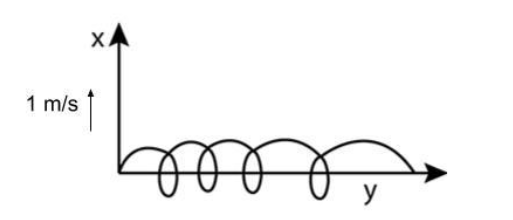
Along y- axis the path of the particle will be helical with increasing pitch as given in the following figure.
We know that the total time period (T) is given by the following equation,
$T = \dfrac{{2\pi m}}{{qB}}$........(1)
where, m is the mass of the particle, q is the magnitude of the charge on the particle, B is the magnetic flux density. Putting all the given values in equation (1) we get,
$ \Rightarrow T = \dfrac{{2\pi \times 1}}{{1 \times 1}} = 2\pi $
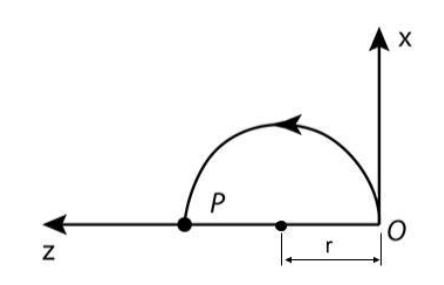
Because of the magnetic field the particle will also follow a circular path about the y- axis i.e. in the x- z plane. In half time period i.e. at t = $\pi $s the particle will have traced a semi- circular path, as shown in the following figure.
Therefore, the radius of the semi- circular path can be obtained from the following equation,
$ \Rightarrow r = \dfrac{{mv}}{{qB}} = \dfrac{{1 \times 1}}{{1 \times 1}}$
$ \Rightarrow r = 1$
Now, from the figure we know that after time t = $\pi $s, the particle will be lying in the y- z plane. Hence its x- coordinate will be zero (x = 0).
The z- coordinate of the particle will be equal to the diameter of the semi- circular path and it is given by, z = 2r = 2 x 1 = 2 m, (z = 2).
Now, we can use the laws of motion to find out the distance travelled by the particle in y-direction. Hence, the y- coordinate of the particle is given by,
$ \Rightarrow y = ut + \dfrac{1}{2}a{t^2}$
$ \Rightarrow y = 0 + \dfrac{1}{2}\dfrac{{qE}}{m}{t^2}$
Put, t= $\pi $s and E = 1 V/m, we get
$\therefore Y = \dfrac{{{\pi ^2}}}{2}$
Hence, the correct answer is option (D).
Note: Following points regarding the magnetic field must be remembered:
• There are two types of magnetic fields B-field and the H-field.
• B-field is measured in tesla (T).
• H-field is measured in amperes per metre (A/m).
• The direction of the magnetic field of the earth is from the magnetic north pole towards the magnetic south pole of the earth. The inclined bar magnet is not a real magnet, it is just a hypothetical magnet.
Complete answer:
Given, mass of the particle = 1 kg, velocity of the particle = 1m/s, magnetic flux density =1 T , charge on the particle = 1 C.
Along y- axis the path of the particle will be helical with increasing pitch as given in the following figure.
We know that the total time period (T) is given by the following equation,
$T = \dfrac{{2\pi m}}{{qB}}$........(1)
where, m is the mass of the particle, q is the magnitude of the charge on the particle, B is the magnetic flux density. Putting all the given values in equation (1) we get,
$ \Rightarrow T = \dfrac{{2\pi \times 1}}{{1 \times 1}} = 2\pi $
Because of the magnetic field the particle will also follow a circular path about the y- axis i.e. in the x- z plane. In half time period i.e. at t = $\pi $s the particle will have traced a semi- circular path, as shown in the following figure.
Therefore, the radius of the semi- circular path can be obtained from the following equation,
$ \Rightarrow r = \dfrac{{mv}}{{qB}} = \dfrac{{1 \times 1}}{{1 \times 1}}$
$ \Rightarrow r = 1$
Now, from the figure we know that after time t = $\pi $s, the particle will be lying in the y- z plane. Hence its x- coordinate will be zero (x = 0).
The z- coordinate of the particle will be equal to the diameter of the semi- circular path and it is given by, z = 2r = 2 x 1 = 2 m, (z = 2).
Now, we can use the laws of motion to find out the distance travelled by the particle in y-direction. Hence, the y- coordinate of the particle is given by,
$ \Rightarrow y = ut + \dfrac{1}{2}a{t^2}$
$ \Rightarrow y = 0 + \dfrac{1}{2}\dfrac{{qE}}{m}{t^2}$
Put, t= $\pi $s and E = 1 V/m, we get
$\therefore Y = \dfrac{{{\pi ^2}}}{2}$
Hence, the correct answer is option (D).
Note: Following points regarding the magnetic field must be remembered:
• There are two types of magnetic fields B-field and the H-field.
• B-field is measured in tesla (T).
• H-field is measured in amperes per metre (A/m).
• The direction of the magnetic field of the earth is from the magnetic north pole towards the magnetic south pole of the earth. The inclined bar magnet is not a real magnet, it is just a hypothetical magnet.
Recently Updated Pages
Master Class 12 Social Science: Engaging Questions & Answers for Success

Master Class 12 Physics: Engaging Questions & Answers for Success
Master Class 12 Maths: Engaging Questions & Answers for Success
Master Class 12 Economics: Engaging Questions & Answers for Success
Master Class 12 Chemistry: Engaging Questions & Answers for Success
Master Class 12 Business Studies: Engaging Questions & Answers for Success
Trending doubts
Which are the Top 10 Largest Countries of the World?
Draw a labelled sketch of the human eye class 12 physics CBSE
Explain the structure of megasporangium class 12 biology CBSE
What are the major means of transport Explain each class 12 social science CBSE
How many chromosomes are found in human ovum a 46 b class 12 biology CBSE
The diagram of the section of a maize grain is given class 12 biology CBSE