




There are two point charges \[A = 5\mu C\] and \[B = - 5\mu C\]. They are separated by \[5\,cm\]. A point charge \[C = 1\mu C\] is placed \[3{\text{ }}cm\] away from the centre on the perpendicular bisector of the line joining the two point charges. The charge C will experience a force directed towards:
A. Point A
B. Point B
C. A direction parallel to line AB
D. A direction along the perpendicular bisector
Answer
 Verified
514.8k+ views
Hint: To answer this question, we will have to make a perfect diagram with all points as mentioned in the question. After making the diagram we will see that there will be 2 forces on charge on point C. we will observe the behavior of these two forces and then provide a conclusion about the force on charge at point C.
Complete step by step answer:
Electric force is the pull or push that an electric charge will experience when placed in the electric field.Let us start answering this question by making a diagram. Look at the following steps to draw a diagram for this question:
-Firstly place a point charge at any point and name that point as \[A = 5\mu C\] .
-At a distance \[5cm\] apart place \[B = - 5\mu C\].
-Then at the perpendicular bisector place charge \[C = 1\mu C\].
Now let us look at the behavior of forces on point C due to A and B. Look at the following image:
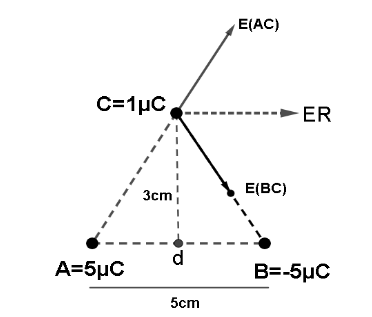
Here E(AC) is field on C due to A, and E(BC) id field on C due to B and ER is resultant field on C. In this image we see that charge on A is positive and charge on C is also positive hence there is a force of repulsion between these two charges, hence the net field E because of A on C will be as shown in the above figure. And away from A.
Now look at B and C , charge on C is positive whereas charge on B is negative hence there will be a force of attraction between these two charges. And the net electric field will be towards B. Now we need the net electric field on C due to both A and B. Looking at the image it is clear that the net electric field will be parallel to line AB.
Hence the correct answer is option C.
Note: Remember that the charges on A and C are opposite in nature and hence they will repel, take the direction along AC because according to the definition of electric force, it is along the line joining two points. Do not draw the electric field E(AC) on the other side or over C to A . It will be wrong.
Complete step by step answer:
Electric force is the pull or push that an electric charge will experience when placed in the electric field.Let us start answering this question by making a diagram. Look at the following steps to draw a diagram for this question:
-Firstly place a point charge at any point and name that point as \[A = 5\mu C\] .
-At a distance \[5cm\] apart place \[B = - 5\mu C\].
-Then at the perpendicular bisector place charge \[C = 1\mu C\].
Now let us look at the behavior of forces on point C due to A and B. Look at the following image:
Here E(AC) is field on C due to A, and E(BC) id field on C due to B and ER is resultant field on C. In this image we see that charge on A is positive and charge on C is also positive hence there is a force of repulsion between these two charges, hence the net field E because of A on C will be as shown in the above figure. And away from A.
Now look at B and C , charge on C is positive whereas charge on B is negative hence there will be a force of attraction between these two charges. And the net electric field will be towards B. Now we need the net electric field on C due to both A and B. Looking at the image it is clear that the net electric field will be parallel to line AB.
Hence the correct answer is option C.
Note: Remember that the charges on A and C are opposite in nature and hence they will repel, take the direction along AC because according to the definition of electric force, it is along the line joining two points. Do not draw the electric field E(AC) on the other side or over C to A . It will be wrong.
Recently Updated Pages
Basicity of sulphurous acid and sulphuric acid are

Master Class 12 English: Engaging Questions & Answers for Success
Master Class 12 Social Science: Engaging Questions & Answers for Success
Master Class 12 Maths: Engaging Questions & Answers for Success
Master Class 12 Economics: Engaging Questions & Answers for Success
Master Class 12 Physics: Engaging Questions & Answers for Success
Trending doubts
Which are the Top 10 Largest Countries of the World?
Draw a labelled sketch of the human eye class 12 physics CBSE
Draw ray diagrams each showing i myopic eye and ii class 12 physics CBSE
Give 10 examples of unisexual and bisexual flowers
Coming together federation is practiced in A India class 12 social science CBSE
Write the formula to find the shortest distance between class 12 maths CBSE