




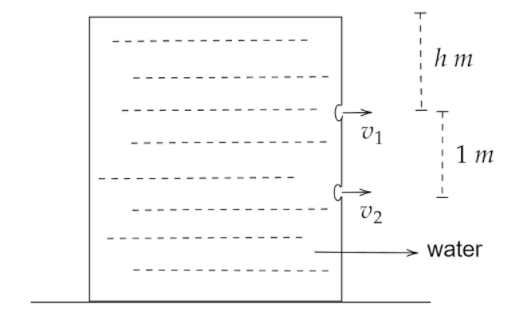
There are two holes one each along the opposite sides of a wide rectangular tank. The cross-section of each hole is $0.01{\text{ }}{m^2}$ and the vertical distance between the holes is one meter. The tank is filled with water. The net force in the tank in Newton when water flows out of the holes is: (Density of water is $1000{\text{ }}\dfrac{{kg}}{{{m^3}}}$) ($g = 10{\text{ }}\dfrac{m}{{{s^2}}}$)
(i) $100$ (ii) $200$ (iii) $300$ (iv) $400$
Answer
 Verified
524.4k+ views
Hint:We have to find the velocity of efflux of both the holes. Then we have to find the rate of flow of liquid from both the holes. We have to make use of the vertical distance as given in the question. From the derivative of momentum we will find the force.
Complete step-by-step solution:
Velocity of efflux is defined as the velocity of liquid that flows out from the hole of a tank.
The cross-section of each hole is $0.01{\text{ }}{m^2}$ and the vertical distance between the holes is $1{\text{ }}m$. Let ${v_1}$ and ${v_2}$ be the velocities of efflux. Let the distance between the upper part of the tank and the $1$st hole be $h$. From the given figure we find out that,
${v_1} = \sqrt {2gh} - - - \left( 1 \right)$
As the distance between the $1$st hole and the $2$nd hole is $h$.
Then, ${v_2} = \sqrt {2g\left( {h + 1} \right)} - - - - \left( 2 \right)$
Let the rate of flow of liquid from the $1$st hole be ${Q_1}$ and the $2$nd hole is ${Q_2}$.
The formula for the rate of flow of liquid is,
$Q = Av = \dfrac{d}{{dt}}\left( V \right) - - - - - \left( 3 \right)$ where $Q = $ rate of flow of liquid, $A = $ area of cross-section and $v = $ velocity of efflux and $V = $ volume.
Force can be defined also as the time rate of change of momentum.
$F = \dfrac{d}{{dt}}\left( {mv} \right)$ where $F = $ force, $m = mass$ and $v = $velocity.
We know, $m = \rho \times V$ where $\rho = $ density.
So, we can now write,
$F = v \times \dfrac{d}{{dt}}\left( m \right)$
Changing the mass into the form of density and volume,
$F = v \times \rho \times \dfrac{d}{{dt}}\left( V \right)$
$\dfrac{d}{{dt}}\left( V \right) = Q = $ time rate of flow.
Let the force and mass of liquid flown at the $1$st hole be ${F_1}$ and ${m_1}$ and the $2$nd hole is ${F_2}$ and ${m_2}$.
Total force $F = {F_2} - {F_1}$
So, we get,
$F = {v_2} \times \dfrac{d}{{dt}}\left( {{m_2}} \right) - {v_1} \times \dfrac{d}{{dt}}\left( {{m_1}} \right)$
Converting the mass and simplifying the equation we get,
$
F = \rho \left[ {{v_2} \times \dfrac{d}{{dt}}\left( {{V_2}} \right) - {v_1} \times \dfrac{d}{{dt}}\left( {{V_1}} \right)} \right] \\
\Rightarrow F = \rho \times \left[ {{v_2}{Q_2} - {v_1}{Q_1}} \right] \\
$
Substituting the values we get,
$F = 1000 \times \left[ {{A_2}v_2^2 - {A_1}v_1^2} \right]$
${A_2} = {A_1} = 0.01$and thus, putting the value of ${v_1}$ and ${v_2}$we get,
$
F = 1000 \times 0.01 \times \left[ {2g\left( {h + 1} \right) - 2gh} \right] \\
\Rightarrow F = 10 \times 2 \times 10 = 200 \\
$
So, the total force is $200{\text{ }}N$.
Note:It must be noted that the vertical distance between two holes is $1{\text{ }}m$ which does not imply total height. We have to use the force’s equation in terms of momentum and not in terms of acceleration and mass in this particular problem. The efflux velocity is dependent only upon height as the acceleration gravity for hole remains the same often.
Complete step-by-step solution:
Velocity of efflux is defined as the velocity of liquid that flows out from the hole of a tank.
The cross-section of each hole is $0.01{\text{ }}{m^2}$ and the vertical distance between the holes is $1{\text{ }}m$. Let ${v_1}$ and ${v_2}$ be the velocities of efflux. Let the distance between the upper part of the tank and the $1$st hole be $h$. From the given figure we find out that,
${v_1} = \sqrt {2gh} - - - \left( 1 \right)$
As the distance between the $1$st hole and the $2$nd hole is $h$.
Then, ${v_2} = \sqrt {2g\left( {h + 1} \right)} - - - - \left( 2 \right)$
Let the rate of flow of liquid from the $1$st hole be ${Q_1}$ and the $2$nd hole is ${Q_2}$.
The formula for the rate of flow of liquid is,
$Q = Av = \dfrac{d}{{dt}}\left( V \right) - - - - - \left( 3 \right)$ where $Q = $ rate of flow of liquid, $A = $ area of cross-section and $v = $ velocity of efflux and $V = $ volume.
Force can be defined also as the time rate of change of momentum.
$F = \dfrac{d}{{dt}}\left( {mv} \right)$ where $F = $ force, $m = mass$ and $v = $velocity.
We know, $m = \rho \times V$ where $\rho = $ density.
So, we can now write,
$F = v \times \dfrac{d}{{dt}}\left( m \right)$
Changing the mass into the form of density and volume,
$F = v \times \rho \times \dfrac{d}{{dt}}\left( V \right)$
$\dfrac{d}{{dt}}\left( V \right) = Q = $ time rate of flow.
Let the force and mass of liquid flown at the $1$st hole be ${F_1}$ and ${m_1}$ and the $2$nd hole is ${F_2}$ and ${m_2}$.
Total force $F = {F_2} - {F_1}$
So, we get,
$F = {v_2} \times \dfrac{d}{{dt}}\left( {{m_2}} \right) - {v_1} \times \dfrac{d}{{dt}}\left( {{m_1}} \right)$
Converting the mass and simplifying the equation we get,
$
F = \rho \left[ {{v_2} \times \dfrac{d}{{dt}}\left( {{V_2}} \right) - {v_1} \times \dfrac{d}{{dt}}\left( {{V_1}} \right)} \right] \\
\Rightarrow F = \rho \times \left[ {{v_2}{Q_2} - {v_1}{Q_1}} \right] \\
$
Substituting the values we get,
$F = 1000 \times \left[ {{A_2}v_2^2 - {A_1}v_1^2} \right]$
${A_2} = {A_1} = 0.01$and thus, putting the value of ${v_1}$ and ${v_2}$we get,
$
F = 1000 \times 0.01 \times \left[ {2g\left( {h + 1} \right) - 2gh} \right] \\
\Rightarrow F = 10 \times 2 \times 10 = 200 \\
$
So, the total force is $200{\text{ }}N$.
Note:It must be noted that the vertical distance between two holes is $1{\text{ }}m$ which does not imply total height. We have to use the force’s equation in terms of momentum and not in terms of acceleration and mass in this particular problem. The efflux velocity is dependent only upon height as the acceleration gravity for hole remains the same often.
Recently Updated Pages
Master Class 12 Social Science: Engaging Questions & Answers for Success

Master Class 12 Physics: Engaging Questions & Answers for Success
Master Class 12 Maths: Engaging Questions & Answers for Success
Master Class 12 Economics: Engaging Questions & Answers for Success
Master Class 12 Chemistry: Engaging Questions & Answers for Success
Master Class 12 Business Studies: Engaging Questions & Answers for Success
Trending doubts
Which are the Top 10 Largest Countries of the World?
Draw a labelled sketch of the human eye class 12 physics CBSE
Explain the structure of megasporangium class 12 biology CBSE
What are the major means of transport Explain each class 12 social science CBSE
How many chromosomes are found in human ovum a 46 b class 12 biology CBSE
The diagram of the section of a maize grain is given class 12 biology CBSE