




There are \[m\] seats in the first row of a theatre, of which \[n\] are to be occupied. The number of ways of arranging \[n\] persons so that there should be at least 2 empty seats between any two persons
A.\[^{m - 2n + 2}{C_n}n!\]
B.\[^{m - n + 1}{C_n}\left( {n - 2} \right)!\]
C.\[^{m - n + 1}{P_n}\]
D.\[^{m - n}{P_n}n!\]
Answer
 Verified
589.8k+ views
Hint: The number of seats \[m\] is separated into number of people \[n\] and number of empty places, say \[x.\], and we will be using this fact to solve for the number of arrangements of the people. A point to remember is that since there are \[n\] people, the range goes from 1 to \[n + 1\] because we have to consider the starting and ending seats which may or may not be occupied.
Formula Used:
Total number of combinations = \[^{N + r - 1}{C_{r - 1}}\] …(i)
Complete step-by-step answer:
Given, the total number of seats = \[m\]
The total number of seats occupied = \[n\]
Let the number of spaces be \[x\]
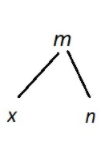
Let \[{x_1},{x_2},{x_3},...,{x_{n + 1}}\] represent the spaces. So, it means,
\[{x_1} + {x_2} + {x_3} + ... + {x_n} = x\]
And we have already established that
\[x + n = m\]
Thus, \[{x_1} + {x_2} + {x_3} + ... + {x_n} + n = m\] …(ii)
Let \[{x_1} = {y_1},{\rm{ }}{x_{n + 1}} = {y_{n + 1}}\] and \[{x_i} = {y_i} - 2,{\rm{ }}i \in \left[ {2,n} \right]\]
We subtracted 2 from all the seats (except the first and last seat) so as to remove the possible spaces between them as the number of spaces between them is given to be 2, but we did not remove the seats from the first and last seats because they are on the ends and do not have the possibility of spaces.
So, doing the substitution of the seats and spaces into equation (ii) and we have got,
\[{y_1} + \left( {{y_2} - 2} \right) + \left( {{y_3} - 2} \right) + \left( {{y_n} - 2} \right) + {y_{n + 1}} + n = m\]
The number of \[y\] terms with a \[ - 2\] with it is - \[n - 2 + 1 = n - 1\] (because we are starting from \[{y_2}\])
Thus, we can club all the \[ - 2\] terms together, and we get:
$\Rightarrow$ \[{y_1} + {y_2} + {y_3} + ... + {y_n} + {y_{n + 1}} - 2\left( {n - 1} \right) + n = m\]
Now, taking \[2\left( {n - 1} \right),n\] to the other side, we get:
$\Rightarrow$ \[{y_1} + {y_2} + {y_3} + ... + {y_n} + {y_{n + 1}} = m - n + 2\left( {n - 1} \right)\]
Solving the right-hand side of the equation, we get:
$\Rightarrow$ \[{y_1} + {y_2} + {y_3} + ... + {y_n} + {y_{n + 1}} = m - n + 2n - 2\]
$\Rightarrow$ \[{y_1} + {y_2} + {y_3} + ... + {y_n} + {y_{n + 1}} = m + n - 2\]
Now, with the total sum of all the \[y\] terms we get the \[N\] used in equation (i) and \[r\] is the total number of units to be filled, which is \[n + 1\].
So, \[N = m + n - 2\] and \[r = n + 1\]
Now, finally putting these values in equation (i) we get:
Total number of combinations, \[T{ = ^{N + r - 1}}{C_{r - 1}}\]
$\Rightarrow$ \[T{ = ^{m + n - 2 + \left( {n + 1} \right) - 1}}{C_{n + 1 - 1}}\]
$\Rightarrow$ \[T{ = ^{m + 2n - 2}}{C_n}\]
Now, these \[n\] people can be arranged among themselves in \[n!\] ways.
Hence, the number of ways of arranging \[n\] persons so that there should be at least 2 empty seats between any two persons is option A \[^{m + 2n - 2}{C_n}n!\].
Note: In these questions, we must remember that the seats on the ends do not have any places, so they won’t be considered in the transformation. Also, special tidiness must be ensured in solving such equations as there are a lot of terms and things get messy, increasing the chances of errors.
Formula Used:
Total number of combinations = \[^{N + r - 1}{C_{r - 1}}\] …(i)
Complete step-by-step answer:
Given, the total number of seats = \[m\]
The total number of seats occupied = \[n\]
Let the number of spaces be \[x\]
Let \[{x_1},{x_2},{x_3},...,{x_{n + 1}}\] represent the spaces. So, it means,
\[{x_1} + {x_2} + {x_3} + ... + {x_n} = x\]
And we have already established that
\[x + n = m\]
Thus, \[{x_1} + {x_2} + {x_3} + ... + {x_n} + n = m\] …(ii)
Let \[{x_1} = {y_1},{\rm{ }}{x_{n + 1}} = {y_{n + 1}}\] and \[{x_i} = {y_i} - 2,{\rm{ }}i \in \left[ {2,n} \right]\]
We subtracted 2 from all the seats (except the first and last seat) so as to remove the possible spaces between them as the number of spaces between them is given to be 2, but we did not remove the seats from the first and last seats because they are on the ends and do not have the possibility of spaces.
So, doing the substitution of the seats and spaces into equation (ii) and we have got,
\[{y_1} + \left( {{y_2} - 2} \right) + \left( {{y_3} - 2} \right) + \left( {{y_n} - 2} \right) + {y_{n + 1}} + n = m\]
The number of \[y\] terms with a \[ - 2\] with it is - \[n - 2 + 1 = n - 1\] (because we are starting from \[{y_2}\])
Thus, we can club all the \[ - 2\] terms together, and we get:
$\Rightarrow$ \[{y_1} + {y_2} + {y_3} + ... + {y_n} + {y_{n + 1}} - 2\left( {n - 1} \right) + n = m\]
Now, taking \[2\left( {n - 1} \right),n\] to the other side, we get:
$\Rightarrow$ \[{y_1} + {y_2} + {y_3} + ... + {y_n} + {y_{n + 1}} = m - n + 2\left( {n - 1} \right)\]
Solving the right-hand side of the equation, we get:
$\Rightarrow$ \[{y_1} + {y_2} + {y_3} + ... + {y_n} + {y_{n + 1}} = m - n + 2n - 2\]
$\Rightarrow$ \[{y_1} + {y_2} + {y_3} + ... + {y_n} + {y_{n + 1}} = m + n - 2\]
Now, with the total sum of all the \[y\] terms we get the \[N\] used in equation (i) and \[r\] is the total number of units to be filled, which is \[n + 1\].
So, \[N = m + n - 2\] and \[r = n + 1\]
Now, finally putting these values in equation (i) we get:
Total number of combinations, \[T{ = ^{N + r - 1}}{C_{r - 1}}\]
$\Rightarrow$ \[T{ = ^{m + n - 2 + \left( {n + 1} \right) - 1}}{C_{n + 1 - 1}}\]
$\Rightarrow$ \[T{ = ^{m + 2n - 2}}{C_n}\]
Now, these \[n\] people can be arranged among themselves in \[n!\] ways.
Hence, the number of ways of arranging \[n\] persons so that there should be at least 2 empty seats between any two persons is option A \[^{m + 2n - 2}{C_n}n!\].
Note: In these questions, we must remember that the seats on the ends do not have any places, so they won’t be considered in the transformation. Also, special tidiness must be ensured in solving such equations as there are a lot of terms and things get messy, increasing the chances of errors.
Recently Updated Pages
Three beakers labelled as A B and C each containing 25 mL of water were taken A small amount of NaOH anhydrous CuSO4 and NaCl were added to the beakers A B and C respectively It was observed that there was an increase in the temperature of the solutions contained in beakers A and B whereas in case of beaker C the temperature of the solution falls Which one of the following statements isarecorrect i In beakers A and B exothermic process has occurred ii In beakers A and B endothermic process has occurred iii In beaker C exothermic process has occurred iv In beaker C endothermic process has occurred

Master Class 11 Social Science: Engaging Questions & Answers for Success
Master Class 11 Physics: Engaging Questions & Answers for Success
Master Class 11 Maths: Engaging Questions & Answers for Success
Master Class 11 Economics: Engaging Questions & Answers for Success
Master Class 11 Computer Science: Engaging Questions & Answers for Success
Three beakers labelled as A B and C each containing 25 mL of water were taken A small amount of NaOH anhydrous CuSO4 and NaCl were added to the beakers A B and C respectively It was observed that there was an increase in the temperature of the solutions contained in beakers A and B whereas in case of beaker C the temperature of the solution falls Which one of the following statements isarecorrect i In beakers A and B exothermic process has occurred ii In beakers A and B endothermic process has occurred iii In beaker C exothermic process has occurred iv In beaker C endothermic process has occurred
Master Class 11 Social Science: Engaging Questions & Answers for Success
Master Class 11 Physics: Engaging Questions & Answers for Success
Trending doubts
One Metric ton is equal to kg A 10000 B 1000 C 100 class 11 physics CBSE
There are 720 permutations of the digits 1 2 3 4 5 class 11 maths CBSE
State and prove Bernoullis theorem class 11 physics CBSE
Draw a diagram of a plant cell and label at least eight class 11 biology CBSE
Difference Between Prokaryotic Cells and Eukaryotic Cells
1 Quintal is equal to a 110 kg b 10 kg c 100kg d 1000 class 11 physics CBSE