




The $y = 2$ is a line
A. Parallel to x-axis
B. Parallel to y-axis
C. Passing through origin
D. None
Answer
 Verified
536.1k+ views
Hint: In order to find the state of a line for the given equation, initiate with thinking out the possible properties of the line, what are the coordinates that it covers. Then draw the graph of the equation using the conditions and check out at what position it lies.
Complete step by step answer:
We are given with an equation $y = 2$. We know that there are two values in a $\left( {x,y} \right)$ coordinate that is x-value and the y-value. Since, the value of y is given to us is a constant term, and the value of x coordinate is not given. This means whatever we place the value of x, the value of y will always be the same , that is $y = 2$.
For example, we take $x = 0$, we have $y = 2$, so the point becomes $\left( {0,2} \right)$.Similarly, when we take $x = 4$, we have $y = 2$, so the point becomes $\left( {4,2} \right)$.And, when we take $x = - 3$, we have $y = 2$, so the point becomes $\left( { - 3,2} \right)$.Substituting all these points on the graph and joining them we get:
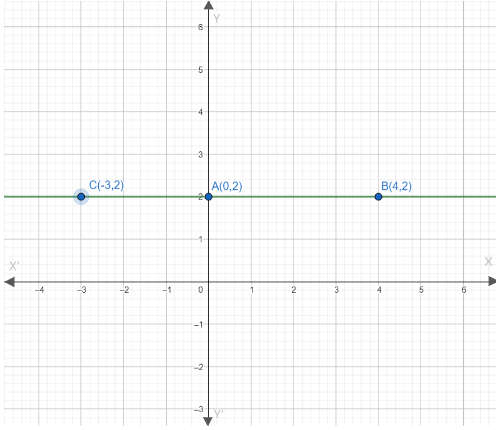
And, we can see that the line becomes parallel to the x-axis. Therefore, $y = 2$ is a line that is Parallel to the x-axis.
Hence, option A is correct.
Note: It has already been proved that in general if $x = a$, then the line will be parallel to y-axis and if $y = b$, then the line will be parallel to x-axis, where a and b are any constant terms. It’s important to graph the values by taking some general points in order to make an equation of a line.
Complete step by step answer:
We are given with an equation $y = 2$. We know that there are two values in a $\left( {x,y} \right)$ coordinate that is x-value and the y-value. Since, the value of y is given to us is a constant term, and the value of x coordinate is not given. This means whatever we place the value of x, the value of y will always be the same , that is $y = 2$.
For example, we take $x = 0$, we have $y = 2$, so the point becomes $\left( {0,2} \right)$.Similarly, when we take $x = 4$, we have $y = 2$, so the point becomes $\left( {4,2} \right)$.And, when we take $x = - 3$, we have $y = 2$, so the point becomes $\left( { - 3,2} \right)$.Substituting all these points on the graph and joining them we get:
And, we can see that the line becomes parallel to the x-axis. Therefore, $y = 2$ is a line that is Parallel to the x-axis.
Hence, option A is correct.
Note: It has already been proved that in general if $x = a$, then the line will be parallel to y-axis and if $y = b$, then the line will be parallel to x-axis, where a and b are any constant terms. It’s important to graph the values by taking some general points in order to make an equation of a line.

Recently Updated Pages
Master Class 11 English: Engaging Questions & Answers for Success

Master Class 11 Social Science: Engaging Questions & Answers for Success
Master Class 11 Maths: Engaging Questions & Answers for Success
Master Class 11 Chemistry: Engaging Questions & Answers for Success
Master Class 11 Biology: Engaging Questions & Answers for Success
Master Class 11 Physics: Engaging Questions & Answers for Success
Trending doubts
What is BLO What is the full form of BLO class 8 social science CBSE
Which Indian state shares the longest international class 8 social science CBSE
Citizens of India can vote at the age of A 18 years class 8 social science CBSE
In Indian rupees 1 trillion is equal to how many c class 8 maths CBSE
Full form of STD, ISD and PCO
Give me the opposite gender of Duck class 8 english CBSE