




The x- intercept of the tangent at any arbitrary point of the curve $\dfrac{a}{{{x}^{2}}}+\dfrac{b}{{{y}^{2}}}=1$ is proportional to:
A.square of the abscissa of the point of tangency
B.square root of the abscissa of the point of tangency
C.cube of the abscissa of the point of tangency
D.cube root of the abscissa of the point of tangency
Answer
 Verified
593.7k+ views
Hint: $x$ intercept of line is calculated by substituting $y=0$ in equation of line $ax+by+c=0$, by differentiating the equation of curve we get the slope of curve at $P\left( r,s \right)$. Put value $y=0$ in equation of tangent $y-s=\dfrac{-a{{s}^{3}}}{b{{r}^{3}}}\left( x-r \right)$ and by using the equation of curve at $P\left( r,s \right)$ obtain the value of $x$ intercept.
Complete step-by-step answer:
The $x$ intercept of the tangent at any arbitrary point of curve$\dfrac{a}{{{x}^{2}}}+\dfrac{b}{{{y}^{2}}}=1$is represented as:
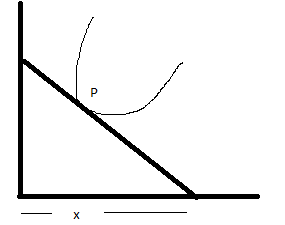
Let the coordinates of the arbitrary point $P$ can be represented as $\left( r,s \right)$
To find the $x$ intercept of any line, put the value of $y$ as zero. The equation for a line is represented as:
$\Rightarrow ax+by+c=0$
Putting the value of$y=0$ in the above equation,
$\Rightarrow ax+b\times 0+c=0$
$\begin{align}
& \Rightarrow ax+c=0 \\
& \Rightarrow x=\frac{-c}{a} \\
\end{align}$
Therefore the value of $x$ intercept is $\dfrac{-c}{a}$
Calculating the slope of the curve by differentiating the equation for curve,
Equation of curve is
$\Rightarrow \dfrac{a}{{{x}^{2}}}+\dfrac{b}{{{y}^{2}}}=1....(1)$
Differentiating equation with respect to $x$ (1)
$\Rightarrow \dfrac{-2a}{{{x}^{3}}}-\dfrac{2b}{{{y}^{3}}}\dfrac{dy}{dx}=0$
Separating $\dfrac{dy}{dx}$term,
$\begin{align}
& \Rightarrow \dfrac{-2a}{{{x}^{3}}}=\dfrac{2b}{{{y}^{3}}}\dfrac{dy}{dx} \\
& \Rightarrow \dfrac{dy}{dx}=\dfrac{-a{{y}^{3}}}{b{{x}^{3}}} \\
\end{align}$
Putting the values of arbitrary points$\left( r,s \right)$
$\Rightarrow \dfrac{dy}{dx}=\dfrac{-a{{s}^{3}}}{b{{r}^{3}}}$
Equation of tangent at $P\left( r,s \right)$is:
$\Rightarrow y-s=\dfrac{-a{{s}^{3}}}{b{{r}^{3}}}\left( x-r \right).....(2)$
Putting the value $y=0$ in equation (2) to find the $x$ intercept,
$\Rightarrow -s=\dfrac{-a{{s}^{3}}}{b{{r}^{3}}}\left( x-r \right)$
Solving it,
$\begin{align}
& \Rightarrow -s\times \dfrac{b{{r}^{3}}}{-a{{s}^{3}}}=x-r \\
& \Rightarrow \dfrac{b{{r}^{3}}}{a{{s}^{2}}}=x-r \\
& \Rightarrow x=r+\dfrac{b{{r}^{3}}}{a{{s}^{2}}} \\
\end{align}$
Taking $r$ common,
$\Rightarrow x=r\left( 1+\dfrac{b{{r}^{2}}}{a{{s}^{2}}} \right)$
$\Rightarrow x=r\left( \dfrac{a{{s}^{2}}+b{{r}^{2}}}{a{{s}^{2}}} \right)....(3)$
From equation of curve $\dfrac{a}{{{x}^{2}}}+\dfrac{b}{{{y}^{2}}}=1$,
$\Rightarrow \dfrac{a}{{{x}^{2}}}+\dfrac{b}{{{y}^{2}}}=1$
At $P\left( r,s \right)$,
$\begin{align}
& \Rightarrow \dfrac{a}{{{r}^{2}}}+\dfrac{b}{{{s}^{2}}}=1 \\
& \Rightarrow a{{s}^{2}}+b{{r}^{2}}={{r}^{2}}{{s}^{2}}.....(4) \\
\end{align}$
Substituting equation (4) in (3)
$\begin{align}
& \Rightarrow x=r\times \dfrac{{{r}^{2}}{{s}^{2}}}{a{{s}^{2}}} \\
& \Rightarrow x=\dfrac{{{r}^{3}}}{a} \\
\end{align}$
Therefore, The $x$- intercept of the tangent at any arbitrary point of the curve $\dfrac{a}{{{x}^{2}}}+\dfrac{b}{{{y}^{2}}}=1$ is proportional to (C) cube of the abscissa of the point of tangency.
Note: Differentiate the equation of curve at $P\left( r,s \right)$ with respect to $x$. Put the coordinates of arbitrary points other than $x$ and $y$ in equations. Take $r$ common from equation (3).
Complete step-by-step answer:
The $x$ intercept of the tangent at any arbitrary point of curve$\dfrac{a}{{{x}^{2}}}+\dfrac{b}{{{y}^{2}}}=1$is represented as:
Let the coordinates of the arbitrary point $P$ can be represented as $\left( r,s \right)$
To find the $x$ intercept of any line, put the value of $y$ as zero. The equation for a line is represented as:
$\Rightarrow ax+by+c=0$
Putting the value of$y=0$ in the above equation,
$\Rightarrow ax+b\times 0+c=0$
$\begin{align}
& \Rightarrow ax+c=0 \\
& \Rightarrow x=\frac{-c}{a} \\
\end{align}$
Therefore the value of $x$ intercept is $\dfrac{-c}{a}$
Calculating the slope of the curve by differentiating the equation for curve,
Equation of curve is
$\Rightarrow \dfrac{a}{{{x}^{2}}}+\dfrac{b}{{{y}^{2}}}=1....(1)$
Differentiating equation with respect to $x$ (1)
$\Rightarrow \dfrac{-2a}{{{x}^{3}}}-\dfrac{2b}{{{y}^{3}}}\dfrac{dy}{dx}=0$
Separating $\dfrac{dy}{dx}$term,
$\begin{align}
& \Rightarrow \dfrac{-2a}{{{x}^{3}}}=\dfrac{2b}{{{y}^{3}}}\dfrac{dy}{dx} \\
& \Rightarrow \dfrac{dy}{dx}=\dfrac{-a{{y}^{3}}}{b{{x}^{3}}} \\
\end{align}$
Putting the values of arbitrary points$\left( r,s \right)$
$\Rightarrow \dfrac{dy}{dx}=\dfrac{-a{{s}^{3}}}{b{{r}^{3}}}$
Equation of tangent at $P\left( r,s \right)$is:
$\Rightarrow y-s=\dfrac{-a{{s}^{3}}}{b{{r}^{3}}}\left( x-r \right).....(2)$
Putting the value $y=0$ in equation (2) to find the $x$ intercept,
$\Rightarrow -s=\dfrac{-a{{s}^{3}}}{b{{r}^{3}}}\left( x-r \right)$
Solving it,
$\begin{align}
& \Rightarrow -s\times \dfrac{b{{r}^{3}}}{-a{{s}^{3}}}=x-r \\
& \Rightarrow \dfrac{b{{r}^{3}}}{a{{s}^{2}}}=x-r \\
& \Rightarrow x=r+\dfrac{b{{r}^{3}}}{a{{s}^{2}}} \\
\end{align}$
Taking $r$ common,
$\Rightarrow x=r\left( 1+\dfrac{b{{r}^{2}}}{a{{s}^{2}}} \right)$
$\Rightarrow x=r\left( \dfrac{a{{s}^{2}}+b{{r}^{2}}}{a{{s}^{2}}} \right)....(3)$
From equation of curve $\dfrac{a}{{{x}^{2}}}+\dfrac{b}{{{y}^{2}}}=1$,
$\Rightarrow \dfrac{a}{{{x}^{2}}}+\dfrac{b}{{{y}^{2}}}=1$
At $P\left( r,s \right)$,
$\begin{align}
& \Rightarrow \dfrac{a}{{{r}^{2}}}+\dfrac{b}{{{s}^{2}}}=1 \\
& \Rightarrow a{{s}^{2}}+b{{r}^{2}}={{r}^{2}}{{s}^{2}}.....(4) \\
\end{align}$
Substituting equation (4) in (3)
$\begin{align}
& \Rightarrow x=r\times \dfrac{{{r}^{2}}{{s}^{2}}}{a{{s}^{2}}} \\
& \Rightarrow x=\dfrac{{{r}^{3}}}{a} \\
\end{align}$
Therefore, The $x$- intercept of the tangent at any arbitrary point of the curve $\dfrac{a}{{{x}^{2}}}+\dfrac{b}{{{y}^{2}}}=1$ is proportional to (C) cube of the abscissa of the point of tangency.
Note: Differentiate the equation of curve at $P\left( r,s \right)$ with respect to $x$. Put the coordinates of arbitrary points other than $x$ and $y$ in equations. Take $r$ common from equation (3).
Recently Updated Pages
Master Class 11 Social Science: Engaging Questions & Answers for Success

Master Class 11 Physics: Engaging Questions & Answers for Success
Master Class 11 Maths: Engaging Questions & Answers for Success
Master Class 11 Economics: Engaging Questions & Answers for Success
Master Class 11 Computer Science: Engaging Questions & Answers for Success
Master Class 11 Chemistry: Engaging Questions & Answers for Success
Trending doubts
One Metric ton is equal to kg A 10000 B 1000 C 100 class 11 physics CBSE
There are 720 permutations of the digits 1 2 3 4 5 class 11 maths CBSE
1 Quintal is equal to a 110 kg b 10 kg c 100kg d 1000 class 11 physics CBSE
State and prove Bernoullis theorem class 11 physics CBSE
Difference Between Prokaryotic Cells and Eukaryotic Cells
Discuss the various forms of bacteria class 11 biology CBSE