



The wheel shown in the diagram has a fixed axle passing through O. The wheel is kept stationary under the action of
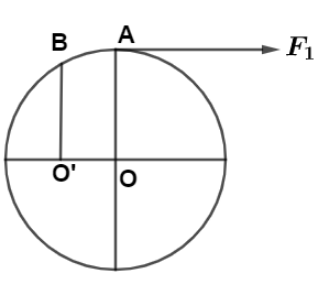
(i) Horizontal force ${F_1}$ at A and
(ii) A vertical force ${F_2}$ at B.
Show the direction of force ${F_2}$ in the diagram.
Answer
 Verified
569.7k+ views
Hint:In order to solve this question we need to understand torque. Torque is defined as a rotating force which causes different bodies to rotate. It is mathematically defined as the cross product of force and the perpendicular distance from the axis to the line of action of force. It is a vector quantity and direction of rotation of circular bodies can be found using cross product rule, which states that for direction stretch your palm in direction of first vector and rotate fingers in direction of second vector, so the thumb direction is torque direction.
Complete step by step answer:
Since in figure, a horizontal force ${F_1}$ acts at A, so for torque direction we draw a perpendicular from axle point O to A whose distance is equal to radius and this vector points in upward direction, so torque due to ${F_1}$ is given by,
\[{\vec \tau _1} = \vec r \times {\vec F_1}\]
Since $\vec r$ is perpendicular to ${\vec F_1}$ so torque become,
\[{\vec \tau _1} = \left| {\vec r} \right|\left| {{{\vec F}_1}} \right|( - \hat n)\]
Here, the negative sign denotes the torque due to ${F_1}$ being into the plane of paper.
For wheel to stationary, there must be torque in outward direction,
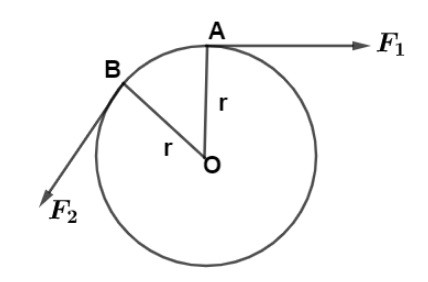
Consider a force ${F_2}$ which in direction as shown, now for torque we draw a perpendicular from axle point O to B whose distance is equal to radius and this vector points in upward direction, so torque due to ${F_2}$ is given by,
\[{\vec \tau _2} = \vec r \times {\vec F_2}\]
Since $\vec r$ is perpendicular to ${\vec F_2}$ so torque become,
\[{\vec \tau _2} = \left| {\vec r} \right|\left| {{{\vec F}_2}} \right|( + \hat n)\]
Here, the positive sign denotes the torque due to ${F_2}$ being out of the plane of paper.
So in this way net torque is zero, and hence the wheel is stationary, so it cannot rotate.
Note: It should be remembered that here we have assumed that there would be no translation motion and also there would be no friction means the wheel is kept at a smooth surface. Also we assumed that the point of contact of the wheel is at rest and since there is no translation motion, the wheel could not drag itself. Also the direction of torque is determined using the cross product direction rule.
Complete step by step answer:
Since in figure, a horizontal force ${F_1}$ acts at A, so for torque direction we draw a perpendicular from axle point O to A whose distance is equal to radius and this vector points in upward direction, so torque due to ${F_1}$ is given by,
\[{\vec \tau _1} = \vec r \times {\vec F_1}\]
Since $\vec r$ is perpendicular to ${\vec F_1}$ so torque become,
\[{\vec \tau _1} = \left| {\vec r} \right|\left| {{{\vec F}_1}} \right|( - \hat n)\]
Here, the negative sign denotes the torque due to ${F_1}$ being into the plane of paper.
For wheel to stationary, there must be torque in outward direction,
Consider a force ${F_2}$ which in direction as shown, now for torque we draw a perpendicular from axle point O to B whose distance is equal to radius and this vector points in upward direction, so torque due to ${F_2}$ is given by,
\[{\vec \tau _2} = \vec r \times {\vec F_2}\]
Since $\vec r$ is perpendicular to ${\vec F_2}$ so torque become,
\[{\vec \tau _2} = \left| {\vec r} \right|\left| {{{\vec F}_2}} \right|( + \hat n)\]
Here, the positive sign denotes the torque due to ${F_2}$ being out of the plane of paper.
So in this way net torque is zero, and hence the wheel is stationary, so it cannot rotate.
Note: It should be remembered that here we have assumed that there would be no translation motion and also there would be no friction means the wheel is kept at a smooth surface. Also we assumed that the point of contact of the wheel is at rest and since there is no translation motion, the wheel could not drag itself. Also the direction of torque is determined using the cross product direction rule.
Recently Updated Pages
If x a + bt + ct2 where x is in meters and t is in class 11 physics CBSE

A car covers the first half distance between two places class 11 physics CBSE
The resultant of two vectors overrightarrow P and overrightarrow class 11 physics CBSE
Find the value of cos 135 class 11 maths CBSE
A mass M is held in place by an applied force F and class 11 physics CBSE
A solution of glucose in water is labelled as 10 dfracwv class 11 chemistry CBSE
Trending doubts
One Metric ton is equal to kg A 10000 B 1000 C 100 class 11 physics CBSE
Find the value of the expression given below sin 30circ class 11 maths CBSE
Draw a diagram of nephron and explain its structur class 11 biology CBSE
10 examples of friction in our daily life
Proton was discovered by A Thomson B Rutherford C Chadwick class 11 chemistry CBSE
Bond order ofO2 O2+ O2 and O22 is in order A O2 langle class 11 chemistry CBSE