




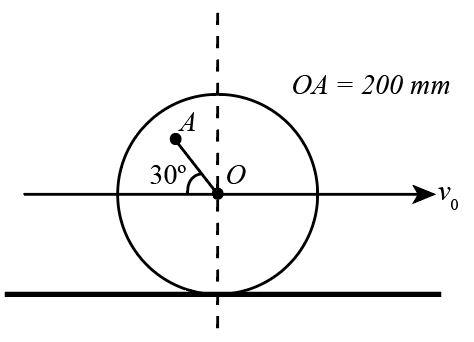
The wheel of radius $r = 300{\rm{ mm}}$ rolls to the right without slipping and has a velocity ${V_0} = 3{\rm{ m/s}}$ of its centre $O$. The speed of the point $A$ on the wheel for the instant represented in the figure is :-
(A) $4.36{\rm{ m/s}}$
(B) ${\rm{5 m/s}}$
(C) ${\rm{3 m/s}}$
(D) ${\rm{1}}{\rm{.5 m/s}}$
Answer
 Verified
589.8k+ views
Hint:
This question is based on the relationship between the linear velocity and the angular velocity of a point on a wheel rolling on a surface without slipping. When two velocity vectors ${V_1}$ and ${V_2}$ are acting on a point in such a way that the angle between them is $\theta $ then the net velocity vector of that point is calculated by Parallelogram Theorem. The formula for the net velocity is given by-
${V_{net}} = \sqrt {{{\left( {{V_1}} \right)}^2} + {{\left( {{V_2}} \right)}^2} + 2{V_1}{V_2}\cos \theta } $
Complete step by step solution
Given:
The radius of the wheel
$
r = 300{\rm{ mm}}\\
{\rm{or,}}\\
{\rm{r = 0}}{\rm{.3 m}}
$
The linear velocity of the centre $O$ of the wheel ${V_0} = 3{\rm{ m/s}}$
And the distance between the centre of the wheel $O$ and point $A$ on the wheel
$
OA = 200{\rm{ mm}}\\
{\rm{or,}}\\
{\rm{OA = 0}}{\rm{.2 m}}
$
The angle between $OA$ and the horizontal $\theta = 30^\circ $
We know the relation between the linear velocity and the angular velocity of a point moving in a circular motion is given by-
${V_0} = \omega r$
Where, $\omega $ is the angular velocity of the wheel and $r$ is the radius of the wheel.
Now substituting the values of ${V_0}$ and $r$ in the equation we get,
$
3{\rm{ m/s}} = \omega \times 0.3{\rm{ m}}\\
\omega = \dfrac{3}{{0.3}}
$
Solving this we get,
$\omega = 10{\rm{ rad/s}}$
Now, using the relation, the linear velocity of the point $A$ on the wheel is given by-
${V_A} = \omega \times OA$
Substituting the values of $\omega $ and $OA$ in the equation we get,
$
{V_A} = 10 \times 0.2\\
{V_A} = 2{\rm{ m/s}}
$
Net velocity of the point $A$ can be calculated by-
${V_{net}} = \sqrt {{{\left( {{V_0}} \right)}^2} + {{\left( {{V_A}} \right)}^2} + 2{V_0}{V_A}\cos \theta } $
Substituting the values of ${V_0}$, ${V_A}$ and $\theta $ in the equation we get,
$
{V_{net}} = \sqrt {{{\left( 3 \right)}^2} + {{\left( 2 \right)}^2} + 2 \times 3 \times 2 \times \cos 30^\circ } \\
\Rightarrow {V_{net}} = \sqrt {9 + 4 + 12 \times \dfrac{1}{2}} \\
\Rightarrow {V_{net}} = \sqrt {19} \\
\Rightarrow {V_{net}} = 4.36{\rm{ m/s}}
$
Therefore, the speed of the point $A$ on the wheel is $4.36{\rm{ m/s}}$ and the correct option is –
(A) $4.36{\rm{ m/s}}$
Note:
It should be noted that the direction of the velocity of the center of the wheel $O$ is parallel to the horizontal surface while the direction of the point $A$ on the wheel is radially outwards at an angle of $30^\circ $ from the horizontal.
This question is based on the relationship between the linear velocity and the angular velocity of a point on a wheel rolling on a surface without slipping. When two velocity vectors ${V_1}$ and ${V_2}$ are acting on a point in such a way that the angle between them is $\theta $ then the net velocity vector of that point is calculated by Parallelogram Theorem. The formula for the net velocity is given by-
${V_{net}} = \sqrt {{{\left( {{V_1}} \right)}^2} + {{\left( {{V_2}} \right)}^2} + 2{V_1}{V_2}\cos \theta } $
Complete step by step solution
Given:
The radius of the wheel
$
r = 300{\rm{ mm}}\\
{\rm{or,}}\\
{\rm{r = 0}}{\rm{.3 m}}
$
The linear velocity of the centre $O$ of the wheel ${V_0} = 3{\rm{ m/s}}$
And the distance between the centre of the wheel $O$ and point $A$ on the wheel
$
OA = 200{\rm{ mm}}\\
{\rm{or,}}\\
{\rm{OA = 0}}{\rm{.2 m}}
$
The angle between $OA$ and the horizontal $\theta = 30^\circ $
We know the relation between the linear velocity and the angular velocity of a point moving in a circular motion is given by-
${V_0} = \omega r$
Where, $\omega $ is the angular velocity of the wheel and $r$ is the radius of the wheel.
Now substituting the values of ${V_0}$ and $r$ in the equation we get,
$
3{\rm{ m/s}} = \omega \times 0.3{\rm{ m}}\\
\omega = \dfrac{3}{{0.3}}
$
Solving this we get,
$\omega = 10{\rm{ rad/s}}$
Now, using the relation, the linear velocity of the point $A$ on the wheel is given by-
${V_A} = \omega \times OA$
Substituting the values of $\omega $ and $OA$ in the equation we get,
$
{V_A} = 10 \times 0.2\\
{V_A} = 2{\rm{ m/s}}
$
Net velocity of the point $A$ can be calculated by-
${V_{net}} = \sqrt {{{\left( {{V_0}} \right)}^2} + {{\left( {{V_A}} \right)}^2} + 2{V_0}{V_A}\cos \theta } $
Substituting the values of ${V_0}$, ${V_A}$ and $\theta $ in the equation we get,
$
{V_{net}} = \sqrt {{{\left( 3 \right)}^2} + {{\left( 2 \right)}^2} + 2 \times 3 \times 2 \times \cos 30^\circ } \\
\Rightarrow {V_{net}} = \sqrt {9 + 4 + 12 \times \dfrac{1}{2}} \\
\Rightarrow {V_{net}} = \sqrt {19} \\
\Rightarrow {V_{net}} = 4.36{\rm{ m/s}}
$
Therefore, the speed of the point $A$ on the wheel is $4.36{\rm{ m/s}}$ and the correct option is –
(A) $4.36{\rm{ m/s}}$
Note:
It should be noted that the direction of the velocity of the center of the wheel $O$ is parallel to the horizontal surface while the direction of the point $A$ on the wheel is radially outwards at an angle of $30^\circ $ from the horizontal.
Recently Updated Pages
Basicity of sulphurous acid and sulphuric acid are

Master Class 11 Business Studies: Engaging Questions & Answers for Success
Master Class 11 Computer Science: Engaging Questions & Answers for Success
Master Class 11 Economics: Engaging Questions & Answers for Success
Master Class 11 Social Science: Engaging Questions & Answers for Success
Master Class 11 English: Engaging Questions & Answers for Success
Trending doubts
One Metric ton is equal to kg A 10000 B 1000 C 100 class 11 physics CBSE
The largest wind power cluster is located in the state class 11 social science CBSE
Explain zero factorial class 11 maths CBSE
State and prove Bernoullis theorem class 11 physics CBSE
Which among the following are examples of coming together class 11 social science CBSE
Can anyone list 10 advantages and disadvantages of friction