



The wheel of a cycle covers $660$ meters by making $500$ revolutions. What is the diameter of the wheel (in cm)?
A.$42$
B.$21$
C.$30$
D.$60$
Answer
 Verified
579k+ views
Hint: First, we will find the distance covered in one revolution which is given by-
$ \Rightarrow $ Distance covered in one revolution=$\dfrac{{{\text{distance covered}}}}{{{\text{number of revolutions}}}}$
Put the given values and solve. Now this distance will be equal to the circumference of the wheel which is given as-$2\pi r$ where r is the radius. Then, equate both equations and solve for r. Then we know that diameter is twice the radius so find the diameter. Then convert the m into cm.
Complete step-by-step answer:
Given, the wheel of a cycle covers a distance of $660$ meters.
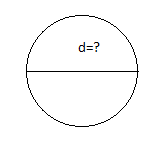
And the number of revolutions used to cover this distance is equal to$500$.
We know the formula of distance covered in one revolution is given as-
$ \Rightarrow $ Distance covered in one revolution=$\dfrac{{{\text{distance covered}}}}{{{\text{number of revolutions}}}}$
On putting the given values, we get-
$ \Rightarrow $ Distance covered in one revolution=$\dfrac{{660}}{{500}}$
On solving, we get-
$ \Rightarrow $ Distance covered in one revolution=$1.32m$ -- (i)
Now we know the distance covered by a wheel of the cycle is equal to the circumference of the wheel of the cycle.
Now we know that the shape of the wheel of the cycle is in a circle. And we know the circumference of the circle is given as-
$ \Rightarrow $ Circumference of the wheel=$2\pi r$ where r is the radius-- (ii)
On equating eq. (i) and (ii), we get-
$ \Rightarrow 2\pi r = 1.32$
On rearranging, we get-
$ \Rightarrow $ r=$\dfrac{{1.32}}{{2\pi }}$
On putting the value of $\pi $ in the above equation, we get-
$ \Rightarrow $ r=$\dfrac{{1.32 \times 7}}{{2 \times 22}}$
On solving, we get-
$ \Rightarrow $ r=$\dfrac{{11.24}}{{44}} = 0.21m$
We have to find the diameter so we know that-
$ \Rightarrow $ Diameter=$2 \times r$
On putting values, we get-
$ \Rightarrow $ Diameter=$2 \times 0.21 = 0.42m$
Now we know that-
$ \Rightarrow 1m = 100cm$
Then $0.42m = 0.42 \times 100 = 42cm$
Hence the correct answer is A.
Note: We can also solve the question by first converting the distance from m to cm. Then,
$ \Rightarrow 600m = 60000cm$
Then we find the distance covered in one revolution same as we have done in the above solution and we will get-
$ \Rightarrow $ Distance covered in one revolution=$132cm$
Then solve in the same pattern as done in the above solution to get the answer.
$ \Rightarrow $ Distance covered in one revolution=$\dfrac{{{\text{distance covered}}}}{{{\text{number of revolutions}}}}$
Put the given values and solve. Now this distance will be equal to the circumference of the wheel which is given as-$2\pi r$ where r is the radius. Then, equate both equations and solve for r. Then we know that diameter is twice the radius so find the diameter. Then convert the m into cm.
Complete step-by-step answer:
Given, the wheel of a cycle covers a distance of $660$ meters.
And the number of revolutions used to cover this distance is equal to$500$.
We know the formula of distance covered in one revolution is given as-
$ \Rightarrow $ Distance covered in one revolution=$\dfrac{{{\text{distance covered}}}}{{{\text{number of revolutions}}}}$
On putting the given values, we get-
$ \Rightarrow $ Distance covered in one revolution=$\dfrac{{660}}{{500}}$
On solving, we get-
$ \Rightarrow $ Distance covered in one revolution=$1.32m$ -- (i)
Now we know the distance covered by a wheel of the cycle is equal to the circumference of the wheel of the cycle.
Now we know that the shape of the wheel of the cycle is in a circle. And we know the circumference of the circle is given as-
$ \Rightarrow $ Circumference of the wheel=$2\pi r$ where r is the radius-- (ii)
On equating eq. (i) and (ii), we get-
$ \Rightarrow 2\pi r = 1.32$
On rearranging, we get-
$ \Rightarrow $ r=$\dfrac{{1.32}}{{2\pi }}$
On putting the value of $\pi $ in the above equation, we get-
$ \Rightarrow $ r=$\dfrac{{1.32 \times 7}}{{2 \times 22}}$
On solving, we get-
$ \Rightarrow $ r=$\dfrac{{11.24}}{{44}} = 0.21m$
We have to find the diameter so we know that-
$ \Rightarrow $ Diameter=$2 \times r$
On putting values, we get-
$ \Rightarrow $ Diameter=$2 \times 0.21 = 0.42m$
Now we know that-
$ \Rightarrow 1m = 100cm$
Then $0.42m = 0.42 \times 100 = 42cm$
Hence the correct answer is A.
Note: We can also solve the question by first converting the distance from m to cm. Then,
$ \Rightarrow 600m = 60000cm$
Then we find the distance covered in one revolution same as we have done in the above solution and we will get-
$ \Rightarrow $ Distance covered in one revolution=$132cm$
Then solve in the same pattern as done in the above solution to get the answer.
Recently Updated Pages
Master Class 8 Social Science: Engaging Questions & Answers for Success

Master Class 8 English: Engaging Questions & Answers for Success
Class 8 Question and Answer - Your Ultimate Solutions Guide
Master Class 8 Maths: Engaging Questions & Answers for Success
Master Class 8 Science: Engaging Questions & Answers for Success
Master Class 9 General Knowledge: Engaging Questions & Answers for Success
Trending doubts
What is BLO What is the full form of BLO class 8 social science CBSE
Citizens of India can vote at the age of A 18 years class 8 social science CBSE
Full form of STD, ISD and PCO
Advantages and disadvantages of science
Right to vote is a AFundamental Right BFundamental class 8 social science CBSE
What are the 12 elements of nature class 8 chemistry CBSE