




The weight of the skin is:
A. 10 Kg
B. 7 Kg
C. 2 Kg
D. Half of the body weight.
Answer
 Verified
604.8k+ views
Hint: Skin comprises mesoderm cells, skin pigments like melanin and protects from ultraviolet rays of the sun. Skin also contains some pigments which are responsible for DNA repair mechanisms and protects from the disease like skin cancer. It also contains sweat glands, blood vessels, dead cells, and nerve endings.
Complete answer:
Skin is the protective layer of the organisms which helps in fighting germs, protects from sunlight, and provides insulation (maintain body temperature).
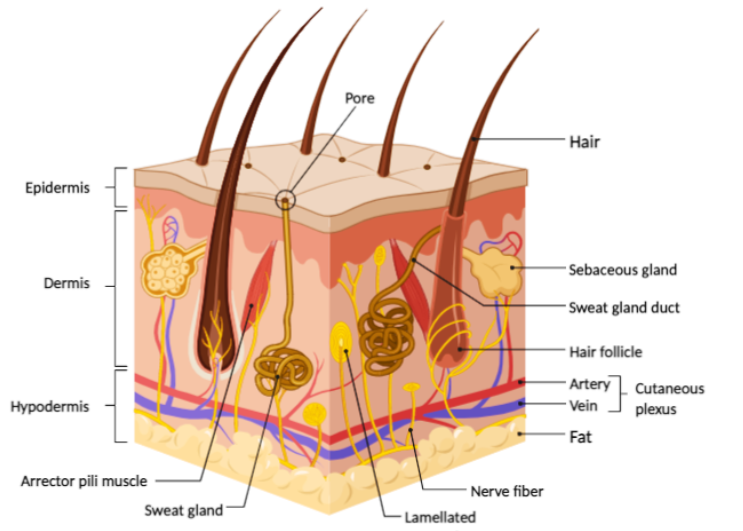
Skin is made up of three layers, that is, the epidermis which is made up of keratinocytes, dermis, and subcutaneous fat. Here, is one diagram to show elements of the skin:
There are so many functions:
Sensation: Skin contains many nerve endings due to which it helps in the sensation of heat or cold shocks, touch, pressure, and tissue injury.
Heat regulation: Blood vessels present in the skin helps in the better regulation of body temperature by preventing heat loss by radiation.
Excretion: Sweating helps in the removal of urea approximately, 1/30th of the total urine produced in the body.
The weight of the total skin of the adult individual is approximately 9-10 Kg. Thus, the option ‘A’ is the correct option.
Note: Surface area of the total skin is the largest organ in the human body, approximately 1.5-2.0 square meters. And the thickness of the skin varies over all parts of the body between males, females, and children. The epidermis layer is made up of cells which divide through the mitosis cell division method.
Complete answer:
Skin is the protective layer of the organisms which helps in fighting germs, protects from sunlight, and provides insulation (maintain body temperature).
Skin is made up of three layers, that is, the epidermis which is made up of keratinocytes, dermis, and subcutaneous fat. Here, is one diagram to show elements of the skin:
There are so many functions:
Sensation: Skin contains many nerve endings due to which it helps in the sensation of heat or cold shocks, touch, pressure, and tissue injury.
Heat regulation: Blood vessels present in the skin helps in the better regulation of body temperature by preventing heat loss by radiation.
Excretion: Sweating helps in the removal of urea approximately, 1/30th of the total urine produced in the body.
The weight of the total skin of the adult individual is approximately 9-10 Kg. Thus, the option ‘A’ is the correct option.
Note: Surface area of the total skin is the largest organ in the human body, approximately 1.5-2.0 square meters. And the thickness of the skin varies over all parts of the body between males, females, and children. The epidermis layer is made up of cells which divide through the mitosis cell division method.
Recently Updated Pages
Master Class 11 English: Engaging Questions & Answers for Success

Master Class 11 Social Science: Engaging Questions & Answers for Success
Master Class 11 Maths: Engaging Questions & Answers for Success
Master Class 11 Biology: Engaging Questions & Answers for Success
Master Class 11 Physics: Engaging Questions & Answers for Success
Master Class 11 Chemistry: Engaging Questions & Answers for Success
Trending doubts
One Metric ton is equal to kg A 10000 B 1000 C 100 class 11 physics CBSE
Difference Between Prokaryotic Cells and Eukaryotic Cells
Two of the body parts which do not appear in MRI are class 11 biology CBSE
Find the value of the expression given below sin 30circ class 11 maths CBSE
Draw a diagram of a plant cell and label at least eight class 11 biology CBSE
10 examples of friction in our daily life