




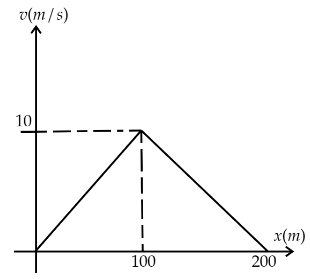
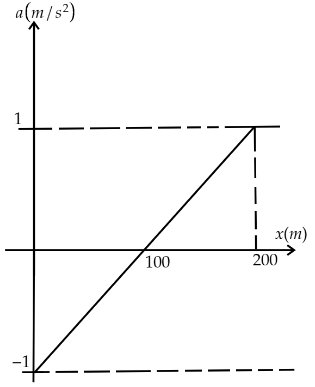
The $v-x$ curve for a car in a race on a straight line is given, identifying the correct $a-x$ graph.
A.
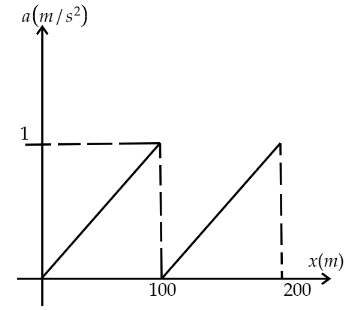
B.
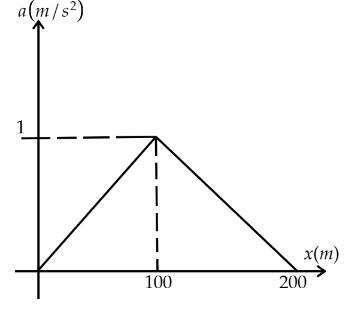
C.
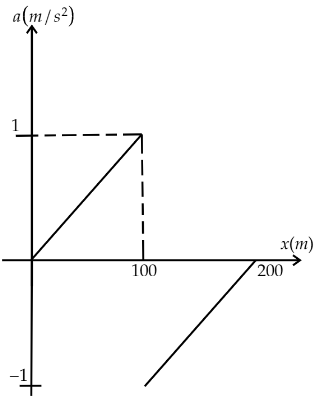
D.
Answer
 Verified
515.1k+ views
Hint: The velocity of a particle is the rate of change of displacement with time and acceleration of a particle is the rate of change of velocity with time. Use the definition to find the relation between the velocity and displacement and the relation between the acceleration and displacement.
Formula used:
The equation of a straight line is given by the formula,
\[y = mx + c\]
where, \[m\] is the slope of the straight line \[c\] is the intercept on the y axis.
The instantaneous velocity of a particle is given by,
\[v = \dfrac{{dx}}{{dt}}\]
where, \[x\] is the displacement of the particle \[t\] is the time.
The instantaneous acceleration of a particle is given by,
\[a = \dfrac{{dv}}{{dt}}\]
where, is the \[v\] velocity of the particle and is the time.
Complete step by step answer:
We know that the velocity of a particle is the rate of change of displacement with time and the acceleration of a particle is the rate of change of velocity with time. The formula for instantaneous velocity is given by, \[v = \dfrac{{dx}}{{dt}}\], where, \[x\]is the displacement of the particle \[t\] is the time. And the formula for instantaneous acceleration is given by, \[a = \dfrac{{dv}}{{dt}}\] where, is the \[v\] velocity of the particle and is the time.
Now, in the curve we first have to find the relation between the velocity and the displacement of the car. We can find the relation using the equation of straight line as the curve is a straight line. So, from the curve we can see that for 0 to 100 the slope of the curve is \[m = \dfrac{{10}}{{100}} = \dfrac{1}{{10}}\] and the intercept on the y axis is zero. So, equation for 0 to 100 is, \[v = \dfrac{1}{{10}}x\] ………( i)
So, differentiating with respect to time we have,
\[\dfrac{{dv}}{{dt}} = \dfrac{1}{{10}}\dfrac{{dx}}{{dt}}\]
\[\Rightarrow a = \dfrac{1}{{10}}v\]
Putting the value of equation (i) again we have,
\[a = \dfrac{1}{{100}}x\]
This shows that the a-x curve will be straight line of slope \[\dfrac{1}{{100}}\]
Now, for 100 to 200 the slope of the curve is \[ - \dfrac{1}{{10}}\]as the angle is negative and the intercept on the v axis is at \[20\].
So the equation of the curve is, \[v = 20 - \dfrac{1}{{10}}x\]………( ii)
So, differentiating with respect to time we have,
\[\dfrac{{dv}}{{dt}} = - \dfrac{1}{{10}}\dfrac{{dx}}{{dt}}\]
\[a = - \dfrac{1}{{10}}v\]
Putting the value of equation (ii) again we have,
\[a = - 2 + \dfrac{1}{{100}}x\]
Hence, the curve will be a straight line of slope \[\dfrac{1}{{100}}\] with an intercept at \[a\] axis at \[ - 2\]. So, the a-x curve can be drawn as given below.

Hence, option C is the correct answer.
Note: Always remember that since there is no direct relation between velocity and displacement or velocity and acceleration so we have to deduce the relation from the graph given then from there it is easy to find any relation as asked.
Formula used:
The equation of a straight line is given by the formula,
\[y = mx + c\]
where, \[m\] is the slope of the straight line \[c\] is the intercept on the y axis.
The instantaneous velocity of a particle is given by,
\[v = \dfrac{{dx}}{{dt}}\]
where, \[x\] is the displacement of the particle \[t\] is the time.
The instantaneous acceleration of a particle is given by,
\[a = \dfrac{{dv}}{{dt}}\]
where, is the \[v\] velocity of the particle and is the time.
Complete step by step answer:
We know that the velocity of a particle is the rate of change of displacement with time and the acceleration of a particle is the rate of change of velocity with time. The formula for instantaneous velocity is given by, \[v = \dfrac{{dx}}{{dt}}\], where, \[x\]is the displacement of the particle \[t\] is the time. And the formula for instantaneous acceleration is given by, \[a = \dfrac{{dv}}{{dt}}\] where, is the \[v\] velocity of the particle and is the time.
Now, in the curve we first have to find the relation between the velocity and the displacement of the car. We can find the relation using the equation of straight line as the curve is a straight line. So, from the curve we can see that for 0 to 100 the slope of the curve is \[m = \dfrac{{10}}{{100}} = \dfrac{1}{{10}}\] and the intercept on the y axis is zero. So, equation for 0 to 100 is, \[v = \dfrac{1}{{10}}x\] ………( i)
So, differentiating with respect to time we have,
\[\dfrac{{dv}}{{dt}} = \dfrac{1}{{10}}\dfrac{{dx}}{{dt}}\]
\[\Rightarrow a = \dfrac{1}{{10}}v\]
Putting the value of equation (i) again we have,
\[a = \dfrac{1}{{100}}x\]
This shows that the a-x curve will be straight line of slope \[\dfrac{1}{{100}}\]
Now, for 100 to 200 the slope of the curve is \[ - \dfrac{1}{{10}}\]as the angle is negative and the intercept on the v axis is at \[20\].
So the equation of the curve is, \[v = 20 - \dfrac{1}{{10}}x\]………( ii)
So, differentiating with respect to time we have,
\[\dfrac{{dv}}{{dt}} = - \dfrac{1}{{10}}\dfrac{{dx}}{{dt}}\]
\[a = - \dfrac{1}{{10}}v\]
Putting the value of equation (ii) again we have,
\[a = - 2 + \dfrac{1}{{100}}x\]
Hence, the curve will be a straight line of slope \[\dfrac{1}{{100}}\] with an intercept at \[a\] axis at \[ - 2\]. So, the a-x curve can be drawn as given below.
Hence, option C is the correct answer.
Note: Always remember that since there is no direct relation between velocity and displacement or velocity and acceleration so we have to deduce the relation from the graph given then from there it is easy to find any relation as asked.
Recently Updated Pages
Master Class 11 Computer Science: Engaging Questions & Answers for Success

Master Class 11 Business Studies: Engaging Questions & Answers for Success
Master Class 11 Economics: Engaging Questions & Answers for Success
Master Class 11 English: Engaging Questions & Answers for Success
Master Class 11 Maths: Engaging Questions & Answers for Success
Master Class 11 Biology: Engaging Questions & Answers for Success
Trending doubts
One Metric ton is equal to kg A 10000 B 1000 C 100 class 11 physics CBSE
There are 720 permutations of the digits 1 2 3 4 5 class 11 maths CBSE
Discuss the various forms of bacteria class 11 biology CBSE
Draw a diagram of a plant cell and label at least eight class 11 biology CBSE
State the laws of reflection of light
Explain zero factorial class 11 maths CBSE