



The volume of a sphere is 1728 \[c{m^3}\] . Its radius is:
Answer
 Verified
611.4k+ views
Hint: In the question we have given the volume of the sphere and we know that volume of the sphere with radius ‘r’ is given by $\dfrac{4}{3}\pi {r^3}$, so we will substitute the value of volume. Now we will solve the formed equation for ‘r’ to get the radius of the sphere to get the required answer.
Complete step by step answer:
Given that, the volume of the sphere is 1728 \[c{m^3}\]. Let’s assume its radius to be r.
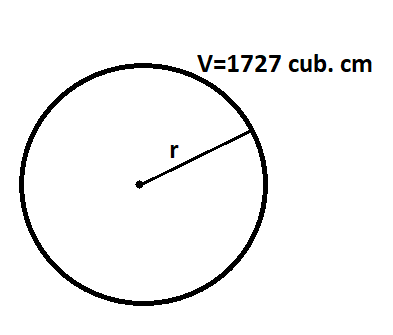
We know, the volume of a sphere with radius r is given by $\dfrac{4}{3}\pi {r^3}$
Therefore,
$\dfrac{4}{3}\pi {r^3} = 1728$
On substituting the value of \[\pi = \dfrac{{22}}{7}\] , we get,
$ \Rightarrow \dfrac{4}{3} \times \dfrac{{22}}{7} \times {r^3} = 1728$
On cross multiplication we get,
$ \Rightarrow {r^3} = 1728 \times \dfrac{3}{4} \times \dfrac{7}{{22}}$
On simplification we get,
$ \Rightarrow {r^3} = 412.3636$
On taking Cube root we get,
$ \Rightarrow r = 7.44{\text{ cm}}$
Hence, if the volume of the sphere is given by 1728 \[c{m^3}\], its radius will be 7.44 cm.
Note: Sometimes a student may get confused for the volume of the sphere over the total surface area as both have the coefficient 4 in the formula, so for to get rid of this confusion, we can check the dimension or the unit of the result we will get after using the formula. As we know that the volume has ‘cub. Unit’ is unit so the radius must be in cube also in the formula and i.e. $\dfrac{4}{3}\pi {r^3}$.
Note the formulae of finding the volume of the following figures.
Complete step by step answer:
Given that, the volume of the sphere is 1728 \[c{m^3}\]. Let’s assume its radius to be r.
We know, the volume of a sphere with radius r is given by $\dfrac{4}{3}\pi {r^3}$
Therefore,
$\dfrac{4}{3}\pi {r^3} = 1728$
On substituting the value of \[\pi = \dfrac{{22}}{7}\] , we get,
$ \Rightarrow \dfrac{4}{3} \times \dfrac{{22}}{7} \times {r^3} = 1728$
On cross multiplication we get,
$ \Rightarrow {r^3} = 1728 \times \dfrac{3}{4} \times \dfrac{7}{{22}}$
On simplification we get,
$ \Rightarrow {r^3} = 412.3636$
On taking Cube root we get,
$ \Rightarrow r = 7.44{\text{ cm}}$
Hence, if the volume of the sphere is given by 1728 \[c{m^3}\], its radius will be 7.44 cm.
Note: Sometimes a student may get confused for the volume of the sphere over the total surface area as both have the coefficient 4 in the formula, so for to get rid of this confusion, we can check the dimension or the unit of the result we will get after using the formula. As we know that the volume has ‘cub. Unit’ is unit so the radius must be in cube also in the formula and i.e. $\dfrac{4}{3}\pi {r^3}$.
Note the formulae of finding the volume of the following figures.
| Figure | Volume |
| Cube | \[{a^3}\] |
| Cuboid | \[l \times b \times h\] |
| Sphere | $\dfrac{4}{3}\pi {r^3}$ |
| Hemisphere | $\dfrac{2}{3}\pi {r^3}$ |
| Cylinder | $\pi {r^2}h$ |
| Cone | $\dfrac{1}{3}\pi {r^2}h$ |
Recently Updated Pages
Master Class 12 Business Studies: Engaging Questions & Answers for Success

Master Class 12 Biology: Engaging Questions & Answers for Success
Master Class 12 Chemistry: Engaging Questions & Answers for Success
Class 12 Question and Answer - Your Ultimate Solutions Guide
Master Class 11 Social Science: Engaging Questions & Answers for Success
Master Class 11 English: Engaging Questions & Answers for Success
Trending doubts
Find the sum of series 1 + 2 + 3 + 4 + 5 + + 100 class 9 maths CBSE
Fill the blanks with the suitable prepositions 1 The class 9 english CBSE
Difference Between Plant Cell and Animal Cell
How many hours before the closure of election must class 9 social science CBSE
What is pollution? How many types of pollution? Define it
Name 10 Living and Non living things class 9 biology CBSE