




The volume of a certain gas was found to be $ 560\;c{m^3} $ when the pressure was $ 600\;mm $ . If the pressure decreases by $ 40\% $ , then find the new volume of the gas.
Answer
 Verified
514.2k+ views
Hint :Boyle’s law: It states that when the temperature and the number of moles of an ideal gas for a system is constant, then the pressure of the gas is inversely proportional to the volume of the gas i.e., if the pressure of the gas increases, then a decrease in the volume of gas will be observed.
Complete Step By Step Answer:
As per question, the given data is as follows:
Initial volume of gas $ {V_1} = 560\;c{m^3} $
Initial pressure of gas $ {P_1} = 600\;mm $
As the final pressure of the gas is $ 40\% $ less than the initial pressure. Therefore, it can be written as:
$ {P_2} = {P_1} - \dfrac{{40}}{{100}} \times {P_1} $
Substituting values:
$ \Rightarrow {P_2} = 600 - 0.4 \times 600 $
$ \Rightarrow {P_2} = 360\;mm $
According to Boyle’s law, the pressure of the gas inversely varies with the volume of the gas. It can be expressed as follows:
$ P \propto \dfrac{1}{V} $
On removing the proportionality sign, a proportionality constant is introduced to the expression as follows:
$ P = \dfrac{k}{V} $
$ \Rightarrow PV = k\;\; - (i) $
At initial condition of gases, the equation (i) can be expressed as $ {P_1}{V_1} = k\;\;\; - (ii) $
At final condition of gases, the equation (i) can be expressed as $ {P_2}{V_2} = k\;\;\; - (iii) $
When equations (ii) and (iii) are compared, then the relation which is obtained as follows:
$ {P_1}{V_1} = {P_2}{V_2} $
Substituting values:
$ 600 \times 560 = 360 \times {V_2} $
$ \Rightarrow {V_2} = \dfrac{{600 \times 560}}{{360}} $
$ \Rightarrow {V_2} = 933.33\;c{m^3} $
Hence the new volume of the gas is $ 933.33\;c{m^3} $ .
Note :
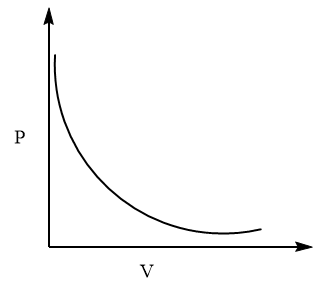
It is important to note that Boyle’s law is only applicable to an isothermal process in which the number of moles of gas are fixed. Also, if a graph is plotted between pressure and volume for a fixed mass of gas in an isothermal process, then an exponential curve is obtained as follows:
Complete Step By Step Answer:
As per question, the given data is as follows:
Initial volume of gas $ {V_1} = 560\;c{m^3} $
Initial pressure of gas $ {P_1} = 600\;mm $
As the final pressure of the gas is $ 40\% $ less than the initial pressure. Therefore, it can be written as:
$ {P_2} = {P_1} - \dfrac{{40}}{{100}} \times {P_1} $
Substituting values:
$ \Rightarrow {P_2} = 600 - 0.4 \times 600 $
$ \Rightarrow {P_2} = 360\;mm $
According to Boyle’s law, the pressure of the gas inversely varies with the volume of the gas. It can be expressed as follows:
$ P \propto \dfrac{1}{V} $
On removing the proportionality sign, a proportionality constant is introduced to the expression as follows:
$ P = \dfrac{k}{V} $
$ \Rightarrow PV = k\;\; - (i) $
At initial condition of gases, the equation (i) can be expressed as $ {P_1}{V_1} = k\;\;\; - (ii) $
At final condition of gases, the equation (i) can be expressed as $ {P_2}{V_2} = k\;\;\; - (iii) $
When equations (ii) and (iii) are compared, then the relation which is obtained as follows:
$ {P_1}{V_1} = {P_2}{V_2} $
Substituting values:
$ 600 \times 560 = 360 \times {V_2} $
$ \Rightarrow {V_2} = \dfrac{{600 \times 560}}{{360}} $
$ \Rightarrow {V_2} = 933.33\;c{m^3} $
Hence the new volume of the gas is $ 933.33\;c{m^3} $ .
Note :
It is important to note that Boyle’s law is only applicable to an isothermal process in which the number of moles of gas are fixed. Also, if a graph is plotted between pressure and volume for a fixed mass of gas in an isothermal process, then an exponential curve is obtained as follows:
Recently Updated Pages
Master Class 11 Computer Science: Engaging Questions & Answers for Success

Master Class 11 Business Studies: Engaging Questions & Answers for Success
Master Class 11 Economics: Engaging Questions & Answers for Success
Master Class 11 English: Engaging Questions & Answers for Success
Master Class 11 Maths: Engaging Questions & Answers for Success
Master Class 11 Biology: Engaging Questions & Answers for Success
Trending doubts
One Metric ton is equal to kg A 10000 B 1000 C 100 class 11 physics CBSE
There are 720 permutations of the digits 1 2 3 4 5 class 11 maths CBSE
Discuss the various forms of bacteria class 11 biology CBSE
Draw a diagram of a plant cell and label at least eight class 11 biology CBSE
State the laws of reflection of light
Explain zero factorial class 11 maths CBSE