




The vertices of a triangle are $A\left( { - 1, - 7} \right)$, $B\left( {5,1} \right)$ and $C\left( {1,4} \right)$. The equation of the angle bisector of the angle $\angle ABC$ is
A) $x + 7y + 2 = 0$
B) $x - 7y + 2 = 0$
C) $x - 7y - 2 = 0$
D) $x + 7y - 2 = 0$
Answer
 Verified
577.8k+ views
Hint:
We know that the angle bisector of an angle of a triangle divides the opposite side in the ratio of the length of the other 2 sides. We can find the distance of the sides of a triangle and find the point of intersection of the bisector with the third side using section formula. Then we can find the equation of the line joining the point of intersection and vertex B. This equation will give the required solution.
Complete step by step solution:
We can draw a triangle with the given vertices. We can draw the angle bisector of the angle $\angle ABC$ and it intersects the opposite side at D.
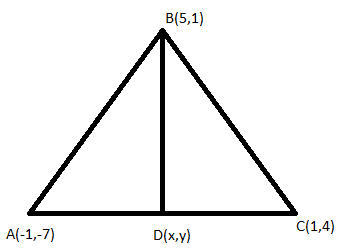
We know that the angle bisector of an angle of a triangle divides the opposite side in the ratio of the length of the other 2 sides.
Now we can find the distance of the other 2 sides.
We know that the distance between to points $\left( {{x_1},{y_1}} \right)$ and $\left( {{x_2},{y_2}} \right)$ is given by $d = \sqrt {{{\left( {{x_1} - {x_2}} \right)}^2} + {{\left( {{y_1} - {y_2}} \right)}^2}} $
So, the side AB is given by,
$AB = \sqrt {{{\left( {5 - \left( { - 1} \right)} \right)}^2} + {{\left( {1 - \left( { - 7} \right)} \right)}^2}} $
On simplification, we get
$ \Rightarrow AB = \sqrt {{{\left( 6 \right)}^2} + {{\left( 8 \right)}^2}} $
On taking the square, we get
$ \Rightarrow AB = \sqrt {36 + 64} $
$ \Rightarrow AB = \sqrt {100} $
On taking the square root, we get
$ \Rightarrow AB = 10$
Similarly, BC is given by
$BC = \sqrt {{{\left( {5 - 1} \right)}^2} + {{\left( {1 - 4} \right)}^2}} $
On simplification, we get
$ \Rightarrow BC = \sqrt {{4^2} + {{\left( { - 3} \right)}^2}} $
On taking the squares, we get
$ \Rightarrow BC = \sqrt {16 + 9} $
$ \Rightarrow BC = \sqrt {25} $
On taking the square root, we get
$ \Rightarrow BC = 5$
So, the ratio is given by,
$\dfrac{{AB}}{{BC}} = \dfrac{{10}}{5}$
So, we have,
$ \Rightarrow \dfrac{{AB}}{{BC}} = \dfrac{2}{1}$
We know that by section formula, the coordinates of the point that divides line joining the points $\left( {{x_1},{y_1}} \right)$ and $\left( {{x_2},{y_2}} \right)$ in the ratio $m:n$ is given by, $\left( {\dfrac{{n{x_1} + m{x_2}}}{{m + n}},\dfrac{{n{y_1} + m{y_2}}}{{m + n}}} \right)$.
So, the coordinates of D are given by substituting the coordinates of A and C and the ratio.
$ \Rightarrow D\left( {\dfrac{{n{x_1} + m{x_2}}}{{m + n}},\dfrac{{n{y_1} + m{y_2}}}{{m + n}}} \right)$
On substituting the coordinates of A and C and the ratio $m:n$ we get,
$ \Rightarrow D\left( {\dfrac{{1 \times \left( { - 1} \right) + 2 \times 1}}{{2 + 1}},\dfrac{{1 \times \left( { - 7} \right) + 2 \times 4}}{{2 + 1}}} \right)$
On simplification, we get
$ \Rightarrow D\left( {\dfrac{{ - 1 + 2}}{3},\dfrac{{ - 7 + 8}}{3}} \right)$
Hence, we have,
$ \Rightarrow D\left( {\dfrac{1}{3},\dfrac{1}{3}} \right)$
Now we can find the equation of the line joining the points B and D.
We know that the equation of the line joining the points $\left( {{x_1},{y_1}} \right)$ and $\left( {{x_2},{y_2}} \right)$ is given by,
$y - {y_1} = \dfrac{{{y_2} - {y_1}}}{{{x_2} - {x_1}}}\left( {{x_2} - {x_1}} \right)$
On substituting the coordinates of the points B and D, we get
$ \Rightarrow y - 1 = \dfrac{{\dfrac{1}{3} - 1}}{{\dfrac{1}{3} - 5}}\left( {x - 5} \right)$
On taking LCM, we get
$ \Rightarrow y - 1 = \dfrac{{\dfrac{{1 - 3}}{3}}}{{\dfrac{{1 - 15}}{3}}}\left( {x - 5} \right)$
On cancelling the denominator, we get
$ \Rightarrow y - 1 = \dfrac{{ - 2}}{{ - 14}}\left( {x - 5} \right)$
On simplifying and cross multiplying, we get
$ \Rightarrow 7\left( {y - 1} \right) = \left( {x - 5} \right)$
On expanding the brackets, we get
$ \Rightarrow 7y - 7 = x - 5$
On rearranging, we get
$ \Rightarrow x - 7y + 2 = 0$
Therefore, the required equation of the angle bisector is $x - 7y + 2 = 0$.
So, the correct answer is option B.
Note:
Alternative solution to the problem is given by,
We know that the angle bisector passes through the angle. So, point B must satisfy the equation of the angle bisector.
Consider option A $x + 7y + 2 = 0$. On substituting the point $B\left( {5,1} \right)$, we get
$ \Rightarrow LHS = 5 + 7 \times 1 + 2 = 14 \ne 0$
So, option A is not a solution.
Consider option B $x - 7y + 2 = 0$. On substituting the point $B\left( {5,1} \right)$, we get
$ \Rightarrow LHS = 5 - 7 \times 1 + 2 = 7 - 7 = 0$
So, option B is the required solution.
We know that the angle bisector of an angle of a triangle divides the opposite side in the ratio of the length of the other 2 sides. We can find the distance of the sides of a triangle and find the point of intersection of the bisector with the third side using section formula. Then we can find the equation of the line joining the point of intersection and vertex B. This equation will give the required solution.
Complete step by step solution:
We can draw a triangle with the given vertices. We can draw the angle bisector of the angle $\angle ABC$ and it intersects the opposite side at D.
We know that the angle bisector of an angle of a triangle divides the opposite side in the ratio of the length of the other 2 sides.
Now we can find the distance of the other 2 sides.
We know that the distance between to points $\left( {{x_1},{y_1}} \right)$ and $\left( {{x_2},{y_2}} \right)$ is given by $d = \sqrt {{{\left( {{x_1} - {x_2}} \right)}^2} + {{\left( {{y_1} - {y_2}} \right)}^2}} $
So, the side AB is given by,
$AB = \sqrt {{{\left( {5 - \left( { - 1} \right)} \right)}^2} + {{\left( {1 - \left( { - 7} \right)} \right)}^2}} $
On simplification, we get
$ \Rightarrow AB = \sqrt {{{\left( 6 \right)}^2} + {{\left( 8 \right)}^2}} $
On taking the square, we get
$ \Rightarrow AB = \sqrt {36 + 64} $
$ \Rightarrow AB = \sqrt {100} $
On taking the square root, we get
$ \Rightarrow AB = 10$
Similarly, BC is given by
$BC = \sqrt {{{\left( {5 - 1} \right)}^2} + {{\left( {1 - 4} \right)}^2}} $
On simplification, we get
$ \Rightarrow BC = \sqrt {{4^2} + {{\left( { - 3} \right)}^2}} $
On taking the squares, we get
$ \Rightarrow BC = \sqrt {16 + 9} $
$ \Rightarrow BC = \sqrt {25} $
On taking the square root, we get
$ \Rightarrow BC = 5$
So, the ratio is given by,
$\dfrac{{AB}}{{BC}} = \dfrac{{10}}{5}$
So, we have,
$ \Rightarrow \dfrac{{AB}}{{BC}} = \dfrac{2}{1}$
We know that by section formula, the coordinates of the point that divides line joining the points $\left( {{x_1},{y_1}} \right)$ and $\left( {{x_2},{y_2}} \right)$ in the ratio $m:n$ is given by, $\left( {\dfrac{{n{x_1} + m{x_2}}}{{m + n}},\dfrac{{n{y_1} + m{y_2}}}{{m + n}}} \right)$.
So, the coordinates of D are given by substituting the coordinates of A and C and the ratio.
$ \Rightarrow D\left( {\dfrac{{n{x_1} + m{x_2}}}{{m + n}},\dfrac{{n{y_1} + m{y_2}}}{{m + n}}} \right)$
On substituting the coordinates of A and C and the ratio $m:n$ we get,
$ \Rightarrow D\left( {\dfrac{{1 \times \left( { - 1} \right) + 2 \times 1}}{{2 + 1}},\dfrac{{1 \times \left( { - 7} \right) + 2 \times 4}}{{2 + 1}}} \right)$
On simplification, we get
$ \Rightarrow D\left( {\dfrac{{ - 1 + 2}}{3},\dfrac{{ - 7 + 8}}{3}} \right)$
Hence, we have,
$ \Rightarrow D\left( {\dfrac{1}{3},\dfrac{1}{3}} \right)$
Now we can find the equation of the line joining the points B and D.
We know that the equation of the line joining the points $\left( {{x_1},{y_1}} \right)$ and $\left( {{x_2},{y_2}} \right)$ is given by,
$y - {y_1} = \dfrac{{{y_2} - {y_1}}}{{{x_2} - {x_1}}}\left( {{x_2} - {x_1}} \right)$
On substituting the coordinates of the points B and D, we get
$ \Rightarrow y - 1 = \dfrac{{\dfrac{1}{3} - 1}}{{\dfrac{1}{3} - 5}}\left( {x - 5} \right)$
On taking LCM, we get
$ \Rightarrow y - 1 = \dfrac{{\dfrac{{1 - 3}}{3}}}{{\dfrac{{1 - 15}}{3}}}\left( {x - 5} \right)$
On cancelling the denominator, we get
$ \Rightarrow y - 1 = \dfrac{{ - 2}}{{ - 14}}\left( {x - 5} \right)$
On simplifying and cross multiplying, we get
$ \Rightarrow 7\left( {y - 1} \right) = \left( {x - 5} \right)$
On expanding the brackets, we get
$ \Rightarrow 7y - 7 = x - 5$
On rearranging, we get
$ \Rightarrow x - 7y + 2 = 0$
Therefore, the required equation of the angle bisector is $x - 7y + 2 = 0$.
So, the correct answer is option B.
Note:
Alternative solution to the problem is given by,
We know that the angle bisector passes through the angle. So, point B must satisfy the equation of the angle bisector.
Consider option A $x + 7y + 2 = 0$. On substituting the point $B\left( {5,1} \right)$, we get
$ \Rightarrow LHS = 5 + 7 \times 1 + 2 = 14 \ne 0$
So, option A is not a solution.
Consider option B $x - 7y + 2 = 0$. On substituting the point $B\left( {5,1} \right)$, we get
$ \Rightarrow LHS = 5 - 7 \times 1 + 2 = 7 - 7 = 0$
So, option B is the required solution.
Recently Updated Pages
Master Class 11 Computer Science: Engaging Questions & Answers for Success

Master Class 11 Business Studies: Engaging Questions & Answers for Success
Master Class 11 Economics: Engaging Questions & Answers for Success
Master Class 11 English: Engaging Questions & Answers for Success
Master Class 11 Maths: Engaging Questions & Answers for Success
Master Class 11 Biology: Engaging Questions & Answers for Success
Trending doubts
One Metric ton is equal to kg A 10000 B 1000 C 100 class 11 physics CBSE
There are 720 permutations of the digits 1 2 3 4 5 class 11 maths CBSE
Discuss the various forms of bacteria class 11 biology CBSE
Draw a diagram of a plant cell and label at least eight class 11 biology CBSE
State the laws of reflection of light
Explain zero factorial class 11 maths CBSE