




The vertical component of velocity of ball with which they are projected
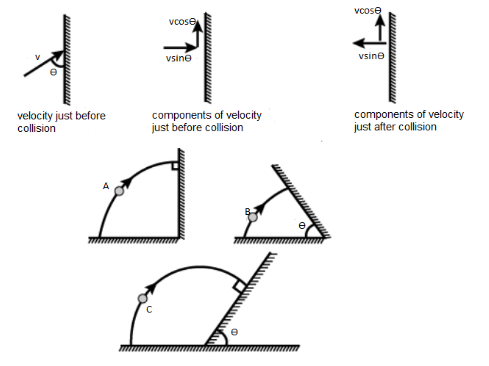
$ \left( A \right)20m{s^{ - 1}} \\
\left( B \right)10m{s^{ - 1}} \\
\left( C \right)10\sqrt 3 m{s^{ - 1}} \\
\left( D \right)undeterminable \\ $
Answer
 Verified
571.8k+ views
Hint : In order to solve this question, we are going to consider three cases of the projection of the ball of three different orientations. Writing the initial velocities of the ball, their vertical and horizontal components, we analyze the options given for the speeds, and answer the one which suits the best.
The formula for the maximum height is given by
$ h = \dfrac{{{u^2}{{\sin }^2}\varphi }}{{2g}} $
Where $ \varphi $ is the angle of projection
The equation third of kinematics
$ {v^2} - {u^2} = 2as $
Complete Step By Step Answer:
Let us consider that the angle of projection in all the cases be $ \theta $
Now, considering the projection in case $ \left( A \right) $
The initial velocity,
$ {u_{initial}} = u\sin \varphi $
The maximum height attained is given by the formula
$ h = \dfrac{{{u^2}{{\sin }^2}\varphi }}{{2g}} $
As we know that in the cases of vertical projection or that with an angle, the acceleration value is $ - g $
Now, by the equation third of kinematics,
$ {v^2} - {u^2} = 2as \\
\Rightarrow 0 - {u^2}{\sin ^2}\varphi = 2 \times \left( { - g} \right) \times \dfrac{{{u^2}{{\sin }^2}\varphi }}{{2g}} \\ $
Here, the vertical component is $ u{\sin ^2}\varphi $
Now considering the case $ \left( B \right) $
Initial velocity,
$ {u_{initial}} = u\sin \varphi $
Resolving the velocity into two components, vertical and horizontal
$ {u_x} = 0 \\
{u_y} = u\sin \varphi \\ $
Now, if we consider the case $ \left( C \right) $
Initial velocity,
$ {u_{initial}} = u\sin \varphi $
Resolving it into its components, vertical and horizontal
$ {u_x} = 0 \\
{u_y} = u\sin \varphi \\ $
Now if we take the three options, then all the conditions above are satisfied with the velocity $ 20m{s^{ - 1}} $ .
Hence, option $ A $ is the correct answer.
Note :
The velocity of the ball does not depend on $ \theta $ , in fact it depends only on the initial projection angle as the velocity components, maximum height and the velocity when the trajectory of the ball ends. Hence, the velocity from the options given is tested for all the three cases taken.
The formula for the maximum height is given by
$ h = \dfrac{{{u^2}{{\sin }^2}\varphi }}{{2g}} $
Where $ \varphi $ is the angle of projection
The equation third of kinematics
$ {v^2} - {u^2} = 2as $
Complete Step By Step Answer:
Let us consider that the angle of projection in all the cases be $ \theta $
Now, considering the projection in case $ \left( A \right) $
The initial velocity,
$ {u_{initial}} = u\sin \varphi $
The maximum height attained is given by the formula
$ h = \dfrac{{{u^2}{{\sin }^2}\varphi }}{{2g}} $
As we know that in the cases of vertical projection or that with an angle, the acceleration value is $ - g $
Now, by the equation third of kinematics,
$ {v^2} - {u^2} = 2as \\
\Rightarrow 0 - {u^2}{\sin ^2}\varphi = 2 \times \left( { - g} \right) \times \dfrac{{{u^2}{{\sin }^2}\varphi }}{{2g}} \\ $
Here, the vertical component is $ u{\sin ^2}\varphi $
Now considering the case $ \left( B \right) $
Initial velocity,
$ {u_{initial}} = u\sin \varphi $
Resolving the velocity into two components, vertical and horizontal
$ {u_x} = 0 \\
{u_y} = u\sin \varphi \\ $
Now, if we consider the case $ \left( C \right) $
Initial velocity,
$ {u_{initial}} = u\sin \varphi $
Resolving it into its components, vertical and horizontal
$ {u_x} = 0 \\
{u_y} = u\sin \varphi \\ $
Now if we take the three options, then all the conditions above are satisfied with the velocity $ 20m{s^{ - 1}} $ .
Hence, option $ A $ is the correct answer.
Note :
The velocity of the ball does not depend on $ \theta $ , in fact it depends only on the initial projection angle as the velocity components, maximum height and the velocity when the trajectory of the ball ends. Hence, the velocity from the options given is tested for all the three cases taken.
Recently Updated Pages
Master Class 12 Economics: Engaging Questions & Answers for Success

Master Class 12 English: Engaging Questions & Answers for Success
Master Class 12 Social Science: Engaging Questions & Answers for Success
Master Class 12 Maths: Engaging Questions & Answers for Success
Master Class 12 Physics: Engaging Questions & Answers for Success
Master Class 9 General Knowledge: Engaging Questions & Answers for Success
Trending doubts
One Metric ton is equal to kg A 10000 B 1000 C 100 class 11 physics CBSE
Difference Between Prokaryotic Cells and Eukaryotic Cells
Two of the body parts which do not appear in MRI are class 11 biology CBSE
1 ton equals to A 100 kg B 1000 kg C 10 kg D 10000 class 11 physics CBSE
Draw a diagram of nephron and explain its structur class 11 biology CBSE
10 examples of friction in our daily life