




The vertebral formula for human beings is
(a) ${C}_{5}{T}_{12}{L}_{7}{S}_{5}{C}_{3- 5}=33- 35$
(b) ${C}_{7}{T}_{12}{L}_{5}{S}_{5}{C}_{4}=33$
(c) ${C}_{5}{T}_{10}{L}_{5}{S}_{5}{C}_{3}=33$
(d) ${C}_{7}{T}_{10}{L}_{5}{S}_{5}{C}_{3- 5}=33$
Answer
 Verified
635.4k+ views
Hint: The spinal column, also referred to as the backbone or spine, is a component of the skeletal structure. The vertebral column is the defining characteristic of a vertebrate during which the notochord (a flexible rod of uniform composition) found altogether chordates has been replaced by a segmented series of bone.
Complete answer:
In a human's vertebral column, there are normally thirty- three vertebrae, the upper twenty- four are articulating and separated from each other by intervertebral discs, and thus the lower nine are fused in adults, five within the sacrum and 4 within the coccyx, or tailbone. The articulating vertebrae are named consistent with their region of the spine. There are seven cervical vertebrae, twelve thoracic vertebrae, and five lumbar vertebrae.
Individual vertebrae are named consistent with their region and position. From top to bottom, the vertebrae are:
- Cervical spine: 7 vertebrae (${ C }_{ 1 }- { C }_{ 7 }$)
- Thoracic spine: 12 vertebrae (${ T }_{ 1 }- { T }_{ 12 }$)
- Lumbar spine: 5 vertebrae (${ L }_{ 1 }- { L }_{ 5 }$)
- Sacrum: 5 (fused) vertebrae (${ S }_{ 1 }- { S }_{ 5 }$)
- Coccyx: 4 (3–5) (fused) vertebrae (Tailbone)
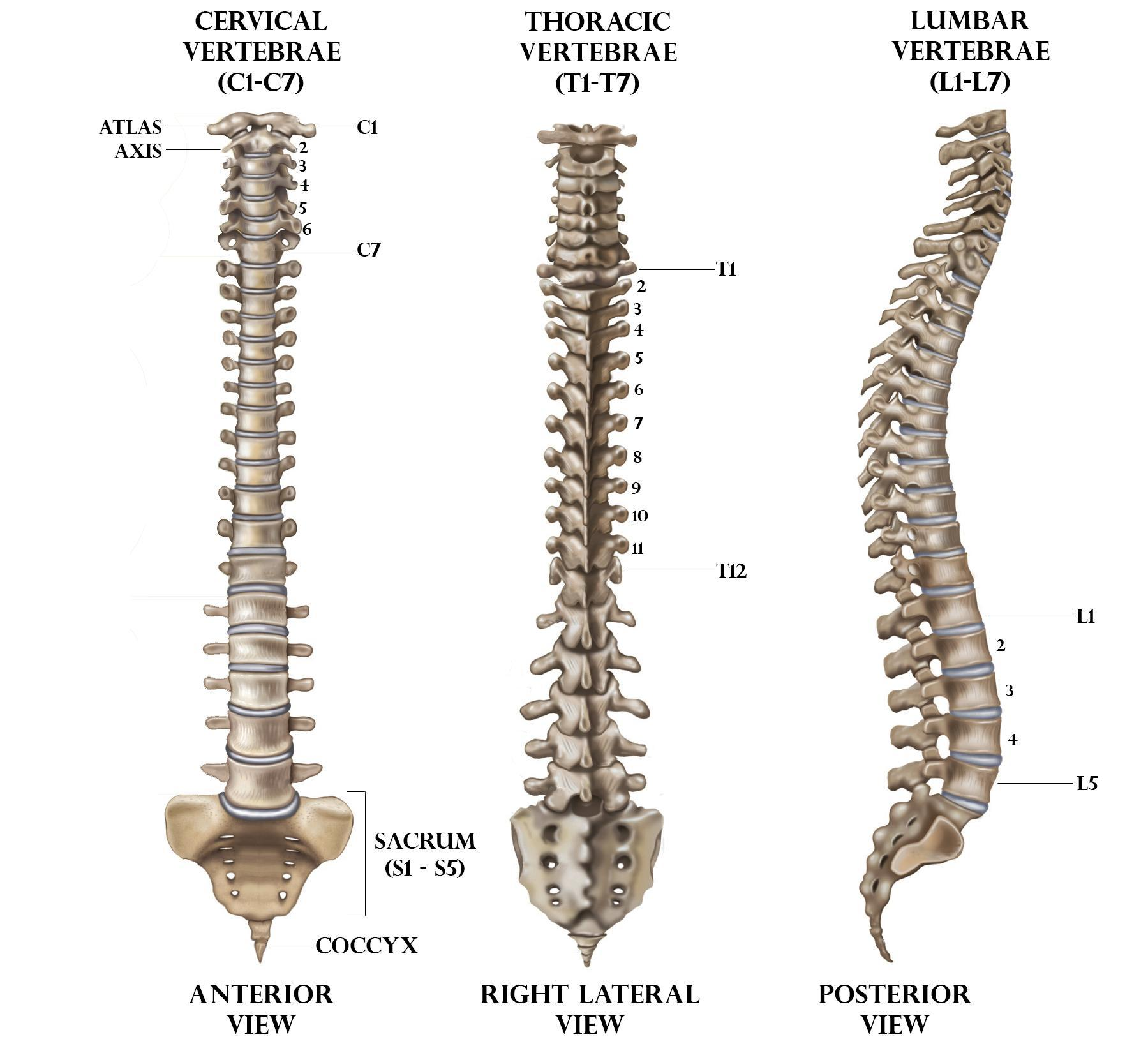
So, the correct answer is ‘${C}_{7}{T}_{12}{L}_{5}{S}_{5}{C}_{4}=33$’.
Note: The spinal cord is part of the central nervous system that supplies nerves and receives information from the peripheral nervous system within the body. There are about 50,000 species of animals that have a spinal column. The human spinal column is one of the most- studied examples.
Complete answer:
In a human's vertebral column, there are normally thirty- three vertebrae, the upper twenty- four are articulating and separated from each other by intervertebral discs, and thus the lower nine are fused in adults, five within the sacrum and 4 within the coccyx, or tailbone. The articulating vertebrae are named consistent with their region of the spine. There are seven cervical vertebrae, twelve thoracic vertebrae, and five lumbar vertebrae.
Individual vertebrae are named consistent with their region and position. From top to bottom, the vertebrae are:
- Cervical spine: 7 vertebrae (${ C }_{ 1 }- { C }_{ 7 }$)
- Thoracic spine: 12 vertebrae (${ T }_{ 1 }- { T }_{ 12 }$)
- Lumbar spine: 5 vertebrae (${ L }_{ 1 }- { L }_{ 5 }$)
- Sacrum: 5 (fused) vertebrae (${ S }_{ 1 }- { S }_{ 5 }$)
- Coccyx: 4 (3–5) (fused) vertebrae (Tailbone)
So, the correct answer is ‘${C}_{7}{T}_{12}{L}_{5}{S}_{5}{C}_{4}=33$’.
Note: The spinal cord is part of the central nervous system that supplies nerves and receives information from the peripheral nervous system within the body. There are about 50,000 species of animals that have a spinal column. The human spinal column is one of the most- studied examples.
Recently Updated Pages
The given figure shows two endocrine glands marked class 11 biology NEET_UG

Match columnI with columnII and select the correct class 11 biology NEET
Match column I with column II and select the correct class 11 biology NEET_UG
Which floral family has left 9 right + 1 arrangement class 11 biology NEET_UG
Which is not a variety of sheep A Lohi B Beetal C Nellore class 11 biology NEET_UG
Match column I with column II and select the correct class 11 biology NEET_UG
Trending doubts
One Metric ton is equal to kg A 10000 B 1000 C 100 class 11 physics CBSE
Draw a diagram of a plant cell and label at least eight class 11 biology CBSE
Difference Between Prokaryotic Cells and Eukaryotic Cells
Draw a well labelled diagram of reflex arc and explain class 11 biology CBSE
Two of the body parts which do not appear in MRI are class 11 biology CBSE
1 ton equals to A 100 kg B 1000 kg C 10 kg D 10000 class 11 physics CBSE