




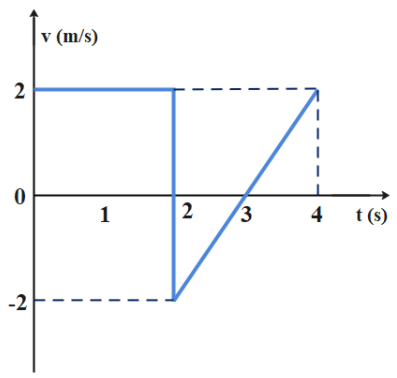
The velocity \[v\] versus $t$ graph of a body in a straight line is as shown in figure. The displacement of the body in 4 second is
A. 2m
B. 4m
C. 6m
D. 8m
Answer
 Verified
583.8k+ views
Hint: The area under the velocity versus time graph will represent the displacement of the particle. In the above figure the area from time 0 second to 2 second is taken as positive. And the area from 2 second to 3 will be taken as negative and the area from 3 second to 4 second will be taken as positive. So the total displacement of the body in 4 seconds will be the sum of all the areas during these 4 seconds.
Complete answer:
From the graph the area under the velocity and time graph from 0 second to 2 second is $2m{{s}^{-1}}\times 2\sec =2\times 2=4m$.
So the displacement of the particle in the first two second is $4m$.
The area under the velocity and time graph during two to three second is
\[\dfrac{1}{2}\times \text{base}\times \text{height=}\dfrac{1}{2}\times 1s\times \left( -2m{{s}^{-1}} \right)=-1m\]
So the displacement of the particle during two to three second is $-1m$
The area under the curve during three to four second is
\[\dfrac{1}{2}\times \text{base}\times \text{height=}\dfrac{1}{2}\times 1s\times \left( 2m{{s}^{-1}} \right)=1m\]
So the displacement of the particle during three to four second is $1m$
The net displacement of the particle is $s=4-1+1=4m$
So the correct option is B.
Note:
During the area calculation the area above the time axis is taken positive and the area below the time axis is taken to be negative. Also only the area enclosed between the x-axis and the graph is taken into account. Due to this in the first region the below area is not taken into account and in the second region the area found to be negative.
Also the slope of velocity versus time graph will give the acceleration of the particle at that instant.
Complete answer:
From the graph the area under the velocity and time graph from 0 second to 2 second is $2m{{s}^{-1}}\times 2\sec =2\times 2=4m$.
So the displacement of the particle in the first two second is $4m$.
The area under the velocity and time graph during two to three second is
\[\dfrac{1}{2}\times \text{base}\times \text{height=}\dfrac{1}{2}\times 1s\times \left( -2m{{s}^{-1}} \right)=-1m\]
So the displacement of the particle during two to three second is $-1m$
The area under the curve during three to four second is
\[\dfrac{1}{2}\times \text{base}\times \text{height=}\dfrac{1}{2}\times 1s\times \left( 2m{{s}^{-1}} \right)=1m\]
So the displacement of the particle during three to four second is $1m$
The net displacement of the particle is $s=4-1+1=4m$
So the correct option is B.
Note:
During the area calculation the area above the time axis is taken positive and the area below the time axis is taken to be negative. Also only the area enclosed between the x-axis and the graph is taken into account. Due to this in the first region the below area is not taken into account and in the second region the area found to be negative.
Also the slope of velocity versus time graph will give the acceleration of the particle at that instant.
Recently Updated Pages
Basicity of sulphurous acid and sulphuric acid are

Master Class 11 Business Studies: Engaging Questions & Answers for Success
Master Class 11 Computer Science: Engaging Questions & Answers for Success
Master Class 11 Economics: Engaging Questions & Answers for Success
Master Class 11 Social Science: Engaging Questions & Answers for Success
Master Class 11 English: Engaging Questions & Answers for Success
Trending doubts
One Metric ton is equal to kg A 10000 B 1000 C 100 class 11 physics CBSE
State and prove Bernoullis theorem class 11 physics CBSE
Actinoid contraction is more than lanthanoid contraction class 11 chemistry CBSE
The transition element that has lowest enthalpy of class 11 chemistry CBSE
Can anyone list 10 advantages and disadvantages of friction
State the laws of reflection of light