




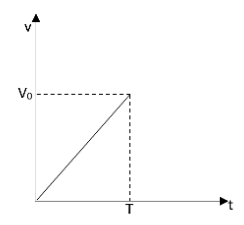
The velocity time graph of a body is shown in the diagram below. The slope of the line is provided as $m$. The distance travelled by the body in a time $T$ second will be?
$\begin{align}
& A.\dfrac{m{{V}_{0}}^{2}}{2T} \\
& B.\dfrac{{{V}_{0}}^{2}}{2T} \\
& C.2m{{V}_{0}}^{2} \\
& D.\dfrac{{{V}_{0}}^{2}}{2m} \\
\end{align}$
Answer
 Verified
620.1k+ views
Hint: The slope of a graph can be calculated by taking the ratio of the values given in the y-axis to the same in the x-axis. The area under the curve represents the product of the values mentioned in the x and y axes. The distance is given by taking the product of the velocity of the particle and the time taken for it. These all may help you to solve this question.
Complete answer:
Let us assume that the distance travelled is expressed as $d$. The velocity with which they travel is given as ${{V}_{0}}$. The time taken is expressed as $T$. And the slope of the graph will be given as $m$.
The area under a curve is defined as the product of the parameters mentioned in the x-axis and the y-axis. As we can see that the curve is a triangle the area under the curve is given as,
$\text{Area of triangle}=\dfrac{1}{2}xy$
Therefore the area under this curve will be,
$\text{A}=\dfrac{1}{2}\times {{V}_{0}}\times T$
This area under the curve is represented as the distance as it is the product of velocity and the time taken.
$d=\dfrac{1}{2}\times {{V}_{0}}\times T$
The slope of the graph is given by the equation,
$m=\dfrac{{{V}_{0}}}{T}$
Rearranging this equation in terms of the time taken will give,
$T=\dfrac{{{V}_{0}}}{m}$
Substituting this value in the equation of distance travelled will give,
$d=\dfrac{1}{2}\times {{V}_{0}}\times \dfrac{{{V}_{0}}}{m}=\dfrac{{{V}_{0}}^{2}}{2m}$
So, the correct answer is “Option D”.
Note:
Velocity is defined as the variation of the position of a body with respect to time. This can be expressed in the form of derivative. The derivative of the distance travelled is given as the velocity. Velocity is a vector quantity which is both magnitude and direction.
Complete answer:
Let us assume that the distance travelled is expressed as $d$. The velocity with which they travel is given as ${{V}_{0}}$. The time taken is expressed as $T$. And the slope of the graph will be given as $m$.
The area under a curve is defined as the product of the parameters mentioned in the x-axis and the y-axis. As we can see that the curve is a triangle the area under the curve is given as,
$\text{Area of triangle}=\dfrac{1}{2}xy$
Therefore the area under this curve will be,
$\text{A}=\dfrac{1}{2}\times {{V}_{0}}\times T$
This area under the curve is represented as the distance as it is the product of velocity and the time taken.
$d=\dfrac{1}{2}\times {{V}_{0}}\times T$
The slope of the graph is given by the equation,
$m=\dfrac{{{V}_{0}}}{T}$
Rearranging this equation in terms of the time taken will give,
$T=\dfrac{{{V}_{0}}}{m}$
Substituting this value in the equation of distance travelled will give,
$d=\dfrac{1}{2}\times {{V}_{0}}\times \dfrac{{{V}_{0}}}{m}=\dfrac{{{V}_{0}}^{2}}{2m}$
So, the correct answer is “Option D”.
Note:
Velocity is defined as the variation of the position of a body with respect to time. This can be expressed in the form of derivative. The derivative of the distance travelled is given as the velocity. Velocity is a vector quantity which is both magnitude and direction.
Recently Updated Pages
Master Class 11 English: Engaging Questions & Answers for Success

Master Class 11 Social Science: Engaging Questions & Answers for Success
Master Class 11 Maths: Engaging Questions & Answers for Success
Master Class 11 Chemistry: Engaging Questions & Answers for Success
Master Class 11 Biology: Engaging Questions & Answers for Success
Master Class 11 Physics: Engaging Questions & Answers for Success
Trending doubts
One Metric ton is equal to kg A 10000 B 1000 C 100 class 11 physics CBSE
Difference Between Prokaryotic Cells and Eukaryotic Cells
Find the value of the expression given below sin 30circ class 11 maths CBSE
1 ton equals to A 100 kg B 1000 kg C 10 kg D 10000 class 11 physics CBSE
Two of the body parts which do not appear in MRI are class 11 biology CBSE
What are hard magnetic materials class 11 physics CBSE